FinnewsHunter Setup and Multi-Agent News Analysis
FinnewsHunter: Multi-agent financial intelligence platform powered by AgenticX. Real-time news analysis, sentiment fusion, and alpha factor mining.
At a glance
- What is it?
- FinnewsHunter is a Python and React platform for collecting financial news, analyzing sentiment and market impact, and generating alpha signals through AgenticX workflows. Its architecture supports five LLM providers and several data services, but the README does not provide evidence of trading performance.
- Who is it for?
- FinnewsHunter is appropriate for developers who want to build a self-hosted financial-news analysis workflow or prototype a research interface around article text. It is a poor fit for an unattended trading system unless the operator first validates news delays, model outputs, data licensing, failure handling, and signal quality.
- Can I use it commercially?
- Yes. Apache-2.0 is a permissive licence: you can use, modify and sell software built on it, as long as you keep its copyright and licence notices.
- Is it still maintained?
- Yes. The repository last received commits 5 days ago.
- What is it written in?
- Mainly Python, according to GitHub's language statistics.
Answers come from the project's GitHub data, last synced on November 14, 2026, and from our analysis. They are not legal advice.
Star history
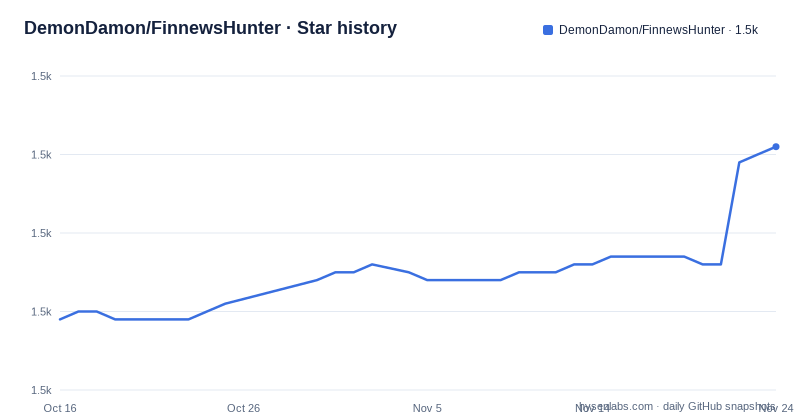
- DemonDamon/FinnewsHunter1,506 ★ · +7
| Repository | 2026-10-16 | 2026-11-14 |
|---|---|---|
| DemonDamon/FinnewsHunter | 1.5k | 1.5k |
7 Stars in the last 29 days, measured from the daily GitHub snapshot. Compare with other projects
Editorial analysis
FinnewsHunter's Financial News Analysis Scope
FinnewsHunter targets financial researchers, quantitative developers, and teams that need to turn news text into structured research signals. According to the README, its source list includes Sina Finance, National Business Daily, Financial World, Securities Times, and other financial publishers. The project is designed to monitor those sources, interpret articles through large language models, estimate sentiment and market impact, connect information through knowledge graphs, and produce what the README calls decision-level alpha signals.
That goal is broader than ordinary document classification. The named `NewsAnalyst` agent is responsible for analyzing news sentiment and possible market effects, while the documented agent collaboration layer also includes a `Researcher` role and debate workflows. PostgreSQL stores application data, Milvus supports vector retrieval, and Redis appears in the stated service stack. The repository layout also contains separate `backend`, `frontend`, `deploy`, `scripts`, and `legacy_v1` directories, matching an application rather than a single Python library.
The distinction matters. FinnewsHunter can serve as a research and interface platform, but the README does not explain how an alpha signal is defined, backtested, risk-adjusted, or connected to an execution system. It describes signal generation and K-line analysis. It does not publish accuracy measurements, latency figures, transaction simulation, factor performance, or live trading evidence. The project should therefore not be treated as a validated quantitative strategy without separate evaluation.
AgenticX, FastAPI, Milvus, and React Data Flow
The README organizes FinnewsHunter into interaction, platform service, agent collaboration, infrastructure, and storage or learning layers. At the front, React, TypeScript, and Shadcn UI form the M6 interaction layer. FastAPI and a task manager make up the M1 platform service layer. Requests can enter through the frontend or the documented API endpoint and reach the backend for search, batch analysis, stock lookup, or related application actions.
The M4 and M5 layers use AgenticX abstractions including `Agent`, `Tool`, and `Workflow`. AgenticX also supplies `BailianEmbeddingProvider` and `MilvusStorage`, which FinnewsHunter uses rather than implementing separate embedding and vector-storage components. This is a concrete dependency on AgenticX rather than a general reference to agent frameworks. Celery worker and beat services handle background work, including the scheduled crawling described in the quick-start guide.
News processing is described as asynchronous in places. The feature list says that vectorization can run in the background so analysis does not block the main flow. Search can cover article title, content, and stock code, with keyword highlighting. Stock lookup uses fuzzy code and name queries and can be initialized with A-share data from `akshare`. Market charts use `akshare` data with daily and minute K-line periods.
The stack is broad, however. An error in PostgreSQL, Redis, Milvus, Celery scheduling, an embedding provider, or an external LLM can affect different parts of the pipeline. The README does not document retry policy, model-output schemas, signal confidence thresholds, duplicate-news handling, or behavior when a publisher changes its page format.
Backend Dependencies, Environment Keys, and Base Services
The documented prerequisites are Python 3.11 or later, Docker with Docker Compose, and Node.js 18 or later for frontend development. At least one of the five supported LLM providers must be configured. The installation guide first installs AgenticX from a checkout at the author-specific path below.
cd /Users/damon/myWork/AgenticX
pip install -e .
That path is not a generic installation location, so a reader using another machine will need the corresponding AgenticX checkout. FinnewsHunter's backend dependencies are then installed from `requirements.txt`.
cd FinnewsHunter/backend
pip install -r requirements.txt
The next documented step copies `env.example` to `.env`. The reader must edit `.env` with an API key and other configuration values before starting the application.
cd FinnewsHunter/backend
cp env.example .env
# Edit .env file and fill in LLM API Key and other configurations
The documented provider variables are `DASHSCOPE_API_KEY`, `OPENAI_API_KEY`, `DEEPSEEK_API_KEY`, `MOONSHOT_API_KEY`, and `ZHIPU_API_KEY`. The README presents Bailian as its recommended example and supplies model and endpoint values in that sample.
# Bailian (Alibaba Cloud) - Recommended, fast access in China
DASHSCOPE_API_KEY=sk-your-dashscope-key
DASHSCOPE_BASE_URL=https://dashscope.aliyuncs.com/compatible-mode/v1
BAILIAN_MODELS=qwen-plus,qwen-max,qwen-turbo

# Optional: Other providers
OPENAI_API_KEY=sk-your-openai-key
DEEPSEEK_API_KEY=sk-your-deepseek-key
These are example credentials and configuration lines, not usable secrets. FinnewsHunter lists support for switching among Bailian, OpenAI, DeepSeek, Kimi, and Zhipu through the frontend, but the README does not fully document model fallback, token limits, or cost controls.
Database Initialization and the First FinnewsHunter Run
FinnewsHunter depends on PostgreSQL, Redis, and several Milvus components. The documented development Compose file starts the named services in detached mode.
cd FinnewsHunter
docker compose -f deploy/docker-compose.dev.yml up -d postgres redis milvus-etcd milvus-minio milvus-standalone
After those services start, the backend initialization script prepares the application database.
cd FinnewsHunter/backend
python init_db.py
Stock search is optional. Its initialization command imports A-share records from `akshare`, which the README describes as approximately 5,000 or more stocks.
cd FinnewsHunter/backend
python -m app.scripts.init_stocks
# Will fetch all A-share data (approximately 5000+ stocks) from akshare and save to database
The FastAPI service is then run locally on port 8000.
cd FinnewsHunter/backend
uvicorn app.main:app --reload --host 0.0.0.0 --port 8000
Scheduled crawling requires Celery worker and beat services in another terminal.
# Open a new terminal
cd FinnewsHunter
docker compose -f deploy/docker-compose.dev.yml up -d celery-worker celery-beat
A first real use begins at the generated API documentation after the infrastructure, database, API, and crawler processes are running. The README does not document the default crawl schedule, initial article count, or a guaranteed article to analyze, so it would be misleading to promise a specific first result. The API page is the most reliable documented entry point because it exposes the FastAPI surface without requiring assumptions about frontend button names.
React Search, Batch Analysis, and K-Line Views
The frontend has its own development setup. The README requires Node.js 18 or later and uses `npm install` before launching the local server.
cd FinnewsHunter/frontend
npm install  # First time requires dependency installation
npm run dev
Once the documented services are running, the reader can open the frontend at `http://localhost:3000`, the backend at `http://localhost:8000`, and the generated API documentation at `http://localhost:8000/docs`. The API documentation provides a practical first inspection point because it exposes the FastAPI endpoints without requiring assumptions about menu layouts.
The README documents batch selection, batch deletion, and batch analysis for news. It also describes search across title, content, and stock code, plus fuzzy stock queries by code or name. Those features suit a research operator who needs to review a selected group of articles or inspect securities related to incoming news. Stock charts can display daily and minute K-line periods sourced from `akshare`.
The frontend is not documented as a trading terminal. No order entry, broker integration, position management, or execution controls are listed. It is better understood as a financial-news analysis interface backed by search, agent workflows, and market context. The README also does not describe authentication, role permissions, or production security settings, so exposing this deployment beyond a trusted environment would require a separate review.
Operational Constraints for Milvus, Celery, and External Models
FinnewsHunter has a substantial service footprint for its first run. PostgreSQL, Redis, etcd, MinIO, and Milvus run through Docker Compose, while the API, Celery processes, and frontend development server occupy additional processes. The README includes service status, restart, shutdown, and log commands, but it does not describe a compact all-in-one development command.
Operators can inspect the listed Compose services with the documented command:
cd FinnewsHunter
docker compose -f deploy/docker-compose.dev.yml ps
Worker logs are particularly relevant because Celery Beat dispatches scheduled tasks and Celery executes background work. The README does not say how failed crawls are retried, how stale articles are marked, or how partial Milvus indexing failures affect search and analysis. Those are real adoption constraints for a system described as real-time.
External services create further dependencies. Financial publishers can change or restrict access, `akshare` depends on upstream market-data availability, and each configured LLM provider introduces its own API behavior and usage. The repository contains `legacy_v1`, but the README does not state whether it participates in the current deployment. Removing unused paths during adoption would require checking imports and deployment configuration rather than assuming the directory is dead code.
The feature list calls the deployment production-ready and mentions logging and monitoring. The quick-start documentation does not provide production TLS settings, database backup procedures, secret management, resource sizing, health checks, or alert definitions. Those labels should not substitute for an environment-specific readiness review.
Apache-2.0 Terms, Maintenance Signals, and Upgrade Work
FinnewsHunter is distributed under `Apache-2.0`. That license governs repository use and modification, subject to its terms, but this review does not provide legal advice. Separately, each connected news publisher, market-data source, model provider, and container image may have its own access conditions or licensing obligations. The README lists external sources and services but does not reproduce their licenses or grant redistribution rights for their data.
The repository is not archived. Its last push was on 2026-10-01, and the repository has no GitHub releases. A release history would make version changes easier to track, especially for a stack containing FastAPI, PostgreSQL, Milvus, Redis, Celery, React, AgenticX, and multiple LLM integrations. The absence of releases does not prove instability, but it removes one visible mechanism for identifying compatible version sets.
Upgrade cost depends on the deployment layer. Python changes begin with `backend/requirements.txt` and AgenticX, while frontend changes require dependency and build review. Base-service changes can affect `deploy/docker-compose.dev.yml`, database initialization, vector storage compatibility, and Celery processing. The README does not provide an upgrade matrix, migration guide, changelog, rollback procedure, or production deployment instructions. It documents a full database reset in its quick-start area, but it does not explain rollback for code, schema, PostgreSQL data, or Milvus collections. Adopters will need to inspect those files directly rather than assume that pulling the latest source is a safe upgrade.
Editorial conclusion
FinnewsHunter is appropriate for developers who want to build a self-hosted financial-news analysis workflow or prototype a research interface around article text. It is a poor fit for an unattended trading system unless the operator first validates news delays, model outputs, data licensing, failure handling, and signal quality. Check the deployed `.env`, verify the PostgreSQL and Milvus connections, and inspect the documented API workflow before adoption. The repository has no GitHub releases, and its last push was on 2026-10-01.
Frequently asked questions
Which LLM providers does FinnewsHunter support?
The README lists Bailian, OpenAI, DeepSeek, Kimi, and Zhipu. At least one provider must be configured, with `DASHSCOPE_API_KEY`, `OPENAI_API_KEY`, `DEEPSEEK_API_KEY`, `MOONSHOT_API_KEY`, or `ZHIPU_API_KEY` corresponding to those choices.
How do I start FinnewsHunter for local development?
Initialize the database, start the documented PostgreSQL, Redis, and Milvus services, run FastAPI on port 8000, and start the Celery services for scheduled crawling. The React frontend is then started from `FinnewsHunter/frontend` with `npm install` and `npm run dev`.
Does FinnewsHunter provide verified trading or backtest results?
No. The README describes alpha factor mining, sentiment analysis, market-impact assessment, and K-line analysis, but it does not publish backtest results, accuracy measurements, factor performance, or an execution record.
Official sources
Add this badge to your README
If you maintain this project, the badge below links readers to this analysis and shows its maintenance status from the daily GitHub snapshot. Paste the markdown into your README; add ?metric=license or ?metric=stars to the image URL for a different field.

[](https://hysenlabs.com/projects/demondamon-finnewshunter)Star history chart for your README
[](https://hysenlabs.com/projects/demondamon-finnewshunter)Was this useful?