SCU-CS-Class-Materials: four years of computer science course material, organised by year and semester
四川大学计算机学院本科课程资料(更新中 🔥)如果您觉得有帮助,还请点亮一下 Star 🌟 哦~ 万分感谢!
At a glance
- What is it?
- SCU-CS-Class-Materials collects undergraduate course files for the School of Computer Science at Sichuan University across four majors, from first year to fourth, with a directory scheme that encodes year, semester, official course name and contributor. It is a student-run, non-profit archive under a Creative Commons Attribution-NonCommercial-ShareAlike licence, and its own documentation warns that the files is specific to the year it was written.
- Who is it for?
- Adopt this repository if you are a student at Sichuan University studying computer science, artificial intelligence, the internet of things or the computational finance class, and you want past revision notes, lab reports and project source code to work from. Do not treat it as a reference implementation or a course text, because the documentation is explicit that the files is tied to the year it was written and is meant only as a reference.
- Can I use it commercially?
- Check first. The repository uses a licence we do not classify automatically, so read its LICENSE file before any commercial use.
- Is it still maintained?
- Yes. The repository last received commits 28 days ago.
- What is it written in?
- Mainly Jupyter Notebook, according to GitHub's language statistics.
Answers come from the project's GitHub data, last synced on November 16, 2026, and from our analysis. They are not legal advice.
Star history
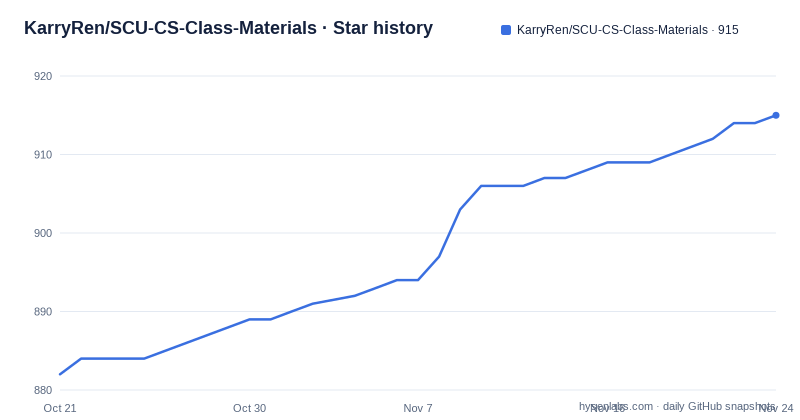
- KarryRen/SCU-CS-Class-Materials909 ★ · +27
| Repository | 2026-10-21 | 2026-11-16 |
|---|---|---|
| KarryRen/SCU-CS-Class-Materials | 882 | 909 |
27 Stars in the last 26 days, measured from the daily GitHub snapshot. Compare with other projects
Editorial analysis
The problem: course material that vanishes with the cohort
Every university has the same problem in a milder form. The student who understood the course in year one writes excellent revision notes, graduates, and the notes go with them. The cohort after them starts from scratch, and the internet is full of generic files that does not match what the professor actually asked for.
SCU-CS-Class-Materials is an attempt to stop that cycle for one school. It is a repository of undergraduate course files for the School of Computer Science at Sichuan University, and the project description in the repository is the Sichuan University computer science undergraduate course files, in the process of being updated.
The scope is wide. The team started building the project in January 2023, and it covers the four majors of the school, which are computer science and technology, artificial intelligence, the internet of things, and an interdisciplinary experimental class in computational finance, including the honours tracks. Within those it covers first year through fourth year.
The audience is therefore quite specific: a student at that school in one of those programmes, or a teacher or applicant who wants to see what the courses actually look like. It is not a general computer science curriculum repository, and the primary language of the repository is listed as Jupyter Notebook, which says more about the artefacts than the languages of the courses.
There is a single release, version 1.0.0 from 2024-07-21, and the last push was on 2026-10-19, so the archive is still being filled.
What the repository actually holds, in four kinds of document
The project states its own scope in four numbered categories, and it is worth reading them as a specification of what a course archive should contain.
The first is final revision notes and final practice questions for some required and elective subjects, including past years' exercises, together with notes for working through the question sets. The second is lab reports and course design source code for the required and elective laboratory courses. The third is course papers and homework assignments for some required and elective subjects. The fourth is study reflections and shared experiences from students who have taken the course.
That fourth category is the one that distinguishes this from a slide dump. A reflection on how a course was actually taught and examined tells a future student something that a copy of the slides cannot, and it is also the category that carries most of the licensing ambiguity, since it is the most personal writing in the repository.
The project description is also honest about why the archive exists. It argues that breaking the information gap matters for understanding a course systematically, organising a knowledge framework and pinning down the core points, and that for undergraduate study the lectures and the exercises matter most, but good course files is still necessary, particularly for computer science, artificial intelligence and financial engineering, where a complete and high quality set helps with understanding the theory, guides the course design work and helps with revision.
The licence and the update policy that go with it are covered further down.
The four level directory scheme, and what the file names encode
The repository's structure is the key to using it, and the project documentation says so directly: understanding the directory architecture is the key to using this project. There are four levels.
The first is the year of study, from first year to fourth. The second is the semester, split into the first and second terms. The third is the subject, and the naming convention here is deliberate: courses are named using the official naming from the university's academic affairs system, so that anyone can look up the exact course in the timetable system, and well known abbreviations are added alongside so that a course like the advanced language programming course has a folder people can find by the name they actually use for it. The fourth level is the files file itself, named for the contributor, the year the files was written, and the grade they received, with some contributors not wanting to expose their scores, in which case xx replaces the number.
That last detail is worth pausing on, because it is a small design decision that shapes the whole archive. The grade is in the path, so a student can see at a glance who contributed a good result, which is an incentive to contribute, and the escape hatch of xx keeps the ones who would rather not be ranked out of the way.
Each semester directory also contains a README.md that summarises the courses of that term, with the main courses and related notes. So the structure is navigable in two directions: by browsing a term, or by searching the tree for a subject name.
The repository root is correspondingly simple, with Grade1/, Grade2/, Grade3/ and Grade4/ directories, the README, the licence and the assets folder.
Finding and downloading: search first, then pick a transport
The usage guide in the project documentation is written for people who are not sure what is in the archive, and it recommends two steps.
The first step is to search the files catalogue with Ctrl + F for the subject name or the course abbreviation, and the note that the course names follow the official naming from the university's academic affairs system, so you can log in and look up the exact name there if a search comes up empty.
The second step is to download, and the documentation offers three ways, with a recommendation. You can download a single file by opening its page and using the raw file download button. You can download the whole project as a zip archive, which the documentation recommends as the simpler option. Or you can clone the project with git:
git clone https://github.com/KarryRen/SCU-CS-Class-Materials.gitThe troubleshooting section is characteristically honest about the real failure mode, which is not a broken repository but a slow network. If a single file download does not respond, the cause is the network and the advice is to try again or change network. If the zip download or the clone fails partway through, the cause is again the network, and the remedy is the same. The documentation also notes that the project recommends connecting to the university campus network if the connection is slow, and gives the campus gateway address for it.
The rest of the guidance is about gaps. If you cannot find the course folder you need, it is because the team has not maintained that course yet, and the project asks you to open an issue so they can collect and maintain the files. If you want to contribute your own files, the project invites you to join the team, and the contribution process is described in the repository's own readme.
The licence, and the three statements that go with it
The repository records its licence as a custom one that GitHub cannot classify, and the important statement is in the project's own notices: the files is licensed under the Creative Commons Attribution-NonCommercial-ShareAlike 4.0 International licence by default, unless there is a specific note to the contrary.
The attribution part is the easy one, and the project's notice handles it by saying that the uploaded files has been contacted with the author and authorised, that the right of attribution belongs to the person who shared the files, and that personal notes remain the copyright of their own authors. There is a contact address for takedown requests if anything is infringing.
The non-commercial part is the one that constrains reuse, and it is worth being explicit about what it means. A shared set of lecture notes and lab reports under a non-commercial licence cannot be bundled into a paid course, a commercial textbook or a monetised tutoring product, and a derivative set of notes has to be shared under the same terms. For a student archive that is a sensible choice, and for anybody who wants to build on the files commercially it is a hard boundary.
The project also describes itself as a non-profit, permanently free open source project that students may read and share freely, and the readme asks for a star if the project has been useful, which is the whole funding model of a project of this kind.
The third statement is about accuracy, and it is the one a new student should read before relying on anything here: the files comes from former students of the school and from the internet, its correctness cannot be fully guaranteed, and the project asks you to open an issue if you have questions or corrections.
The update cycle, and the warning that comes with it
The project maintains itself on a schedule tied to the academic year, and it is worth understanding because it explains what you will and will not find in the tree.
The project uses a relatively centralised approach to continuous updating, and the peak update period is after each semester's final exam. The reason is in the nature of the files: the resources are strongly tied to a point in time, and each one lists the time when it was written and the course it was taken in.
That last point is the project's own warning and it is the most important sentence in the documentation for a new student. The files is for reference only, and the project asks everyone to study according to what the teacher of the year required, to generalise from it, and specifically not to copy it mechanically or plagiarise it. That is a warning against treating last year's answer key as this year's specification, and it is a fair one, because the exam changes even when the course name does not.
The same centralised model has an effect on the archive's shape. A subject is either maintained, in which case it has a folder of recent contributions, or it is not, in which case there is no folder at all and the usage guide sends you to the issue tracker. There is no such thing as a partially maintained subject in this scheme, which is a simple rule but a lumpy one.
The last push was on 2026-10-19, and the single release is version 1.0.0 from 2024-07-21, so the repository is a working archive rather than a released package. Anyone automating against it should treat the branch as the interface, and should expect the tree to change shape between semesters.
Where this is useful, and where it is not
The honest assessment is that this is a good example of a narrow, well-organised, community resource, and a poor substitute for a proper course archive with versioned releases and a structured format.
It is genuinely useful for a student at that school. The value is not the notes themselves, which are only a year or two valid, but the fact that a whole cohort's worth of revision notes, lab reports and project source code exists in one tree, organised so that you can find the subject in a minute. For a course like data structures, a C++ programming course or an assembly course, having several students' lab reports and course design code side by side is worth a great deal when you are stuck at two in the morning.
It is not useful as a reference implementation, because a folder of somebody's 2023 lab report is not a specification and not a maintained codebase. It is not useful for a machine learning pipeline, because the files is unstructured and the licence restricts what you can do with it commercially. And it is not a substitute for attending the lectures, which the project says twice in different words.
The right way to use it is as a map of what the course asks and what a strong answer looked like, checked against the current syllabus. The directory naming, the official course names and the year in the file name are the parts designed to help you do that.
And the project asks for something in return, which is the fairest thing about it: it wants contributions. A student who took a course this year and wrote good notes has as much to contribute as anyone in the archive, and the contribution process is linked from the readme.
Editorial conclusion
Adopt this repository if you are a student at Sichuan University studying computer science, artificial intelligence, the internet of things or the computational finance class, and you want past revision notes, lab reports and project source code to work from. Do not treat it as a reference implementation or a course text, because the documentation is explicit that the files is tied to the year it was written and is meant only as a reference. Before you rely on anything in it, check the year in the folder name against the year of the course you are taking, and read the licence terms, since the assets are shared under a non-commercial licence by default and the repository asks for a takedown request to be honoured.
Frequently asked questions
What does SCU-CS-Class-Materials contain?
Undergraduate course files for the School of Computer Science at Sichuan University across computer science and technology, artificial intelligence, the internet of things and a computational finance interdisciplinary class, from first year to fourth. The four categories are final revision notes and practice questions, lab reports and course design source code, course papers and homework, and study reflections.
How is the directory structure of the repository organised?
There are four levels: the year of study, the semester, the subject, and the files file. Subjects are named after the official course name in the university's academic affairs system with a familiar abbreviation added, and files files are named for the contributor, the year written and the grade, with xx used where a contributor did not want their score exposed. Each semester directory also has a README.md summarising its courses.
How do I download the course files?
You can download a single file with the raw file download button, download the whole project as a zip archive, which the documentation recommends, or clone it with git clone https://github.com/KarryRen/SCU-CS-Class-Materials.git. The documentation notes that download and clone failures are usually network related and suggests retrying or switching network, including connecting to the university campus network.
What licence applies to the files?
The repository is recorded under a custom licence, and the project's own notice states that the files is licensed under Creative Commons Attribution-NonCommercial-ShareAlike 4.0 by default unless there is a specific note otherwise. Attribution stays with whoever shared the files, personal notes remain the copyright of their authors, and infringing uploads are removed on request.
How current is the files, and is it safe to rely on?
The project updates in a wave after each semester's final exams, and the files is strongly tied to a point in time, with each file recording when it was written and the course it was taken in. The documentation asks students to follow the current year's teacher's requirements, to generalise from the files rather than copy it, and to report corrections through issues, since the files comes from former students and the internet and its correctness cannot be fully guaranteed.
Official sources
Add this badge to your README
If you maintain this project, the badge below links readers to this analysis and shows its maintenance status from the daily GitHub snapshot. Paste the markdown into your README; add ?metric=license or ?metric=stars to the image URL for a different field.

[](https://hysenlabs.com/projects/karryren-scu-cs-class-materials)Star history chart for your README
[](https://hysenlabs.com/projects/karryren-scu-cs-class-materials)Was this useful?