DeepSeek Harness: An Agent Harness Where Every Component Is a Plugin
DeepSeek Harness: Everything is a Plugin.
At a glance
- What is it?
- DeepSeek Harness (dsh) is a developer-preview agent harness from DeepSeek AI, built on an everything-is-a-plugin architecture powered by Cordis. It is early, breaking changes are promised, and the real test is whether the plugin model holds up beyond the Web UI.
- Who is it for?
- Adopt DeepSeek Harness if you are a plugin author or an early adopter who wants to shape an agent harness before it stabilizes, and you accept the explicit compatibility-breaking changes ahead. Do not adopt it for production agent workloads yet: the developer preview status, the safety notice, and the rapid release cadence (three releases in one week) signal that APIs will shift.
- Can I use it commercially?
- Yes. MIT is a permissive licence: you can use, modify and sell software built on it, as long as you keep its copyright and licence notices.
- Is it still maintained?
- Yes. The repository last received commits 7 days ago.
- What is it written in?
- Mainly TypeScript, according to GitHub's language statistics.
Answers come from the project's GitHub data, last synced on October 25, 2026, and from our analysis. They are not legal advice.
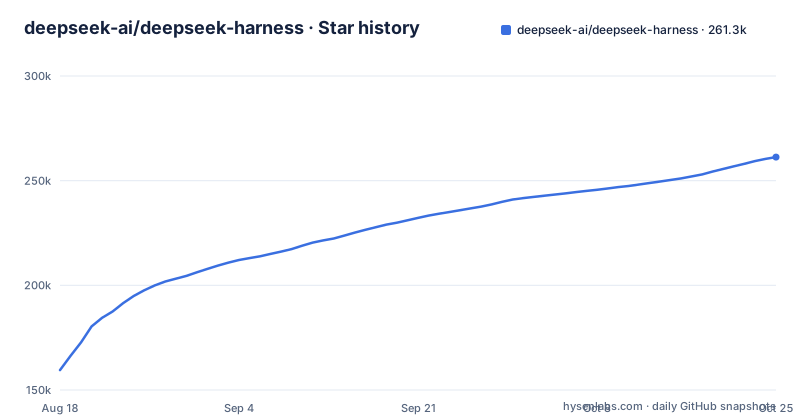
Star history
- deepseek-ai/deepseek-harness261,279 ★ · +101,792
| Repository | 2026-08-18 | 2026-10-25 |
|---|---|---|
| deepseek-ai/deepseek-harness | 159.5k | 261.3k |
101,792 Stars in the last 68 days, measured from the daily GitHub snapshot. Compare with other projects
Editorial analysis
What Problem This Solves and Who It Targets
DeepSeek Harness (dsh) is an open-source agent harness from DeepSeek AI. The README positions it as built on an everything-is-a-plugin architecture, powered by Cordis, a framework whose design is described in an arXiv paper on spatiotemporal composability. The problem it addresses is the common mess in agent tooling: hardcoded components, tangled dependencies, and a steep cost to swap out a single piece. By making every component a plugin, the project aims to let you replace, extend, or compose parts of the harness without rewriting the core. The target audience is developers building agents, plugin authors who want to publish reusable pieces, and teams that need a modular base for their own agent workflows. The project is in developer preview, so the intended user is someone comfortable with instability and willing to track a fast-moving codebase.
The Architecture: Cordis, Spatiotemporal Composability, and the Plugin Model
The core design claim is that everything is a plugin, and the foundation is Cordis. The README links to an arXiv paper titled A Programming Paradigm for Spatiotemporal Composability, which suggests the plugin model is not just about modularity but about how components are composed in space and time: which plugins run concurrently, which run sequentially, and how they coordinate. In practice, this means the harness itself is a thin shell, and the Web UI, the agent loop, the tools, and likely the model adapters are all plugins. The architecture documentation is referenced but not included in the README, so the exact plugin API is not visible from this material. That is a gap. You cannot evaluate the plugin contract without reading docs/architecture.md and the development guide. The trade-off is clear: a fully plugin-based harness gives you flexibility, but it also means the core provides little out of the box until you assemble the right set of plugins.
Getting It Running: Commands and Configuration
The README gives two ways to run dsh. The quickest is via npm: install Node.js, then run npx @deepseek-ai/dsh web. That starts the Web UI at http://127.0.0.1:3080 by default and opens it in your default browser. For a local launch that is the default behavior; an SSH launch only prints the host URL because the SSH client or editor owns the forwarded address. You can pass --no-open to run the server without opening a browser. Running from source requires a checkout: git clone, then cd into the directory, run pnpm install, then pnpm run build to prepare repository artifacts, and finally pnpm dsh web to use those built artifacts without rebuilding. The key configuration item visible here is the port, which defaults to 3080, and the --no-open flag. There is no mention of environment variables or a config file in the README, so you will need the Web UI guide (docs/user/guide/index.md) for deeper setup.
The Developer Preview Reality: Breaking Changes and Safety
The README is explicit: DeepSeek Harness is in developer preview and iterating rapidly, with compatibility-breaking changes promised. The release history confirms that pace: dsh-v0.1.2-alpha.1 on 2026-08-27, dsh-v0.1.1-rc.2 on 2026-08-21, and dsh-v0.1.1-rc.1 on the same day. Three releases in six days, including an alpha and two release candidates, tells you the project is not stable. The README also directs you to review the safety notice (SAFETY.md) before running the project. That is a strong signal: an agent harness that can execute code or drive tools carries real risk, and the project authors want you to read the warnings first. For a production user, this is the wrong tool today. For a plugin author, it is an opportunity to get early feedback, but you must expect to update your plugins frequently as the API shifts.
A Real Limitation: The Web UI Is the Only Visible Surface
The only runnable command shown in the README is dsh web, which starts the Web UI. There is no CLI-only mode, no headless agent command, and no documented API for programmatic use in the README. That is a limitation if you want to embed the harness in a server-side pipeline or run agents in a CI environment without a browser. The README does mention an SSH launch, which prints the host URL, but that is still a web-based interaction. The plugin architecture suggests you could build a headless plugin, but nothing in the README shows how. So for a developer who needs a non-interactive agent runner, dsh as documented does not yet offer that path. You would have to dig into the source or the architecture docs to see if a headless plugin exists or can be written.
Alternatives: Cordis Itself and Other Agent Frameworks
The most direct alternative is Cordis, the framework that powers dsh. Cordis is a general-purpose plugin framework, not an agent harness, so you would build your own agent logic on top of it. That is a different approach: dsh gives you a harness with a Web UI and a plugin system, while Cordis gives you the composability primitives and leaves the agent-specific parts to you. If you want full control and do not need the Web UI, Cordis is the lower-level choice. Another alternative is a conventional agent framework like LangChain or AutoGPT, which are not plugin-based in the same way; they use chains, graphs, or tool registries. The difference is structural: dsh's everything-is-a-plugin model means every component, including the harness itself, is replaceable, whereas those frameworks have a fixed core with extensions. If you need a mature ecosystem with stable APIs, those alternatives are safer. If you want to experiment with a spatiotemporal composability model, dsh is the only one here that offers it.
Maintenance, Licensing, and Upgrade Cost
The project is MIT licensed, which is permissive and allows commercial use, modification, and redistribution, with the license file and third-party notices provided. The maintenance cost is tied to the rapid iteration: with breaking changes promised, every upgrade could require changes to your plugins or your usage of the CLI. The release cadence (an alpha and two RCs in one week) means you cannot assume a stable API for months. The README directs contributors to CONTRIBUTING.md and developers to docs/development.md and docs/architecture.md, so there is a structure for contributing, but the project is clearly in an early phase. The plugin ecosystem is nascent: there is a dsh-plugin topic on GitHub for discoverability, but no plugin registry or marketplace is mentioned. You will likely need to write your own plugins or rely on a small set from the community. Before adopting, check the last push date and the issue tracker to gauge activity, but the fact that the last push is the same day as the latest release suggests active development.
Editorial conclusion
Adopt DeepSeek Harness if you are a plugin author or an early adopter who wants to shape an agent harness before it stabilizes, and you accept the explicit compatibility-breaking changes ahead. Do not adopt it for production agent workloads yet: the developer preview status, the safety notice, and the rapid release cadence (three releases in one week) signal that APIs will shift. Before committing, verify that your target plugins are maintained, read SAFETY.md in full, and test the Web UI on a local machine with --no-open to avoid browser surprises. The project is MIT licensed, so you can fork it, but the plugin ecosystem is young and the architecture is the real bet: if Cordis's composability model does not fit your agent logic, you will fight the framework rather than benefit from it.
Frequently asked questions
what is deepseek harness
DeepSeek Harness, whose command is dsh, is an open-source agent harness from DeepSeek AI built on an everything is a plugin architecture and powered by Cordis. It is in developer preview and warns that compatibility breaking changes are coming.
How to use deepseek harness?
Install Node.js, then run npx @deepseek-ai/dsh web, which starts the Web UI at http://127.0.0.1:3080 by default. Pass --no-open to run the server without opening a browser, and over SSH the command only prints the host URL.
Is harness similar to GitHub?
The README draws no such comparison. It describes dsh as an open-source agent harness from DeepSeek AI, hosted on GitHub, with feedback and bug reports taken through GitHub Discussions and a Discord community.
What is the role of harness?
The harness is the layer that hosts agents, and this one is built so every part is a plugin. The design comes from Cordis, described in A Programming Paradigm for Spatiotemporal Composability, and plugin authors are asked to add the dsh-plugin topic to their repository for discoverability.
What is harness and how does it work?
You launch it with dsh web, either from npm using npx or from a checkout after pnpm install, pnpm run build and pnpm dsh web. pnpm dsh web uses the built artifacts without rebuilding, and pnpm run dev:web rebuilds client bundles on source edits.
Official sources
Where developers are discussing it
Posts on Hacker News, dev.to and Lobsters that link to this repository, found by our scan of those communities. 1 in the last 30 days; newest first.
- Choosing a Local LLM Through Fate (2026 Edition)dev.to · Oct 12, 2026 · 2 points · 0 comments
Add this badge to your README
If you maintain this project, the badge below links readers to this analysis and shows its maintenance status from the daily GitHub snapshot. Paste the markdown into your README; add ?metric=license or ?metric=stars to the image URL for a different field.

[](https://hysenlabs.com/projects/deepseek-ai-deepseek-harness)
[](https://hysenlabs.com/projects/deepseek-ai-deepseek-harness)Star history chart for your README
[](https://hysenlabs.com/projects/deepseek-ai-deepseek-harness)Was this useful?