996.ICU: A GitHub Repository as a Labor Rights Protest, Not a Software Project
GitHub describes it as Repo for counting stars and contributing. Press F to pay respect to glorious developers.. The metadata lists the NOASSERTION license. This article stays within the project description and details documented in the GitHub repository README.
At a glance
- What is it?
- 996.ICU is a repository that documents and protests the Chinese tech industry's 996 work schedule. It is not software, but a campaign hub with a license, a blacklist, and a call to action.
- Who is it for?
- Adopt 996.ICU if you are a developer or employer who wants to signal opposition to the 996 schedule and contribute to a labor rights campaign. Do not use it if you expect software, code, or a technical tool.
- Can I use it commercially?
- Check first. The repository uses a licence we do not classify automatically, so read its LICENSE file before any commercial use.
- Is it still maintained?
- Probably not. The repository last received commits 15 months ago, on August 22, 2025.
- What is it written in?
- GitHub does not report a main language for this repository.
Answers come from the project's GitHub data, last synced on November 15, 2026, and from our analysis. They are not legal advice.
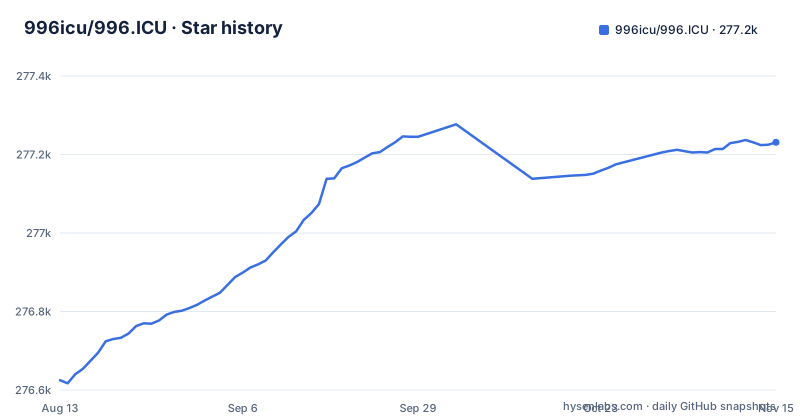
Star history
- 996icu/996.ICU277,231 ★ · +606
| Repository | 2026-08-13 | 2026-11-15 |
|---|---|---|
| 996icu/996.ICU | 276.6k | 277.2k |
606 Stars in the last 94 days, measured from the daily GitHub snapshot. Compare with other projects
Editorial analysis
A Repository That Is Not Software
The repository's purpose is political and social, not technical. It collects evidence, hosts a license, and links to community projects. The README states that the issues area was switched off by the maintainer personally, because it was out of control even with interaction limits. That is a concrete sign that this is not a typical open source project. The repository is a statement, and its maintenance model reflects that. It is a place to show support, not to file bug reports or request features.
The Mechanism: A Blacklist, a License, and a Badge
The data flow is simple: contributors update the blacklist with evidence, and the list becomes a public record. The license operates separately, as a legal constraint on usage. The badge is a visual marker. There is no automation, no API, and no code to run. The repository is a static document with a governance model based on manual contribution. That is a deliberate design choice, but it has limits. The blacklist depends on the quality and verifiability of submissions, and the README does not describe any verification process. Anyone can contribute, which means the list could contain errors or outdated entries.
Getting Involved: Commands and Actions
The practical steps are straightforward. For a developer, the most direct action is to add the badge to a GitHub project. That requires no code, just a link or image reference. For a contributor, editing the blacklist is a standard pull request workflow. The repository does not require any build tools or dependencies. The barrier to entry is low, which is intentional. The campaign wants broad participation, not technical expertise. However, the lack of a formal contribution guide beyond the README means that first-time contributors must infer the process from the file structure.
The Anti-996 License: A Novel but Untested Instrument
For a developer, adopting this license is a statement, not a technical decision. It signals support for labor rights, but it may also deter some companies from using your code, even those that comply with labor laws. The license is untested in court, at least as far as the repository shows. The README does not mention any legal precedent or case law. That is a limitation. If you are building a project that needs broad adoption, the Anti-996 License could be a hindrance. If you are building a project for a community that shares the protest's values, it could be a badge of honor. The choice is political, and the repository does not hide that.
Community Ecosystem and the Limits of a Star Count
The README lists a large ecosystem of related repositories, including 955.WLB, a whitelist of work-life balanced companies, and 996.LIST, a ranking of 996 and 955 companies. There are also tools like 996.avengers, which adds tags to recruitment websites, and 996.Error, which collects exceptions in various languages. These projects extend the protest beyond a single repository. They show that the movement has spawned practical tools, like a survey and a petition. However, 996.ICU itself is a static hub. It does not integrate with these projects beyond linking to them. The star count on the repository is often cited as a measure of support, but stars are not evidence of effectiveness. The repository's impact is in the blacklist and the license, not in its popularity metrics. The README even includes a hit counter from hits.dwyl.com, which is a vanity metric. The real test is whether the blacklist changes employer behavior, and that is not measurable from the repository.
Maintenance, Governance, and the Cost of a Protest
The license is a draft, and the README invites legal professionals to contribute to future versions. That is a clear signal that the license is not final. For a developer considering the license, this is a risk. You would be adopting a document that is still evolving. The repository also accepts donations in cryptocurrency, and the README says only that donations will be used to sustain and maintain the website, with no budget or spending plan. The maintenance cost is real, but it is not technical. It is the cost of keeping a protest relevant.
Alternatives: 955.WLB and the Formal Petition Route
Each alternative has its own maintenance burden. 955.WLB requires constant updates to keep the whitelist accurate. 996.Petition requires coordination with government bodies. 996.ICU is the simplest to maintain because it is a static document, but it is also the least actionable. The repository itself does not provide a mechanism for change beyond visibility. The alternatives offer more direct interventions.
Should You Adopt or Avoid?
The repository's future is uncertain. The last push was on 2025-08-22, and the issues are off. The README does not announce a shutdown. If you rely on the blacklist or the license, monitor the repository for updates. The license is a draft, so check the Anti-996-License-1.0 repository for changes. The campaign may have achieved its goal of raising awareness, but the repository remains a historical record. Its value is in its documentation of a moment in tech labor history, not in its ongoing utility.
Editorial conclusion
Adopt 996.ICU if you are a developer or employer who wants to signal opposition to the 996 schedule and contribute to a labor rights campaign. Do not use it if you expect software, code, or a technical tool. Before contributing, verify the current blacklist entries and the license terms, since the repository is not actively maintained and the issues are disabled. The repository serves as a historical and ongoing protest artifact, not a living codebase.
Frequently asked questions
What does 996 stand for?
In this project the name refers to Work by 996, sick in ICU, an ironic saying among Chinese developers, meaning that following the 996 schedule risks getting into the intensive care unit. The repository defines 996 as an unofficial schedule of 9 a.m. to 9 p.m., six days a week, at least 60 hours a week.
What is 996 and 007?
The repository covers 996 only: an unofficial schedule of 9 a.m. to 9 p.m., six days a week, at least 60 hours a week, linked to the Wikipedia page on the 996 working hour system. It does not define 007 anywhere.
Is 996 illegal in China?
The project calls 996 an unofficial work schedule, states that it is not a political movement, and says it firmly upholds the labor law while asking employers to respect the rights and interests of their employees. It offers no analysis of specific legal provisions, so it is not a legal answer to the question.
What is 996.ICU?
It is a repository, a website at 996.icu and a license. You can update the company list at blacklist/README.md with evidence, add the badge from externals/instruction.md to your project, put your own project under the Anti-996 License, and translate the contents through i18n/README.md.
Official sources
Add this badge to your README
If you maintain this project, the badge below links readers to this analysis and shows its maintenance status from the daily GitHub snapshot. Paste the markdown into your README; add ?metric=license or ?metric=stars to the image URL for a different field.

[](https://hysenlabs.com/projects/996icu-996-icu)Star history chart for your README
[](https://hysenlabs.com/projects/996icu-996-icu)Was this useful?