The transparency dashboard is the actual feature
A modern, feature-rich YouTube and YouTube Music client with local recommendation for Android built with Jetpack Compose
At a glance
- What is it?
- Flow is an Android YouTube and YouTube Music client in Kotlin and Compose, and the part worth evaluating is not the player, since ExoPlayer, SponsorBlock and downloads are table stakes in this category, but FlowNeuro, a recommender that runs on the phone and ships a dashboard explaining what it knows about you and why it chose something, plus the ability to export the whole profile as a file.
- Who is it for?
- Adopt Flow if you want a YouTube client with discovery as well as playback and you refuse to hand a watch history to a server, since the local engine plus the exportable profile is a claim you can check. Do not adopt it expecting the official app's recommendations, because no on-device model can match a service trained on the behaviour of everyone, and expect to install an APK rather than an audited store build.
- Can I use it commercially?
- Yes, with conditions. GPL-3.0 is a copyleft licence: if you distribute software that includes it, you must release that software's source code under the same licence. Running it internally without distributing it does not trigger that obligation.
- Is it still maintained?
- Yes. The repository received new commits within the last day.
- What is it written in?
- Mainly Kotlin, according to GitHub's language statistics.
Answers come from the project's GitHub data, last synced on November 22, 2026, and from our analysis. They are not legal advice.
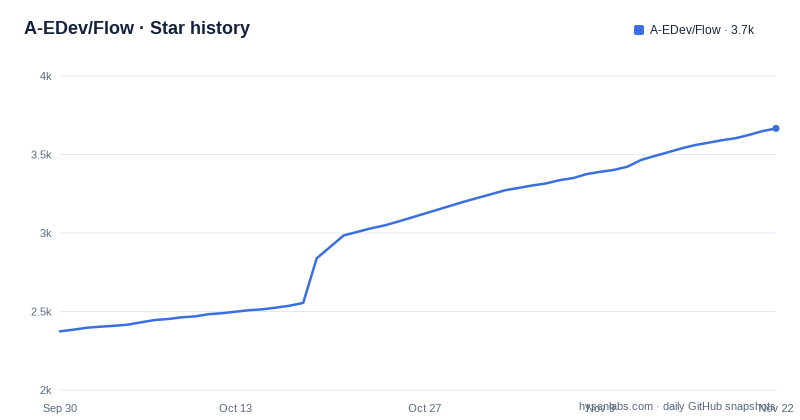
Star history
- A-EDev/Flow3,666 ★ · +1,292
| Repository | 2026-09-30 | 2026-11-22 |
|---|---|---|
| A-EDev/Flow | 2.4k | 3.7k |
1,292 Stars in the last 53 days, measured from the daily GitHub snapshot. Compare with other projects
Editorial analysis
A recommender that lives on the phone
The problem statement in the README is precise about the gap. Most open source YouTube clients give you playback and no way to discover anything, so the choice is between the official app, which tracks you, and an alternative, which has no recommendations at all. Flow's answer is to run the recommender locally, and the name for it is FlowNeuro. The claims are specific: it runs entirely on the device, with no server, no telemetry and no account needed, and it learns from what you watch, skip, like, dislike, search for and how long you watch. The design consequence is worth stating, because it is a real trade rather than a free win. A local model learns from one person's history, so it can be more personal than a global one and it can be private, and in exchange it has far less data per decision. Whether that trade is worth making depends on whether you want a feed tuned to you or a feed tuned to the population.
Boredom detection and the anti-collapse rule
The feature list says more about the algorithm than most project documentation ever does, and the interesting entries are the ones about failure. It distinguishes weekday from weekend patterns and morning from night preferences, which is a time-of-day and day-of-week conditioning rather than a single global model. It detects when you are getting bored of a topic and mixes in new content, which is an explicit boredom signal rather than an implicit consequence of a ranking score. It prevents the feed from collapsing into the same two or three topics, which is the well-known failure mode of every recommender that optimises for watch time. It surfaces related videos from your recent watches to create natural topic transitions, which is a way of moving between interests rather than jumping. And it uses engagement signals, specifically like-to-view ratios, to filter out low-quality content, which is the one place the list mentions filtering on a quality proxy rather than on popularity. Each of these is a design decision you could argue with, which is the right kind of documentation.
A dashboard, and a profile you can export
Two features turn a privacy claim into something you can check. The first is a full transparency dashboard, described as letting you see what the algorithm knows and why it recommended something. That is a stronger claim than no tracking, because it makes the model inspectable at the level of individual recommendations rather than at the level of a privacy policy. The second is export and import of the entire recommendation profile as a file. Combined, they mean the thing that makes the recommender personal is also something you own rather than something you are given, and it means you can move the profile to a new phone, or keep it, or read it. The README states the same point in the Why section, that you can inspect everything it knows about you, adjust it, or wipe it at any time. Whether the dashboard is genuinely informative or merely reassuring is the open question, and the only way to know is to run it long enough for it to have something to say.
Playback here is the commodity
The video feature list is long and almost all of it is standard for this category. Playback goes through ExoPlayer from the Media3 library, with resolution switching across 1080p, 720p, 480p and 360p. SponsorBlock skips sponsors, intros, outros and filler. DeArrow replaces clickbait thumbnails and titles with community-sourced alternatives. Return YouTube Dislike is wired in. There is background playback, picture in picture, casting to televisions and streaming devices, speed control from 0.25 to 2 times, chapters with seek jumping, gesture controls for brightness, volume and seeking, subtitles with configurable size, colour and background, downloads with VP9, AV1 and standard formats, and resume from where you stopped. None of that is a differentiator and all of it is table stakes; if you are evaluating Flow against another client, treat this list as the baseline every candidate has to meet rather than as evidence for Flow. The download support in particular, listing the codec families explicitly, is the feature most likely to matter to a specific user and the one most likely to be a policy question rather than a technical one.
InnerTube and a borrowed extractor are the load-bearing parts
The repository topics are the most technically informative thing in the README: innertube and newpipe-extractor alongside youtube-client and video-player. Taken together they say how the app works. It talks to YouTube's internal API rather than to a documented public one, and it reuses the extractor library that NewPipe built for exactly that job. That is how every client in this category works, and it is also the project's central architectural risk, because an interface nobody has promised to keep can change without a deprecation period, at which point the failure mode is a client that plays nothing rather than a client that crashes. The repository layout suggests the project treats this as a known quantity rather than an accident. There is a legacy directory, which is where the previous implementation lives, and a benchmark directory, which implies the extraction and playback paths are measured. If you are adopting this, the practical check is empirical: install a release, try the things you actually watch, and keep the official app's APK around, because a client that cannot reach the API is not a client you can debug yourself.
No account, local storage, and a way in from NewPipe
The privacy section is a list of five short claims, and they are the kind that are easy to state and hard to verify from outside. No Google account is required, there are no ads, analytics or tracking, all data is stored locally on the device, subscriptions and history can be imported from NewPipe, and everything can be exported or deleted at any time. Two of those are checkable in an afternoon. Install the app, see whether it asks you to sign in, and use it for a day, then check the app's data directory and its permission list. The import path from NewPipe is the friendliest detail here, because it removes the switching cost that keeps people on a tracked app: your subscriptions and history come across, and the recommender starts learning from a history you already have rather than from a week of new watching. The repository also ships a privacy policy file, which is a small signal that the project treats privacy as a documented commitment rather than a marketing line.
Music is a second application in the same shell
The music section describes a full player rather than an afterthought. There is a dedicated music player with album art and audio visualisations, queue management with add, remove and reorder, shuffle and repeat in single and all modes, a mini player that persists across the app, synchronised lyrics display, tracks fetched from YouTube Music, and its own speed control. The mini player detail is the one that tells you this was designed by someone who uses it, because a persistent player is the difference between an app you can leave and an app you keep restarting. The screenshot set lines up with the feature list, with separate captures for a music player, a music hub and an artist page alongside the video screens, which is a sign the music side is treated as a first-class surface. Note the same architectural caveat applies here as on the video side, since the tracks come from the same internal service, so a change to that interface affects both halves of the app at once.
An APK from releases, and a repository built for shipping
Installation is an APK from the GitHub releases page rather than a store listing, and the address the README gives is the releases page itself:
https://github.com/A-EDev/Flow/releasesThat has a practical consequence. No store is mediating the build, so there is no review step and no staged rollout, and the security badge in the README header refers to a SHA-256 verification section rather than to a store signature. The repository contents show a project set up for shipping rather than for a demo. There is a fastlane directory, which is the usual tool for automated store uploads and metadata, a release notes file, a separate privacy policy file, a security policy, a code of conduct, a contributing guide and an editor configuration. There are both gradlew and gradlew.bat wrappers plus a run_gradle.bat, so building on Windows is a first-class path. There is an AGENTS.md and an agent directory, an editor settings directory, and a legacy directory holding the previous implementation. The licence is GPL-3.0, with the file named License rather than the conventional uppercase name, and the releases are versioned steadily: v2.1.5 in June 2026, v2.2.0 in July, v2.2.1 in August.
Against the official app, and against NewPipe
Two comparisons, and they are the two everybody makes. The official app wins on recommendations and loses on everything the privacy section claims, and the choice is really about whether you are willing to have a watch history server-side in exchange for a model trained on everyone's behaviour. NewPipe is the reference point for the other end, and Flow's own import path from NewPipe is an admission of how the category is divided: NewPipe is the playback client, Flow is the playback client plus something. The approach difference is architectural rather than cosmetic. Flow adds an on-device model, which means it needs storage, a training or update loop, and a way to explain itself, and all three are visible in the feature list. What it does not get is scale. A model trained on one person's history cannot know about the video nobody has uploaded yet, and it cannot benefit from a billion other users correcting it, so its cold-start problem is real and its discovery is bounded by what you have already shown it. That is a fair trade for the person who wants it, and a downgrade for the person who wanted the best recommendations available anywhere.
Editorial conclusion
Adopt Flow if you want a YouTube client with discovery as well as playback and you refuse to hand a watch history to a server, since the local engine plus the exportable profile is a claim you can check. Do not adopt it expecting the official app's recommendations, because no on-device model can match a service trained on the behaviour of everyone, and expect to install an APK rather than an audited store build. Verify four things first: that the InnerTube-based client still works for your account and region, since the topics list names innertube and NewPipe's extractor and that is an unofficial interface, that the dashboard tells you something you find useful rather than something you find reassuring, that the GPL-3.0 licence fits what you intended to do with it, and which build you install, given v2.2.1 from 2026-08-27 with the last push on 2026-09-28 and a legacy directory in the tree. Android 8.0 or newer is the stated floor.
Frequently asked questions
What is FlowNeuro in the Flow YouTube client?
It is the recommendation engine, and it runs entirely on the device with no server, no telemetry and no account. It learns from what you watch, skip, like, dislike, search for and how long you watch, and it ships a transparency dashboard plus the ability to export the whole profile as a file.
Does Flow require a Google account?
No. The privacy section states that no Google account is required, that there are no ads, analytics or tracking, and that all data is stored locally on the device. You can also export or delete everything at any time, and import subscriptions and history from NewPipe.
How do I install Flow?
Download the APK from the GitHub releases page. There is no store listing in the README, so the build is not reviewed or staged by a store, and the README carries a SHA-256 verification section in the security part instead. Android 8.0 or newer is the stated minimum.
What video features does Flow support?
ExoPlayer playback with resolution switching, SponsorBlock, DeArrow, Return YouTube Dislike, background playback, picture in picture, casting, speed control from 0.25 to 2 times, chapters, gesture controls, customisable subtitles, downloads with VP9 and AV1, and resume playback. It also has a YouTube Music player with a queue, synced lyrics and a persistent mini player.
How does an on-device recommender compare with the official app?
It is more personal and private but less informed, since it learns from one history rather than from a population. The README is explicit that it exists because alternative clients have no discovery at all, and its feature list includes boredom detection, topic-transition videos and a like-to-view filter aimed at feed variety and quality.
What licence is Flow released under?
GPL-3.0, with the licence file in the repository. The most recent release is v2.2.1 from 2026-08-27 and the last push to main was 2026-09-28.
Official sources
Add this badge to your README
If you maintain this project, the badge below links readers to this analysis and shows its maintenance status from the daily GitHub snapshot. Paste the markdown into your README; add ?metric=license or ?metric=stars to the image URL for a different field.

[](https://hysenlabs.com/projects/a-edev-flow)Star history chart for your README
[](https://hysenlabs.com/projects/a-edev-flow)Was this useful?