Ransack: ActiveRecord Search Without Extra Infrastructure
Search everywhere and in a hurry!
At a glance
- What is it?
- Ransack is a Ruby gem that adds search forms and query building to Rails applications using only ActiveRecord and ERB. It fits teams that want filtering without running Elasticsearch, and it is a poor fit for relevance ranking or full-text search.
- Who is it for?
- Adopt Ransack if you are on Rails 8.1 with Ruby 3.4 or later, your search means filtering and sorting columns users already understand, and you would rather not operate a search cluster. Do not adopt it if you need relevance ranking, stemming or typo tolerance.
- Can I use it commercially?
- Yes. MIT is a permissive licence: you can use, modify and sell software built on it, as long as you keep its copyright and licence notices.
- Is it still maintained?
- Yes. The repository received new commits within the last day.
- What is it written in?
- Mainly Ruby, according to GitHub's language statistics.
Answers come from the project's GitHub data, last synced on November 14, 2026, and from our analysis. They are not legal advice.
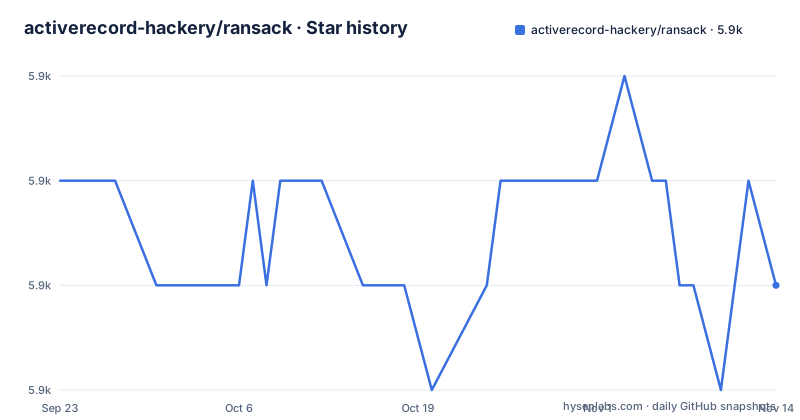
Star history
- activerecord-hackery/ransack5,858 ★ · -1
| Repository | 2026-09-23 | 2026-11-14 |
|---|---|---|
| activerecord-hackery/ransack | 5.9k | 5.9k |
-1 Stars in the last 52 days, measured from the daily GitHub snapshot. Compare with other projects
Editorial analysis
The problem Ransack solves for Rails teams
Most Rails applications eventually need a filter form: a text box for a name, a dropdown for a status, a date range for created_at. Writing that by hand means building a chain of where clauses, validating which params came from the client, and keeping the whole thing in sync with the form. Ransack takes that work and turns it into a convention. The README frames the project as a way to add searching and sorting to a Rails application with plain Ruby and ERB, "without a search server or any other infrastructure". The audience is the team that already has ActiveRecord and does not want to run a second service, write queries in another language, or maintain a separate index. Ransack keeps the work in Ruby and ERB. That is the whole pitch, and it is a narrow one: this is structured filtering over relational data, not a search engine.
How Ransack turns params into ActiveRecord queries
The mechanism is a search object. You build one from a model and a params hash, and it produces a relation. Predicates are part of the parameter name: a key like name_cont means "name contains", and the suffix tells Ransack which SQL comparison to build. The repository layout reflects this split: lib/ holds the gem, spec/ holds the test suite, and docs/ holds the Markdown that becomes the published site. The documentation is built from the Markdown under docs/ and published at activerecord-hackery.github.io/ransack. One thing worth noting: the README itself does not walk through predicates or the search object in detail. It delegates that to the documentation site, which means the README is an entry point rather than a tutorial.
Installing Ransack and running a first search
Installation is a single line in the Gemfile. The README gives this exactly:
# Gemfile
gem 'ransack'
After running bundle install, the next step is a controller action that builds a search from params and a view that renders a form for it. The README shows both: `@q = Post.ransack(params[:q])` and `@posts = @q.result`, and a `search_form_for @q` block with `f.search_field :title_cont` plus `sort_link(@q, :published_at)`. For a first real use, pick one model you already filter by hand, expose two or three columns, and confirm the generated SQL with the Rails log before you build a larger form. The gem's own test suite lives in spec/, so if a predicate behaves unexpectedly, that directory is where the behaviour is defined.
Where Ransack is the wrong tool
Ransack builds SQL. That single fact decides most of its limits. If your users expect a single search box that ranks results by relevance, tolerates typos, or matches across free-text documents, Ransack is not that product, and no amount of configuration will make it one. It also inherits the performance profile of the database underneath it. A predicate against an unindexed column becomes a scan, and the gem cannot fix that for you. The README does not discuss indexing, query plans or performance at all, which means the responsibility sits entirely with the application. The other boundary is version support. The README states support for Rails 8.1 on Ruby 3.4 and later, on Postgres, MySQL, Trilogy and SQLite. If you are on an older Rails or an older Ruby, you are outside the stated support window, and the README points to its Security Policy for supported versions.
Ransack compared with Elasticsearch and Algolia
The difference is architectural rather than cosmetic. Elasticsearch and Algolia are separate search systems: documents are indexed outside your database, queries run against that index, and results come back ranked by a scoring model. Ransack never leaves the database. It compiles a search form into SQL against your existing tables, so results are always consistent with the current row data, with no indexing pipeline and no sync lag. The trade is capability. You get exact and pattern matching, comparisons, ranges and associations. You do not get relevance scoring, analyzers or typo correction. For a Rails app whose search is really a filter panel over a few thousand rows, the separate infrastructure is cost without benefit. For an app whose search is the product, Ransack is a detour.
Maintenance, releases and the MIT licence
The repository is not archived, and the last push was on 2026-10-25. Recent releases listed are v6.0.1, v5.0.3 and v4.4.4, all dated 2026-10-25. The presence of 6.0.x, 5.0.x and 4.4.x lines on the same day is worth reading carefully before you upgrade: it suggests maintained older branches alongside the current major version, and major-version jumps in a query-building library are exactly where parameter handling and allowlisting behaviour tends to change. The CHANGELOG.md at the repository root is the place to check what moved between them. Ransack is MIT licensed, which in practice means you can use it in commercial and closed-source applications; the LICENSE file at the root carries the actual terms, and if your organisation has specific obligations around attribution, that file is what your legal review should read rather than this article. The project accepts support through Open Collective, and the README directs questions to GitHub Discussions rather than the issue tracker, with bugs filed only when they can be reproduced from the information provided.
Editorial conclusion
Adopt Ransack if you are on Rails 8.1 with Ruby 3.4 or later, your search means filtering and sorting columns users already understand, and you would rather not operate a search cluster. Do not adopt it if you need relevance ranking, stemming or typo tolerance. Before committing, verify that your tables are indexed for the columns your search form will expose, and check the documentation's authorization and upgrading pages for how your version handles attribute allowlisting.
Frequently asked questions
What is Ransack software?
Ransack is a Ruby gem that adds searching and sorting to a Rails application with plain Ruby and ERB, without a search server or any other infrastructure. It builds ActiveRecord queries from search parameters.
How do you install Ransack in a Rails app?
Add gem 'ransack' to your Gemfile and run bundle install.
Which Rails and Ruby versions does Ransack support?
The README states that Ransack is supported for Rails 8.1 on Ruby 3.4 and later, on Postgres, MySQL, Trilogy and SQLite. Older combinations are outside that stated support window.
Where is the Ransack documentation?
The documentation is published at activerecord-hackery.github.io/ransack, built from the Markdown under docs/, with pages on getting started, authorization, predicates and upgrading.
Is Ransack a replacement for Elasticsearch?
No. The README presents Ransack as adding searching and sorting with plain Ruby and ERB, without a search server or any other infrastructure. Ransack compiles searches into SQL rather than maintaining a separate ranked index.
Official sources
Add this badge to your README
If you maintain this project, the badge below links readers to this analysis and shows its maintenance status from the daily GitHub snapshot. Paste the markdown into your README; add ?metric=license or ?metric=stars to the image URL for a different field.

[](https://hysenlabs.com/projects/activerecord-hackery-ransack)Star history chart for your README
[](https://hysenlabs.com/projects/activerecord-hackery-ransack)Was this useful?