AetherViz Master is a Claude skill, not a visualisation library
AetherViz Master - 互动教育可视化建筑师,将任意教学主题转化为沉浸式3D交互网页
At a glance
- What is it?
- AetherViz Master ships no application code. It is a SKILL.md prompt definition that tells Claude Code how to write a single-file Three.js page for a teaching topic, so the value is in the instruction set and the rendering decision table rather than in anything you can import. Useful for a teacher who wants a classroom demo in one prompt, wrong for a product that needs a maintained visualisation component.
- Who is it for?
- Adopt AetherViz Master when you need one interactive teaching page per topic, produced on demand by Claude Code, and you are willing to hand-edit the HTML it writes. Do not adopt it as a library, since there is nothing to import, and do not treat reproducible output as documented, because generation depends on the model reading SKILL.md.
- Can I use it commercially?
- Yes. MIT is a permissive licence: you can use, modify and sell software built on it, as long as you keep its copyright and licence notices.
- Is it still maintained?
- Activity is slowing. The repository last received commits 6 months ago.
- What is it written in?
- GitHub does not report a main language for this repository.
Answers come from the project's GitHub data, last synced on November 7, 2026, and from our analysis. They are not legal advice.
Star history
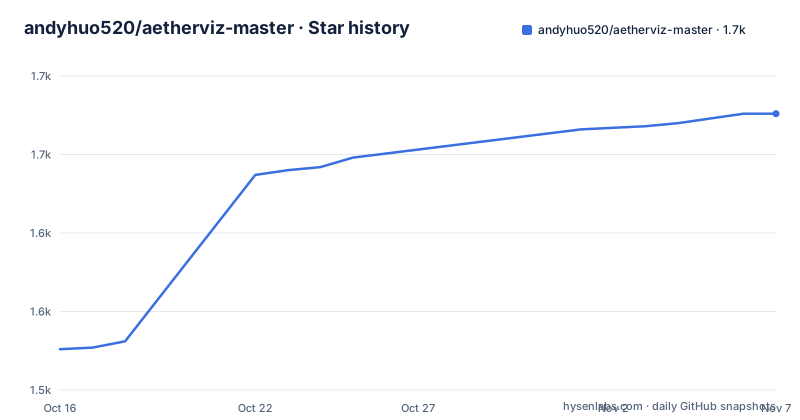
- andyhuo520/aetherviz-master1,676 ★ · +150
| Repository | 2026-10-16 | 2026-11-07 |
|---|---|---|
| andyhuo520/aetherviz-master | 1.5k | 1.7k |
150 Stars in the last 22 days, measured from the daily GitHub snapshot. Compare with other projects
Editorial analysis
What is actually in the repository
The honest description has to come first, because the README's framing invites the wrong expectation. AetherViz Master presents itself as a tool that turns a topic into an immersive 3D interactive page. There is no build system, no package.json, no source tree and no library to install. The repository root contains three files: `LICENSE`, `README.md` and `SKILL.md`.
What `SKILL.md` is, is a skill definition for Claude Code. You start Claude Code, invoke the skill, and hand it a topic such as Newton second law, uniform motion or photosynthesis. The model reads the skill instructions and writes a complete HTML file. The generation is done by the model, not by code in this repository.
The README documents a `docs/skill.md` as the detailed skill documentation, and the project structure block shows it nested under `docs/`. If your clone does not contain that file, the detail it holds is missing and you are running on the top-level SKILL.md alone. Check it before assuming the documentation covers a topic area you care about.
The license is MIT and the repository has no GitHub releases. The changelog lives in the README itself, where v5.0 and v4.0 are both dated 2026-02-22, which tells you these were written together rather than shipped a release apart.
The keyword table is the actual mechanism
The most concrete part of the design is the routing decision, and it is worth reading as a rule set rather than as a feature list. The README draws it as a diagram: the topic input is analysed, then keywords are matched, then a rendering mode is chosen.
Motion, particles, molecules, machinery and celestial bodies route to pure Three.js 3D. Functions, graphs, curves and geometry route to a 2D SVG chart. Newton, waves, energy and electromagnetism route to a hybrid mode combining both. Subject detection runs in parallel and picks the colour theme, with physics, chemistry, biology, mathematics, astronomy and programming each mapped to their own palette.
Three worked examples show the pipeline end to end. Uniform motion is identified as physics, the keyword motion selects pure 3D, and the output is a ball simulation with a velocity slider and a displacement trail. Trigonometric functions are identified as mathematics, the function and graph keywords select SVG, and the result is a waveform with parameter sliders and live drawing. Waves and vibration hits the hybrid path and produces a 3D spring oscillator with an SVG waveform overlaid.
Language is handled the same way. The skill detects Chinese or English input and writes the page in the matching language, which is what makes it usable in a bilingual classroom without regenerating by hand.
Running it is three shell commands and a topic
There is nothing to build. Clone the repository and serve it over HTTP so the generated page can load its libraries:
git clone https://github.com/andyhuo520/aetherviz-master.git
cd aetherviz-master
python -m http.server 8080
The README offers `npx serve.` and `php -S localhost:8080` as alternatives. Requirements are a modern browser with WebGL support.
The generation step happens inside Claude Code rather than on your machine:
claudeThen invoke the skill by name, or simply type the topic:
/aetherviz-masterThe README's examples are Newton second law, uniform motion and photosynthesis. The output is a complete HTML file that you open directly.
The stack versions are pinned in the README, not enforced anywhere
Because there is no package manifest, the technology table is documentation rather than a dependency declaration. According to the README the generated pages target Three.js r134 for the 3D engine, Tailwind CSS v3.4 or newer for styling, KaTeX 0.16.11 for formulas, D3.js v7 as an optional visualisation layer, and OrbitControls described as an inline simplified version rather than the upstream module.
That OrbitControls entry is the one to notice. The README describes this as an inline simplified version, but does not document how its behaviour differs from the upstream controls. For a classroom demo that is a fair trade. For anything you intend to keep running as the base of a product, it is a line of code you own.
The educational scaffolding is specified too, and it is what separates this from a bare 3D demo: learning objectives with checkable progress, KaTeX formulas rendered live, a plain-language explanation pitched at high school to university level, a collapsible quiz panel, and playback controls for pause, single step and speed. The interface is described as glassmorphism with a sidebar, a control panel and a HUD readout, laid out responsively for desktop, tablet and phone.
The limits are structural
The first limit is that reproducible output is not documented. The generator is a model reading a markdown instruction file, but the README gives no guarantee that two runs on the same topic will be identical. There is no test suite in the repository to catch a regression, no snapshot of expected output, and no way to diff a new result against a previous one. For a tool aimed at producing teaching material, that is a real gap: a teacher who found a good version has no supported path to regenerate it.
The second is the promise of smoothness. The README claims a 60fps experience from Three.js plus SVG hybrid rendering. That is a claim by the project about generated output, with no measurement procedure given, and the same README pins Three.js to an older r134 release.
The third is where this sits against alternatives. Writing the page yourself with Three.js gives you source you can diff, test and keep, at the cost of writing the scene, the controls and the teaching scaffolding. Using a hosted diagram or charting tool gives you stable, shareable output with none of the 3D interaction. AetherViz Master sits between the two: faster than writing it, and lighter than a product, with no middle ground in between.
Maintenance is the last point. The last push was on 2026-04-20 and the repository is not archived, with no tagged releases to pin to and a changelog whose two most recent entries share the date 2026-02-22. The README's contributing flow is a plain fork, branch, commit, push and pull request.
git checkout -b feature/your-feature
git commit -m 'Add amazing feature'
git push origin feature/your-feature
Editorial conclusion
Adopt AetherViz Master when you need one interactive teaching page per topic, produced on demand by Claude Code, and you are willing to hand-edit the HTML it writes. Do not adopt it as a library, since there is nothing to import, and do not treat reproducible output as documented, because generation depends on the model reading SKILL.md. Verify first that the docs/skill.md referenced in the README exists in your clone, since the repository root as shipped contains only README.md, SKILL.md and LICENSE, and inspect the generated page before using it.
Frequently asked questions
What is AetherViz Master and what does it install?
It is a Claude Code skill definition rather than a library. The repository contains LICENSE, README.md and SKILL.md, and generation happens when you run `claude` and invoke the skill with a topic, which writes a complete HTML file.
How do I run AetherViz Master locally?
Clone the repository and serve it over HTTP with `python -m http.server 8080` or `php -S localhost:8080`, then open http://localhost:8080; the README also lists `npx serve.` as an alternative. The README requires a modern browser with WebGL support.
How does AetherViz Master decide between 3D and 2D rendering?
It matches keywords in the topic. Motion, particles, molecules and celestial bodies go to pure Three.js, functions and graphs go to SVG, and Newton, waves, energy and electromagnetism go to a hybrid Three.js plus SVG mode.
Which libraries does AetherViz Master use?
The README lists Three.js r134, Tailwind CSS v3.4 or newer, KaTeX 0.16.11, optional D3.js v7, and an inline simplified version of OrbitControls. There is no package manifest in the repository, so these versions are documented rather than enforced.
What license is AetherViz Master under?
MIT, with the text in the LICENSE file at the repository root. The project has no GitHub releases; the version history appears as a changelog section in the README, where v5.0 and v4.0 are both dated 2026-02-22.
Official sources
Add this badge to your README
If you maintain this project, the badge below links readers to this analysis and shows its maintenance status from the daily GitHub snapshot. Paste the markdown into your README; add ?metric=license or ?metric=stars to the image URL for a different field.

[](https://hysenlabs.com/projects/andyhuo520-aetherviz-master)Star history chart for your README
[](https://hysenlabs.com/projects/andyhuo520-aetherviz-master)Was this useful?