Apache Fory: a serialization framework that wants your domain objects, not wrappers
A blazingly fast multi-language serialization framework for idiomatic domain objects, schema IDL, and cross-language data exchange.
At a glance
- What is it?
- Eleven language implementations, a reference-aware schema IDL, a row format for partial reads, and a Java path that positions itself against JDK serialization rather than against Protobuf.
- Who is it for?
- Fory is worth a look when your traffic crosses a language boundary and both sides would rather not negotiate a schema, or when a Java service is genuinely bottlenecked on JDK serialization and you control both ends. It is the wrong tool if you need a stable, language-neutral wire format that a third party will implement against, because the compact binary encoding is the other side of that trade.
- Can I use it commercially?
- Yes. Apache-2.0 is a permissive licence: you can use, modify and sell software built on it, as long as you keep its copyright and licence notices.
- Is it still maintained?
- Yes. The repository received new commits within the last day.
- What is it written in?
- Mainly Java, according to GitHub's language statistics.
Answers come from the project's GitHub data, last synced on October 23, 2026, and from our analysis. They are not legal advice.
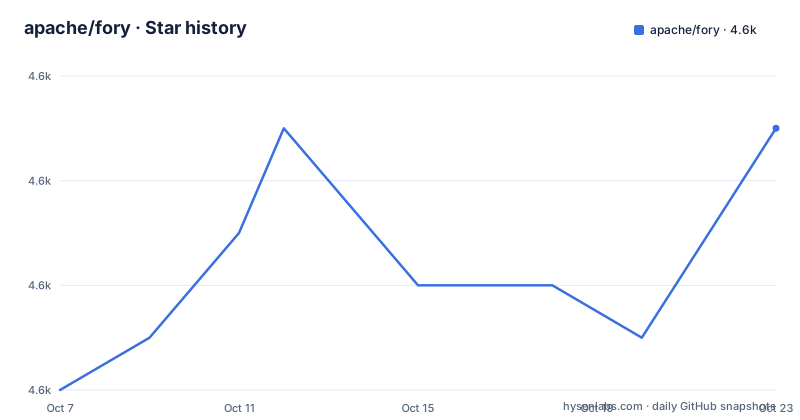
Star history
- apache/fory4,571 ★ · +5
| Repository | 2026-10-07 | 2026-10-23 |
|---|---|---|
| apache/fory | 4.6k | 4.6k |
5 Stars in the last 16 days, measured from the daily GitHub snapshot. Compare with other projects
Editorial analysis
Three modes that solve different problems
The easiest way to get lost in Fory is to treat it as one thing. The README describes at least four distinct modes, and they make different trade-offs.
There is cross-language mode, which is the headline: compact binary encoding, metadata packing, schema evolution, shared and circular references, and polymorphic runtime types, exchanged between any supported pair of languages. There is a reference-aware schema IDL, which lets you define schemas once and generate native domain objects per language, with shared and circular references expressible directly in the schema alongside numbers, strings, lists, maps, arrays, enums, structs and unions.
Then there are the same-language modes. Java native serialization is positioned as a high-performance replacement for JDK serialization, Hessian, Kryo and FST, and it supports JDK custom serialization semantics. Python native serialization is the equivalent for `pickle` and `cloudpickle`, covering classes, modules, functions and custom object state, with fine-grained control through `DeserializationPolicy`. And there are specialized formats: a row format for partial reads, and Fory JSON, a separate Java framework built around runtime-generated codecs.
Why zero-copy needs a row format
Row format is the piece that separates Fory from the usual serialization argument. A normal object serializer has to build the object graph before you can touch it, which means allocating a representation of all of it just to read two fields.
The row format skips that. You get direct access to fields, arrays, collection elements and nested values without reconstructing complete objects, with zero-copy access and partial reads. The Go implementation added this in v1.7.3, published 2026-09-15, and the release notes point out that it enables row data exchange with Java, C++, Python and Rust.
If your workload is columnar rather than object-shaped, and you are moving tabular data between services, this is the mode that changes the economics. If your workload is ordinary request and response objects, the row format is something you will read about and not use.
Where the implementations get their speed
The README is specific about the mechanism rather than vague about it. Java uses JIT serializers, generated at runtime. Other language implementations use generated or static serializers. That distinction matters because it explains why the speed claims are not evenly distributed across languages: the Java path has been worked on hardest and has the broadest benchmark comparison set.
The Java numbers are also the ones the project puts first, with a claim of up to 170x the throughput of JDK serialization on selected workloads. Read that carefully. Selected workloads is doing real work in that sentence, and the supporting charts live under `docs/benchmarks/`, with separate pages for C++, Go, JavaScript and TypeScript, C#, Swift and Dart, plus Python and Rust under `benchmarks/`.
The repository tree explains the shape of the effort. Alongside `java/`, `python/`, `go/`, `rust/`, `cpp/`, `javascript/`, `kotlin/` and `scala/`, there are `csharp/` and `swift/`, a `compiler/` directory, `benchmarks/`, `integration_tests/`, `examples/` and `docs/`. A `compiler/` directory in a serialization project implies code generation is part of the design, not an afterthought.
Build system, governance and what the README leaves out
Apache Fory builds with Bazel. The tree carries `MODULE.bazel`, `WORKSPACE`, `BUILD`, `.bazelrc` and a pinned `.bazelversion`, plus a `bazel/` directory, and there is a `Package.swift` for the Swift implementation. Release notes through v1.7.4 reference pull requests in the 4,000 range, which is a project with substantial continuous contribution behind it.
The Apache governance files are all present: `NOTICE`, `licenses/`, `licenserc.toml`, `CONTRIBUTING.md`, `SECURITY.md`, `CODE_OF_CONDUCT.md` and `.asf.yaml`. The license is Apache-2.0, which for a library that ends up inside other people's distributions is a more consequential choice than MIT, and worth reading properly rather than skimming.
There are also `AGENTS.md`, `CLAUDE.md`, `.agents/` and `.claude/` directories at the root, plus an `AI_POLICY.md`. Seeing an AI policy file at the top level of an Apache project in 2026 is unremarkable, but the presence of agent instruction files alongside it is a signal about how much of the contributor workflow is automated.
The README itself stops right after the benchmark section. It contains no install command, no dependency coordinates in a copyable form, and no usage example. The badges point at Maven Central for `org.apache.fory:fory-core`, crates.io for `fory`, PyPI for `pyfory`, npm for `@apache-fory/core`, NuGet for `Apache.Fory` and pub.dev for `fory`:
fory-core
pyfory
@apache-fory/core
Everything beyond the package names lives at fory.apache.org, which the README treats as the real documentation.
Where Fory fits, and where it does not
The comparison every reader has is against Protobuf, and it is worth being blunt about the difference in approach. Protobuf is schema-first and language-neutral: you write an IDL, generate stubs, and the wire format is a public contract that survives both sides changing. Fory's cross-language mode is object-first, so you can send a Python dataclass or a Go struct without generating anything, at the cost of a binary format that only Fory implementations can read.
That is a fine trade inside one organisation and a bad one across a boundary you do not control. If a partner, a mobile client on an old OS version, or a third-party integration has to read your payloads, a self-describing schema you own is the safer contract.
There is also the security dimension nobody puts on the front page. Native mode in both Java and Python is explicitly a replacement for mechanisms, JDK serialization and `pickle`, that have well-known deserialization attack surfaces. Fory supports JDK custom serialization semantics, which also means it inherits the risk profile of whatever those semantics do. Deserialize only from peers you trust, and treat that as a design constraint rather than a warning label.
Editorial conclusion
Fory is worth a look when your traffic crosses a language boundary and both sides would rather not negotiate a schema, or when a Java service is genuinely bottlenecked on JDK serialization and you control both ends. It is the wrong tool if you need a stable, language-neutral wire format that a third party will implement against, because the compact binary encoding is the other side of that trade. The last push was on 2026-09-22 and v1.7.4 shipped on 2026-09-20, so the project moves fast. Start by reading the Java native serialization page for a single-language case, and the schema IDL documentation before assuming it can express your object graph.
Frequently asked questions
What is Apache Fory?
Apache Fory is a serialization framework for exchanging data between programming languages, with implementations for Java, Python, C++, Go, Rust, JavaScript and TypeScript, C#, Swift, Dart, Scala and Kotlin. It works with native domain objects directly, and also offers a reference-aware schema IDL when you want a contract between the two sides.
How does Apache Fory compare with Protobuf?
Protobuf is schema-first: you define an IDL and generate code, and the wire format is a stable public contract. Fory's cross-language mode is object-first, so a Python dataclass or a Go struct can be sent without generating anything, but the compact binary encoding is readable only by Fory implementations. Related searches for the project include "Apache Fory vs Protobuf", which is the comparison most readers arrive with.
Does Apache Fory replace JDK serialization in Java?
That is one of its stated modes. The README positions Java native serialization as a high-performance replacement for JDK serialization, Hessian, Kryo and FST, and notes that it supports JDK custom serialization semantics, and it claims up to 170x the throughput of JDK serialization on selected workloads. Benchmark charts live under docs/benchmarks.
What is Fory's row format for?
The row format lets you read fields, arrays, nested values and collection elements without rebuilding complete objects, with zero-copy access and partial reads. That suits columnar or tabular payloads where rebuilding an object graph to read two values is wasteful. Go support for the Standard Row Format arrived in v1.7.3 on 2026-09-15.
Official sources
Add this badge to your README
If you maintain this project, the badge below links readers to this analysis and shows its maintenance status from the daily GitHub snapshot. Paste the markdown into your README; add ?metric=license or ?metric=stars to the image URL for a different field.

[](https://hysenlabs.com/projects/apache-fory)Star history chart for your README
[](https://hysenlabs.com/projects/apache-fory)Was this useful?