500 AI Agents Projects: A Catalog of Agent Use Cases, Not a Framework
The 500 AI Agents Projects is a curated collection of AI agent use cases across various industries. It showcases practical applications and provides links to open-source projects for implementation, illustrating how AI agents are transforming sectors such as healthcare, finance, education, retail, and more.
At a glance
- What is it?
- This repository collects 500+ AI agent examples across industries and frameworks, but it is a directory, not a runtime. It helps you find a starting point, yet you must verify each linked project yourself.
- Who is it for?
- Adopt this repository if you are a developer, researcher, or student looking for a broad map of AI agent applications and a quick way to run a self-contained example. Do not adopt it if you need a maintained, unified codebase or a framework with consistent APIs, because the projects are independent and vary in quality.
- Can I use it commercially?
- Yes. MIT is a permissive licence: you can use, modify and sell software built on it, as long as you keep its copyright and licence notices.
- Is it still maintained?
- Yes. The repository last received commits 9 days ago.
- What is it written in?
- Mainly Python, according to GitHub's language statistics.
Answers come from the project's GitHub data, last synced on November 15, 2026, and from our analysis. They are not legal advice.
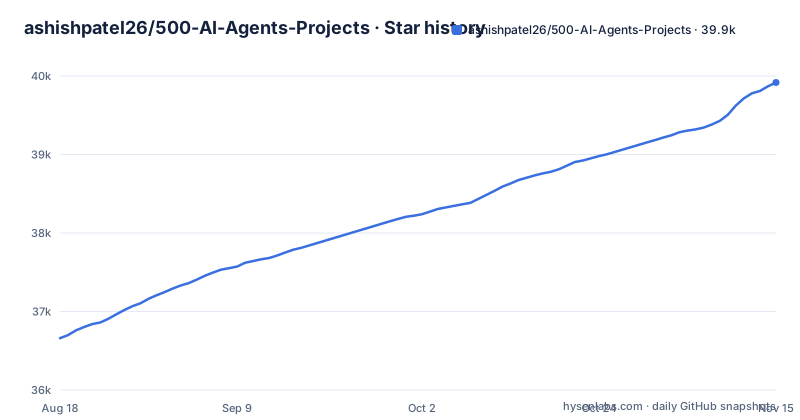
Star history
- ashishpatel26/500-AI-Agents-Projects39,917 ★ · +3,257
| Repository | 2026-08-18 | 2026-11-15 |
|---|---|---|
| ashishpatel26/500-AI-Agents-Projects | 36.7k | 39.9k |
3,257 Stars in the last 89 days, measured from the daily GitHub snapshot. Compare with other projects
Editorial analysis
What This Repository Actually Is
This is not a software product. It is a curated list of more than 500 AI agent projects, each linking to an external open-source repository. The README describes it as a collection of production examples, tutorials, and working code spanning frameworks like LangGraph, CrewAI, AutoGen, and Agno, and industries from healthcare to cybersecurity. The audience is developers building their first agent, researchers surveying the landscape, teams evaluating frameworks, and students learning from real examples. The repository itself contains runnable agents in an agents/ directory, plus a framework comparison table and a list of industry use cases. The value is in the curation and navigation, not in any original runtime.
How the Repository Is Organized
The structure is straightforward. There is an agents/ directory where each subdirectory is self-contained, with its own requirements.txt and .env.example. The README claims you can clone the repo, enter a directory like agents/01-web-research-agent, install dependencies, copy the environment template, and run agent.py. This is a deliberate design choice to avoid a monorepo setup. Beyond that, the README provides a navigation guide with links to framework-wise use cases, industry use cases, and a framework comparison table. There is also a crewai_mcp_course/ directory for learning. The industry use case table is the core content: each row names a use case, an industry, a description, and a link to an external GitHub repository. Examples include a Health Insights Agent, an Automated Trading Bot, and a Real-Time Threat Detection Agent.
Running an Example: The Quick Start Path
The README gives a concrete quick start. You clone the repository, then move into a specific agent directory. The commands are: git clone https://github.com/ashishpatel26/500-AI-Agents-Projects.git, then cd into the repo, then cd agents/01-web-research-agent, pip install -r requirements.txt, cp .env.example .env, and finally python agent.py. This implies that the example agent expects an API key, which you add to the .env file. The README emphasizes that all agents in agents/ are self-contained, so there is no shared dependency setup. The industry use case links are external and may or may not follow the same pattern. You should expect to read each external project's own README before running it.
The Framework Comparison: A Decision Aid, Not a Benchmark
The repository includes a table comparing LangGraph, CrewAI, AutoGen, Agno, and LlamaIndex. It rates complexity with stars and marks support for multi-agent, streaming, and local LLMs. For example, LangGraph is described as best for stateful workflows and RAG pipelines, with three-star complexity and support for all three features. CrewAI is for role-based teams and rapid prototyping, with two-star complexity. Agno is for lightweight single agents with one-star complexity. The table is a quick reference, but it is not a benchmark. There are no performance numbers, no version-specific notes, and no citations. The README also gives a decision guide: start with Agno or CrewAI, use LangGraph for stateful graphs, AutoGen for code-writing or research agents, and LlamaIndex for enterprise document pipelines. This is useful as a starting point, but you should verify the current state of each framework independently.
A Genuine Limitation: The Catalog Is Only as Good as Its Links
The biggest limitation is that the repository is a directory, not a maintained codebase. Each linked project has its own license, its own maintenance status, and its own dependencies. Some links may be dead, some projects may be abandoned, and some may have changed significantly since they were added. The repository itself has no releases and its last push was on 2026-07-27, so check how current the entries are. Another limitation: the industry use case table describes projects in one line, which is not enough to judge whether a project fits your needs. For example, the 'Vibe Hacking Agent' is described as an autonomous multi-agent red team testing service, but you would need to visit the linked repository to learn about its setup, limitations, and whether it is production-ready. The repository is a map, not a guide.
The Wrong Tool for Production Evaluation
If your goal is to evaluate a framework for production, this repository is the wrong tool. The framework comparison table is too coarse. It does not include version numbers, release dates, or community maintenance indicators. It also does not mention licensing or commercial support. For a production decision, you would need to read the official documentation of each framework and run your own benchmarks. The repository is more suitable for exploration and education. It gives you a broad view of what is possible, but it cannot tell you which framework is stable or which has the best performance. The README lists teams evaluating frameworks for production use among its audience, but the comparison table is too coarse to settle that decision.
A Real Alternative: Framework-Specific Documentation and Official Examples
Instead of relying on this catalog, you can go directly to the official documentation of each framework. For example, LangGraph has its own documentation with tutorials and examples. CrewAI has a documentation site with role-based agent examples. AutoGen has a repository with code samples. The difference in approach is that these sources are maintained by the framework authors and are guaranteed to be consistent with the current version. The 500 AI Agents Projects repository is a third-party aggregation that may lag behind. Another alternative is to search GitHub for a specific use case and filter by stars and recent activity, which gives you a more direct signal of quality. The catalog is convenient for a broad survey, but official docs are better for learning a specific framework deeply.
Maintenance and License Considerations
The repository itself is licensed under MIT, according to the metadata. That means the curation, the README, and the quick start examples are free to use and modify. However, each linked project has its own license. You must check each one separately. For example, a project linked under a GPL license would impose different obligations than an MIT one. The repository has no GitHub releases and its last push was on 2026-07-27. A contribution guide (CONTRIBUTION.md) exists. If you plan to use a specific agent from the list, you should verify its last commit date and whether it supports the Python version you use. The quick start example is simple, but the external projects may require additional setup that the catalog does not document.
Editorial conclusion
Adopt this repository if you are a developer, researcher, or student looking for a broad map of AI agent applications and a quick way to run a self-contained example. Do not adopt it if you need a maintained, unified codebase or a framework with consistent APIs, because the projects are independent and vary in quality. Before using any linked project, verify its license, dependencies, and whether it is still maintained, since the repository itself does not vouch for them. Start with the agents/ directory and run one example end to end to gauge the actual state of the code.
Frequently asked questions
What are some good AI agent projects?
That is what this repository is for: a curated collection of 500+ agent projects, use cases and working implementations, sorted by framework across LangGraph, CrewAI, AutoGen, Agno and LlamaIndex, and by industry across healthcare, finance, education, cybersecurity and more. Note that most rows are links to other authors' repositories rather than code included here.
What are some of Ashishpatel26's 500+ AI agent projects?
The industry table names them, including the HIA Health Insights Agent for medical reports, an automated trading bot in finance, a product recommendation agent in retail pointing at microsoft/RecAI, a virtual AI tutor in education, and an agent memory guard in cybersecurity pointing at the OWASP project. Each row links out to the repository that implements it.
What are 7 real-world AI projects I can build in 2026?
The table offers more than seven candidates, among them a smart farming assistant for crop health, an energy demand forecasting agent for grid management, a legal document review assistant, a recruitment recommendation agent, a factory process monitoring agent, a self-driving delivery agent for route optimisation, and a real-time threat detection agent. The repository has no releases, so check each linked repository for its current state.
Official sources
Add this badge to your README
If you maintain this project, the badge below links readers to this analysis and shows its maintenance status from the daily GitHub snapshot. Paste the markdown into your README; add ?metric=license or ?metric=stars to the image URL for a different field.

[](https://hysenlabs.com/projects/ashishpatel26-500-ai-agents-projects)Star history chart for your README
[](https://hysenlabs.com/projects/ashishpatel26-500-ai-agents-projects)Was this useful?