ChenYilong/iOSInterviewQuestions: A Chinese-Language Answer Set for iOS Hiring Loops
iOS interview questions, with answers.
At a glance
- What is it?
- The repository collects reference answers to 55 Objective-C interview questions, a Swift theory and practical track, MVVM and SwiftUI demos, and behavioral interview material. It is a reading resource, not a library you install.
- Who is it for?
- Adopt it if you are preparing for a Chinese-market iOS interview and want worked answers rather than a question list, or if you are an interviewer who needs a starting rubric. Skip it if you need current Swift concurrency coverage or a graded, self-scoring course, because the repository is a set of Markdown documents and demos with no test harness.
- Can I use it commercially?
- Not without permission. GitHub finds no licence file in the repository, and without a licence all rights are reserved by default: you may read the code but not reuse it. Check the README, or ask the authors, before using it.
- Is it still maintained?
- Yes. The repository last received commits 11 days ago.
- What is it written in?
- Mainly Swift, according to GitHub's language statistics.
Answers come from the project's GitHub data, last synced on November 15, 2026, and from our analysis. They are not legal advice.
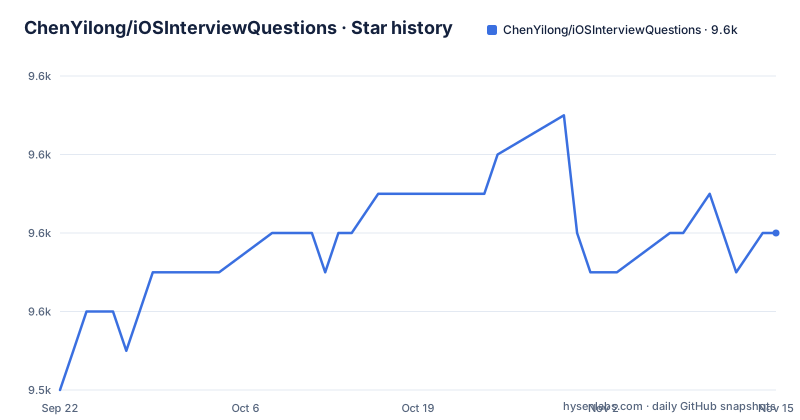
Star history
- ChenYilong/iOSInterviewQuestions9,552 ★ · +4
| Repository | 2026-09-22 | 2026-11-15 |
|---|---|---|
| ChenYilong/iOSInterviewQuestions | 9.5k | 9.6k |
4 Stars in the last 54 days, measured from the daily GitHub snapshot. Compare with other projects
Editorial analysis
What the repository actually contains
This is a study repository, not a package. The README links to two Objective-C answer documents under the directory 01《招聘一个靠谱的iOS》面试题参考答案, and to a Swift track split into 理论篇 (theory) and 实战篇 (practical) under 02_Swift_interview_questions. Alongside those it points to a coding challenge area with a Swift MVVM demo, a SwiftUI demo, and a technical design document demo, plus a behavioral interview section organized into self-introduction, subjective, and software engineering question files. A separate file covers software development terminology. The question set itself, according to the README, comes from a 2015 blog post by the Weibo account @我就叫Sunny怎么了 titled 《招聘一个靠谱的 iOS》: 55 questions, of which the first is an error-correction question and the other 54 are short-answer. The repository author wrote the answers that the original post left out. That provenance matters, because it dates the question set to a specific moment in iOS hiring.
Who benefits from a 55-question answer set
The audience is narrow and identifiable. First, candidates interviewing for iOS roles in the Chinese market, where this particular question list has circulated widely and where interviewers may still draw from it. Second, interviewers who want a worked reference answer to compare a candidate's response against, rather than a bare question. Third, engineers who learned iOS on the job and want a structured way to fill gaps in Objective-C fundamentals, since the answer documents are where most of the depth sits. The repository is less useful for someone preparing for a Western-style system design loop, because the README does not describe a system design track. It is also a poor fit for a beginner who wants a curriculum, since the questions assume working knowledge and the answers explain rather than teach from zero.
How the material is organized and how you read it
There is no build step and no runtime. The data flow is: question source (the external blog post) to two answer documents for the Objective-C set, and a parallel Swift track written directly in this repository. The Swift track is the one the repository lists as its primary language, and the README splits it into a theory file covering Swift and Objective-C language basics and a practical file covering iOS project development skills. The coding challenge area is separate again, holding a Swift MVVM demo, a SwiftUI demo, and a technical design document demo. Behavioral material is compartmentalized into three files by question type. The practical consequence is that you navigate by topic, not by difficulty or by role level, and nothing in the README describes an ordering, a progress tracker, or a difficulty rating. You decide the order.
Getting the files and doing a first pass
There is no install, because there is nothing to install. The README gives no package name, no version, and no supported platform beyond iOS itself. The way to use it is to clone the repository and read the Markdown files directly. The command below is the standard clone for this repository on its default branch, master; the README does not document any other distribution channel.
git clone https://github.com/ChenYilong/iOSInterviewQuestions.git
cd iOSInterviewQuestions
ls
After the clone you should see the top-level entries the repository lists: the answer directory, 02_Swift_interview_questions, Behavioral_based_interviewing_Competency_Based, Other, Swift, SwiftUI, assets, and the README. The Swift track lives in plain files, so you can read them with any editor or render them in a Markdown viewer.
The Swift theory and practical split
Splitting the Swift material into theory and practical is the most useful structural decision in the repository. Theory covers Swift and Objective-C language basics. The practical file covers iOS project development skills. Reading only one half produces a lopsided preparation: a candidate who can recite language semantics but cannot describe how a view controller's lifecycle interacts with a network call will still struggle in a real loop. The two files are meant to be read together, and the README presents them as a pair under the same Swift section.
Where this resource stops being enough
The clearest limitation is age and scope. The Objective-C question set traces to a 2015 blog post, and the README does not claim the answers have been rewritten for later Swift versions. The Swift track is written in this repository, but the README does not list a Swift version, and the .swift-version file at the top level is the only version signal in the repository layout. There is no mention of Swift concurrency, actors, or async/await anywhere in the README, so a candidate facing a modern loop should not treat this as complete coverage. The second limitation is that this is a reading resource with no feedback loop: no tests, no expected outputs for the demos, and no scoring. The MVVM and SwiftUI demos are reference implementations you read, not exercises you complete and have checked. If you want graded practice or an automated judge, this is the wrong tool.
How it differs from a question-bank site
The obvious alternative is a community question-and-answer site where candidates post the questions they were actually asked, such as the interview threads that circulate on Reddit. The difference in approach is fundamental. A community site gives you recency and volume: questions from loops that ran last month, with the caveat that any individual report is one person's recollection and the answers in the comments are unvetted. This repository gives you the opposite trade: a fixed, small set of 55 questions with answers the author wrote and stands behind, at the cost of currency. Neither is a substitute for the other. Use the repository when you want a worked answer you can study and argue with; use community threads when you want to know what is being asked right now. The repository's behavioral section, organized by question type rather than by company, follows the same philosophy: structure over recency.
Maintenance, licensing, and what to check
The repository is not archived, and the last push was on 2026-09-20, so it is being touched. That said, a recent push does not tell you which files changed, and the README does not carry a changelog or release notes; the repository has no published GitHub releases. Treat the push date as evidence of activity, not of content updates. On licensing, the README's footer states 自由转载-非商用-非衍生-保持署名 and links to Creative Commons BY-NC-ND 3.0. That is a non-commercial, no-derivatives licence, which is unusual for a code repository and worth reading carefully before you copy the answer text into internal training material or a paid product; the repository's LICENSE file is not present in the top-level listing, so the README footer is the only licence statement available. This is a description of what the repository says, not legal advice.
Editorial conclusion
Adopt it if you are preparing for a Chinese-market iOS interview and want worked answers rather than a question list, or if you are an interviewer who needs a starting rubric. Skip it if you need current Swift concurrency coverage or a graded, self-scoring course, because the repository is a set of Markdown documents and demos with no test harness. Before relying on any answer, open the two Objective-C answer files and the Swift theory and practical files, and check whether the topic you are being asked about appears there at all.
Frequently asked questions
How can I prepare for an iOS interview using ChenYilong/iOSInterviewQuestions?
Clone the repository and read the two Objective-C answer documents together with the Swift theory and practical files, then read the MVVM and SwiftUI demos to see the concepts applied. The README presents these as separate tracks, so you choose the order yourself.
Does ChenYilong/iOSInterviewQuestions cover Swift as well as Objective-C?
Yes. The README lists an Objective-C question set with two answer documents and a separate Swift track split into a theory file on Swift and Objective-C language basics and a practical file on iOS project development skills.
How many questions are in the ChenYilong/iOSInterviewQuestions Objective-C set?
The README states the set contains 55 questions, of which the first is an error-correction question and the remaining 54 are short-answer questions. The answers were written by the repository author because the original blog post did not include them.
Is ChenYilong/iOSInterviewQuestions free to reuse?
The README footer states 自由转载-非商用-非衍生-保持署名 and links to Creative Commons BY-NC-ND 3.0, which permits non-commercial sharing with attribution but not derivatives. No LICENSE file appears in the top-level repository listing.
Can I install ChenYilong/iOSInterviewQuestions as a package?
No. It is a collection of Markdown documents and demo projects, and the README gives no package name, version, or installation step. You clone the repository and read the files.
Official sources
Add this badge to your README
If you maintain this project, the badge below links readers to this analysis and shows its maintenance status from the daily GitHub snapshot. Paste the markdown into your README; add ?metric=license or ?metric=stars to the image URL for a different field.

[](https://hysenlabs.com/projects/chenyilong-iosinterviewquestions)Star history chart for your README
[](https://hysenlabs.com/projects/chenyilong-iosinterviewquestions)Was this useful?