CodeTriage for finding open source issues worth reviewing
Discover the best way to get started contributing to Open Source projects
At a glance
- What is it?
- CodeTriage is a Ruby and Rails service that helps non-maintainers contribute by sending repository subscribers open issues to diagnose and discuss. Its workflow centers on useful issue triage rather than adding context-free reactions.
- Who is it for?
- Developers who want a guided way to examine bugs, proposed fixes, and pull requests should consider CodeTriage, while people seeking dependency management or an issue tracker should choose another project. Before adopting it for a repository, verify that maintainers welcome reproduction reports, code review, and explanatory comments, and read CONTRIBUTING.md to understand the local setup.
- Can I use it commercially?
- Yes. MIT is a permissive licence: you can use, modify and sell software built on it, as long as you keep its copyright and licence notices.
- Is it still maintained?
- Yes. The repository last received commits 37 days ago.
- What is it written in?
- Mainly Ruby, according to GitHub's language statistics.
Answers come from the project's GitHub data, last synced on November 7, 2026, and from our analysis. They are not legal advice.
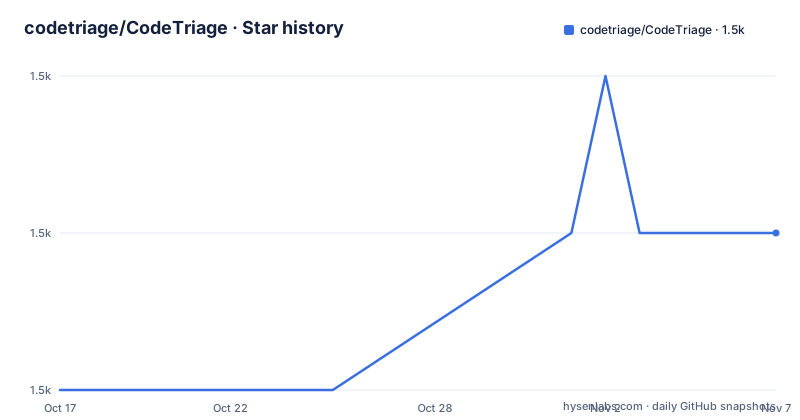
Star history
- codetriage/CodeTriage1,472 ★ · +1
| Repository | 2026-10-17 | 2026-11-07 |
|---|---|---|
| codetriage/CodeTriage | 1.5k | 1.5k |
1 Stars in the last 21 days, measured from the daily GitHub snapshot. Compare with other projects
Editorial analysis
CodeTriage's role in open source issue review
CodeTriage addresses a specific contributor problem: finding an appropriate open source task without having to monitor repository activity continuously. Open source maintainers must assess incoming issues, proposed fixes, and contributions, while newcomers may not know where useful work begins. CodeTriage connects those two needs by assigning subscribers an open issue and asking them to investigate it.
The intended audience is clear from the README: contributors who do not maintain the repository but still want to help. A useful contribution may involve reproducing a reported bug, reviewing code included in an issue, checking whether a change has a clear use case, and considering whether it follows the project's style without breaking its tests. The project also allows contributors to review pull requests.
This is narrower than GitHub's general contribution flow. CodeTriage does not present itself as a place to run arbitrary automation against a repository or as a tool for finding paid work. Its purpose is triage. In the project's analogy, a triage nurse assigns a patient to the doctor best suited to treat the case. CodeTriage applies that model to issues so maintainers can spend their limited review time on work that has already received some examination.
The central judgment is worth stating plainly. A context-free "+1" adds little value, according to the README. A reproduction result, an explanation that supports a proposed fix, or a reasoned objection can help a maintainer decide what to do. CodeTriage is most useful when its community follows that standard rather than treating issue assignment as a reaction counter.
Sidekiq issue collection and daily assignment
CodeTriage operates as a hosted web service at codetriage.com. The documented user flow begins with creating an account and following a repository. Once a day, the service emails the subscriber one open issue from that repository, along with instructions for performing a useful triage task.
The background architecture uses Sidekiq in two stages. According to the README, a background job retrieves issues through GitHub's API. A second background task assigns one issue each day to a user subscribed to that repository. That separation matches the two responsibilities in the system: acquiring issue data and distributing review work.
The repository layout is consistent with a Ruby on Rails application. It includes an `app/` directory, a `config.ru` Rack entry point, database files under `db/`, Rails configuration under `config/`, tests under `test/`, dependency declarations in `Gemfile` and `Gemfile.lock`, and deployment-related files including `Procfile` and `heroku.yml`. A JavaScript `package.json` is present but contains an empty object, so there is no documented Node package workflow to follow from that file.
The README does not document issue selection criteria, retry behavior, rate-limit handling, account recovery, or what happens when several subscribed users receive work from the same repository. Those omissions matter to anyone considering self-hosting or depending on the service for a predictable review queue. The documented mechanism is periodic assignment, not immediate assignment or an explicit acknowledgment that assignment reserves an issue.
A useful first CodeTriage review
There is no installation or first-use command in the README. It directs contributors to `CONTRIBUTING.md` for both contribution guidance and instructions for running CodeTriage locally. Because that file is not quoted in the repository README, this review cannot reproduce setup commands or configuration without inventing details.
For the hosted service, the documented first step is to sign up and follow a repository. The next documented event is a daily email containing one open issue and triage instructions. No specific URL for registration, email frequency time zone, repository search command, or notification preference appears in the README, so those details should not be inferred.
A contributor receiving an issue can use the repository's own instructions to structure the work. For a bug, try to reproduce it and record the result in the issue comments. If the issue contains code, check whether the solution has a clear use case, follows the project's style, and avoids failures in the test system. Reviewers should explain why a contribution appears useful rather than leaving only a reaction. If they object, the README also asks for an explanation.
The first-use tutorial therefore ends with a repository-specific action rather than a project command: read the assigned issue, inspect any linked code or report, and post a comment that gives the maintainer evidence or reasoning. Whether the repository permits unsolicited diagnosis or code review remains a matter of its contribution policy.
Triage quality depends on maintainer expectations
CodeTriage's main limitation is visible in its workflow. A daily assignment can surface an issue, but it cannot guarantee that the issue is reproducible, sufficiently documented, suitable for outside contributors, or wanted by the maintainer. Contributors may spend time investigating a stale report or a proposal that conflicts with the project's direction.
There is also a communication risk. The README explicitly says that a bare "+1" does not help maintainers much. That criticism applies not only to outside contributors but also to the service's participation model. If users treat the email as a daily voting prompt, CodeTriage can generate low-information comments and additional review work for maintainers. The value depends on evidence, clear reasoning, and respect for project conventions.
CodeTriage is the wrong tool for someone who wants executable security findings from a static analyzer, automated bulk issue processing, or a complete bug-tracking system. It does not promise vulnerability detection, issue creation, dependency upgrades, or pull request automation. Its documented contribution categories are diagnosis, review, reproduction, and discussion.
It is also not a substitute for reading a project's `CONTRIBUTING.md`, issue template, or maintainer instructions. The top-level repository includes `CODE_OF_CONDUCT.md`, `SECURITY.md`, `PULL_REQUEST_TEMPLATE.md`, and `CONTRIBUTING.md`, but the README does not explain how CodeTriage enforces them. Adopters should treat those repository files as governing the quality of a submitted review.
CodeTriage compared with direct repository triage
CodeTriage differs from contributing directly through a repository's own issue tracker by adding a subscription and periodic assignment layer. A direct workflow leaves the contributor to search GitHub, select an issue, and decide whether to comment. CodeTriage sends an issue by email once a day and instructs the subscriber on how to investigate it.
That difference can reduce the discovery burden for newcomers. It also changes the contributor's role. Instead of choosing among all open issues, the subscriber receives a specific review target. The intended result is a smaller, distributed pool of preliminary issue analysis for maintainers.
Direct triage has advantages that CodeTriage's documentation does not remove. Contributors can follow a project's existing labels, assignments, discussions, and contribution rules without an intermediary. They can also select work that matches their language expertise or reproduce an issue immediately. CodeTriage is therefore more useful as a guided entry point than as a complete substitute for understanding the target repository.
The service is a better fit for developers who can inspect and explain issues, and for maintainers willing to accept carefully reasoned contributions. It is less suitable for automation operators who want a bulk issue-fetching interface or for repositories that require narrowly assigned work under an existing governance process.
Deployment files, maintenance, and the MIT license
Based on the repository layout, CodeTriage is a conventional Rails application with a Rack entry point, test directory, database configuration, and deployment descriptors. The presence of `Procfile`, `Procfile.concurrency`, `Procfile.development`, `heroku.yml`, and `app.json` indicates deployment-related configuration, although the README does not describe their settings or provide hosting instructions.
The repository is not archived. Its last push was on 2026-10-01, but it has no GitHub releases. The README does not define a release cadence or upgrade policy. Consequently, maintenance can be described only from the repository status and push date, not as a claim about guaranteed support or a predictable publishing schedule.
CodeTriage uses the MIT License. The README includes the copyright notice for Schneems, while `LICENSE.txt` is listed as the repository's license file. The MIT license permits use, modification, distribution, and inclusion in other projects under its conditions, subject to its notice requirements. This is a statement about the declared license, not legal advice. Anyone redistributing a modified copy should inspect `LICENSE.txt` and retain the required notice.
Because the README contains no releases or upgrade notes, maintenance cost for a fork cannot be estimated. The relevant technical boundary for a fork owner is the Ruby dependency set declared by `Gemfile.lock`, but the individual dependency versions and upgrade procedure are not reproduced in the README.
Editorial conclusion
Developers who want a guided way to examine bugs, proposed fixes, and pull requests should consider CodeTriage, while people seeking dependency management or an issue tracker should choose another project. Before adopting it for a repository, verify that maintainers welcome reproduction reports, code review, and explanatory comments, and read CONTRIBUTING.md to understand the local setup.
Frequently asked questions
What is CodeTriage used for?
CodeTriage helps non-maintainers contribute to open source projects by assigning them open issues to investigate and discuss. The goal is to give maintainers useful information about bug reports, proposed fixes, and pull requests.
How does CodeTriage assign issues?
After a user follows a repository, the service sends an email once a day with one open issue and triage instructions. Sidekiq retrieves issues from GitHub's API, and another background task assigns them to subscribed users.
How do I install and run CodeTriage locally?
The README directs contributors to `CONTRIBUTING.md` for local development and contribution instructions. The README itself does not include installation commands or configuration steps for running the application locally.
Does CodeTriage replace a project's issue tracker?
No. The documented service sends issue assignments and triage instructions, but it does not claim to provide complete issue tracking, automatic triage, or repository-specific contribution governance. Contributors still need to follow the target project's own instructions.
Official sources
Add this badge to your README
If you maintain this project, the badge below links readers to this analysis and shows its maintenance status from the daily GitHub snapshot. Paste the markdown into your README; add ?metric=license or ?metric=stars to the image URL for a different field.

[](https://hysenlabs.com/projects/codetriage-codetriage)Star history chart for your README
[](https://hysenlabs.com/projects/codetriage-codetriage)Was this useful?