Marketing Skills for AI Agents: A Structured Skill Library for Claude Code and Beyond
Marketing skills for Claude Code and AI agents. CRO, copywriting, SEO, analytics, and growth engineering.
At a glance
- What is it?
- Marketing Skills is a free, MIT-licensed collection of markdown-based skills that give AI coding agents specialized workflows for CRO, copywriting, SEO, analytics, and growth. It targets technical marketers and founders who want their coding agents to execute marketing tasks with consistent frameworks.
- Who is it for?
- Adopt Marketing Skills if you are a technical marketer or founder using Claude Code, OpenAI Codex, Cursor, or Windsurf and you want a structured, dependency-aware set of marketing workflows that your agent can pull in automatically. Do not adopt it if you expect a plug-and-play tool with zero setup or if you need a solution that works with agents that do not follow the Agent Skills spec.
- Can I use it commercially?
- Yes. MIT is a permissive licence: you can use, modify and sell software built on it, as long as you keep its copyright and licence notices.
- Is it still maintained?
- Yes. The repository last received commits 2 days ago.
- What is it written in?
- Mainly JavaScript, according to GitHub's language statistics.
Answers come from the project's GitHub data, last synced on November 13, 2026, and from our analysis. They are not legal advice.
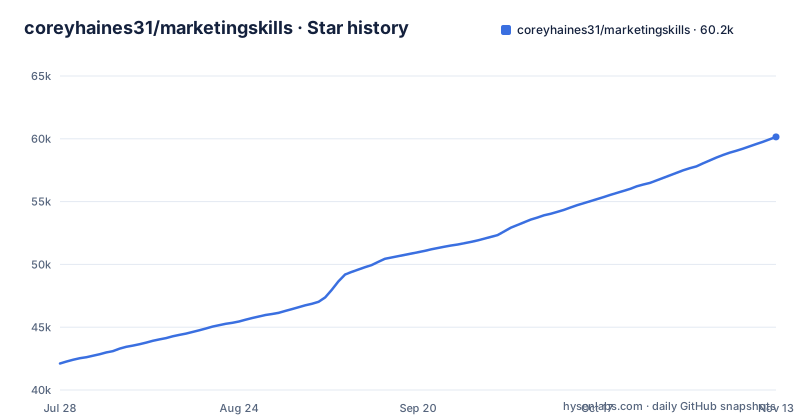
Star history
- coreyhaines31/marketingskills60,151 ★ · +18,041
| Repository | 2026-07-28 | 2026-11-13 |
|---|---|---|
| coreyhaines31/marketingskills | 42.1k | 60.2k |
18,041 Stars in the last 108 days, measured from the daily GitHub snapshot. Compare with other projects
Editorial analysis
What Problem This Solves and Who It Is For
Marketing Skills addresses a specific gap: coding agents like Claude Code are good at writing code, but they lack marketing judgment. Without guidance, they produce generic copy, run A/B tests without a hypothesis, or skip attribution entirely. This repository packages marketing knowledge into markdown files that agents can read and follow, turning a coding tool into something closer to a marketing assistant. The intended user is a technical marketer or a founder who already works in a terminal and wants the agent to handle conversion optimization, copywriting, SEO, analytics, and growth engineering. It is not for marketers who avoid the command line; the README points to a separate guide, Coding for Marketers, for newcomers, which signals that some comfort with coding agents is assumed. The description says it works with Claude Code, OpenAI Codex, Cursor, Windsurf, and any agent that supports the Agent Skills spec, so the audience is narrow but specific.
How the Skills Work Together
The mechanism is a set of markdown files, each defining a skill. The README explains that skills reference each other and build on shared context. The key design is the product-marketing skill, which is the foundation. Every other skill checks it first to understand your product, audience, and positioning before doing anything. The dependency map shows a tree: product-marketing sits at the top, and below it sit the other skills. This means the agent does not start from zero on a task like writing a landing page; it first loads the product context and then applies the copywriting or CRO skill. The README's skills table covers areas from ab-testing and cold email to competitor profiling. The skill descriptions start with trigger conditions, such as "When the user wants to plan, design, or implement an A/B test," which tells the agent when to activate the skill. This is a structured approach: the agent recognizes the task, reads the relevant skill, and follows the workflow inside it.
Getting It Running: Commands and Configuration
The README says skills are markdown files that you add to your project, and then your agent can recognize when you are working on a marketing task. There is one concrete command in the repo: after editing partners.json, you run node scripts/sync-partners.mjs to regenerate the Partners block. For a user, the practical step is to ensure your agent supports the spec, then add the skills folder. The README also mentions tools/REGISTRY.md and tools/PARTNERS.md, which define verified partners and boundaries, so you should read those to see what tools the skills may recommend.
The Partner Model: Funding Without Bias
The library is free and MIT-licensed, and funding comes from Verified Partners. The README says partners are vetted, disclosed tool integrations, listed alongside neutral options and never influencing what the core skills recommend. The full rules are in tools/PARTNERS.md. As of the README, four partners are listed in the generated Partners block: Converly (conversion tracking and attribution), Ploy (an AI website and growth platform), AIsa (SEO, search and social data) and Omnia (AI search visibility). This is an honest disclosure of a common open-source dilemma: how to fund maintenance without corrupting recommendations. The design is to separate partner listings from the core skill content, so a partner cannot change what a skill says. The sync script keeps the Partners block in sync with partners.json, which is a clean way to manage that. Because partners fund the work and are listed in the README, read tools/REGISTRY.md to see the neutral options listed alongside them before following a tool recommendation.
What the Skills Actually Cover
The skill list is broad but not infinite. It includes ab-testing, ad-creative, ads, ai-seo, analytics, aso, attribution, churn-prevention, co-marketing, cold-email, community-marketing, competitor-profiling, competitors, content-strategy, copy-editing, copywriting, cro, customer-research, directory-submissions, emails, events, and free-tools. The descriptions are trigger-based, so each skill knows when to activate. For example, the cold-email skill is described as writing and running B2B cold outbound that gets replies, from cold emails and follow-ups to sending setup. The ai-seo skill handles optimizing for AI search engines and getting cited by LLMs. This coverage is practical for a growth-focused marketer.
Limitations and Failure Modes
The biggest limitation is that the skills are only as good as the context you provide. The product-marketing skill is the foundation, and every other skill checks it first. If you do not fill in your product, audience, and positioning, the agent will work with incomplete information, and the output will be generic. Another failure mode is the dependency on the Agent Skills spec. If your agent does not support the spec, the skills will not activate automatically, and you would have to manually prompt the agent to read each file, which defeats the purpose. The partner model is disclosed in the README, which lists four partners that fund the work. The last push is dated 2026-10-31, with recent releases, so the project is active, but that is not a guarantee. Finally, the skills are marketing frameworks, not guarantees. They give a workflow, but the actual results depend on your execution and your market.
Alternatives and How They Differ
The main alternative is to use a general-purpose agent with your own prompts or a custom knowledge base. Instead of a predefined skill library, you could write your own markdown files or use a system prompt that instructs the agent on marketing best practices. The difference is that Marketing Skills provides a curated, dependency-aware structure with a foundation skill, whereas a custom setup requires you to design that structure yourself. The Agent Skills spec itself is a broader ecosystem; you could adopt skills from other authors or build your own, which gives you flexibility but more work. The key difference is that this repo offers a ready-made, tested set of skills with a clear dependency map, which saves you the initial design effort. The trade-off is that you inherit the author's opinions on marketing workflows, which may not match your own.
Maintenance, Upgrade Cost, and License
The license is MIT, which means you can use, modify, and redistribute the skills freely, even commercially, with attribution. That is a permissive license, so there is no legal barrier to adoption. The maintenance cost is low in terms of license, but the real cost is keeping the skills updated. The repository has regular releases, with v2.14.0 adding the reverse-engineer-marketing skill, v2.13.10 moving ai-seo from 2.11.0 to 2.12.0 and v2.13.9 moving prospecting from 1.4.0 to 1.5.0. If you fork the repo, you will need to merge upstream changes to get those improvements, which is a standard open-source cost. The README invites contributions and says to open a PR, so the community can help. The sync script for partners is a small maintenance point, but it only matters if you edit partners.json. For a user, the upgrade path is to pull the latest version of the skills into your project, which is simple if you use a submodule or a script. Overall, the license is favorable, but the ongoing effort is on you.
Editorial conclusion
Adopt Marketing Skills if you are a technical marketer or founder using Claude Code, OpenAI Codex, Cursor, or Windsurf and you want a structured, dependency-aware set of marketing workflows that your agent can pull in automatically. Do not adopt it if you expect a plug-and-play tool with zero setup or if you need a solution that works with agents that do not follow the Agent Skills spec. Before adopting, verify that your agent supports the spec, check the product-marketing skill to understand the required context, and review the tools/REGISTRY.md to see the neutral options and any verified partners, since the README now lists four partners (Converly, Ploy, AIsa and Omnia) that fund the work. The library is free and permissively licensed, but the real cost is the time to craft your product-marketing foundation and to keep skills updated as the repository evolves.
Frequently asked questions
What do you mean by marketing skills in this repository?
They are markdown files that give an AI agent specialised knowledge and workflows for marketing tasks. Adding them to your project lets the agent recognise when a marketing task is in play and apply the frameworks, with product-marketing read first as the shared context for product, audience and positioning.
How do I use marketing skills in Claude?
The skills work with Claude Code and with any agent supporting the Agent Skills spec, and a .claude-plugin/ directory at the repository root is what lets the collection load as a plugin. Each skill activates on the wording of your request, so asking for a specific task such as an A/B test, an attribution model or a competitor profile is what loads the right file.
How do I install the marketing skills by Corey Haines?
The repository is coreyhaines31/marketingskills and the skills are markdown files you add to your project. The page links the Agent Skills spec for the format, names Claude Code, OpenAI Codex, Cursor and Windsurf as working agents, and points newcomers who are unfamiliar with the terminal to a companion guide called Coding for Marketers.
What is marketingskills used for?
It is a collection of marketing task skills for coding agents, covering conversion rate optimisation, copywriting, SEO, analytics and growth engineering. Named skills include cro, copywriting, copy-editing, content-strategy, analytics, attribution, ab-testing, ads, aso, cold-email and ai-seo, which targets being cited by language models.
Official sources
Add this badge to your README
If you maintain this project, the badge below links readers to this analysis and shows its maintenance status from the daily GitHub snapshot. Paste the markdown into your README; add ?metric=license or ?metric=stars to the image URL for a different field.

[](https://hysenlabs.com/projects/coreyhaines31-marketingskills)Star history chart for your README
[](https://hysenlabs.com/projects/coreyhaines31-marketingskills)Was this useful?