Notcurses: a character graphics library that is not a drop-in ncurses replacement
blingful character graphics/TUI library. definitely not curses.
At a glance
- What is it?
- Notcurses builds complex TUIs on modern terminal emulators with 24-bit color, images and video, and threads. It is not source-compatible with X/Open Curses, so the decision is about which terminals you can target.
- Who is it for?
- Adopt Notcurses when your audience runs modern terminal emulators and you want images, video, sprites or 24-bit color without writing escape sequences by hand. Do not adopt it as a drop-in for existing Curses code, and do not adopt it for industrial or retail terminals where Curses portability is the point.
- Can I use it commercially?
- Check first. The repository uses a licence we do not classify automatically, so read its LICENSE file before any commercial use.
- Is it still maintained?
- Yes. The repository last received commits 5 days ago.
- What is it written in?
- Mainly C, according to GitHub's language statistics.
Answers come from the project's GitHub data, last synced on November 15, 2026, and from our analysis. They are not legal advice.
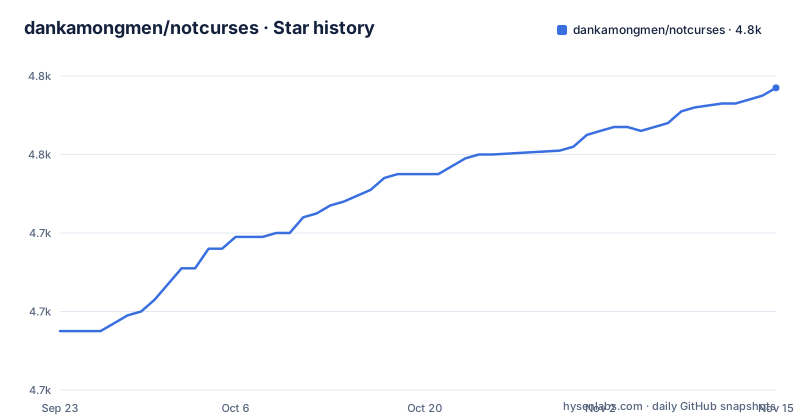
Star history
- dankamongmen/notcurses4,777 ★ · +62
| Repository | 2026-09-23 | 2026-11-15 |
|---|---|---|
| dankamongmen/notcurses | 4.7k | 4.8k |
62 Stars in the last 53 days, measured from the daily GitHub snapshot. Compare with other projects
Editorial analysis
The problem Notcurses solves, and who it is for
Curses was designed for a world of serial terminals and a minimum common denominator. The README puts the trade-off plainly: Curses assumes the minimum and lets you step up with effort, while Notcurses assumes the maximum and steps down by itself when necessary. That inversion is the whole product. If you are writing a full-screen application for a modern terminal emulator, you get images, fonts, video, sprites, transparent regions and 24-bit color through one API instead of hand-rolled escape sequences. If you are writing for industrial or retail terminals, the README says to use NCURSES instead, and it means it. The library is Apache2-licensed in its entirety, which the README contrasts with the NCURSES licence history, summarized there as a restatement of MIT-X11. The audience is C and C++ developers, plus users of the Python and Rust bindings that the repository advertises through PyPI and crates.io badges.
TUI mode and CLI mode: two different output models
Notcurses exposes two modes, and they are not cosmetic. TUI mode is for high-performance, non-scrolling, full-screen applications: the library owns the screen and redraws it. CLI mode supports scrolling output for shell utilities while still giving you the rest of the API. Choosing wrong is a design error rather than a tuning problem, because a scrolling utility and a full-screen application have different expectations about who controls the cursor and when the screen is cleared. The library is thread-safe by design, and the README lists thread safety as a consideration from the beginning rather than a later addition. Internally, the nccell API is built around Unicode's Extended Grapheme Cluster concept, so a cell is not a byte and not necessarily a single code point. All APIs natively support the Universal Character Set, and 24-bit color is quantized down as needed for the terminal in use. Where it can, Notcurses uses the Terminfo library shipped with NCURSES, which is the pragmatic part of the design: the portability work NCURSES did is reused rather than replaced.
Building Notcurses and running the demo
The repository ships INSTALL.md and a CMakeLists.txt at the top level. The README states the build requirements directly: CMake 3.21.0+ and a C17 compiler, plus terminfo 6.1+ and GNU libunistring 0.9.10+ at build and runtime. Multimedia is optional, and the README notes the library can be built without it, requiring a significantly lesser set of dependencies. A typical out-of-source build looks like this.
mkdir build && cd build
cmake ..
make
The README points to INSTALL.md for more information on building and installation. Once built, the fastest way to see what the library does is the demo binary, which the README says covers most of the functionality of Notcurses.
notcurses-demoExpect a full-screen program, not scrolling text. The repository also includes a TERMINALS.md file. Small example programs live in src/poc/ for C and src/pocpp/ for C++.
Notcurses vs ncurses: what actually differs
The README is explicit that Notcurses abandons the X/Open Curses API bundled in the Single UNIX Specification and is not a drop-in Curses replacement. Exported identifiers are prefixed to avoid namespace collisions, and where reasonable the library uses static inline header-only code, which helps compiler optimization and loader time. The visual feature list is where the gap is widest: images, fonts, video, high-contrast text, sprites and transparent regions, with bitmapped graphics through Sixel, Kitty, and even the Linux framebuffer console. NCURSES can reach some of this, but the README's position is that it was not designed for it. The other difference is the licence: Notcurses is Apache2 in its entirety. The keyboard side matters too. Notcurses supports unambiguous keyboard protocols, which is the kind of thing that only becomes visible when you try to distinguish modified keys in a real application. None of this is free. Abandoning the standard API means existing Curses code does not compile against it, and every capability you use narrows the set of terminals that can display your program correctly.
Where Notcurses is the wrong tool
The README answers this itself, which is unusual and worth taking at face value: if you are targeting industrial or critical applications, or want time-tested reliability and portability, use NCURSES. The design that makes images and video possible is the same design that breaks on older hardware. Notcurses assumes the maximum and steps down, so on a terminal that supports none of the advanced features you are carrying a dependency on terminfo, libunistring and possibly FFmpeg or OpenImageIO for output that could have been produced with far less. The optional dependency list is long: libgpm, libqrcodegen, libswscale, libavformat, libavutil, libavdevice, and OpenImageIO, the last of which requires a C++ compiler. Docker users are warned in the README to consult the environment notes before running Notcurses applications. If your program must run identically on whatever terminal a customer happens to have, this is the wrong library, and the README says so before you find out the hard way.
The real alternative, and the difference in approach
NCURSES is the alternative, and the difference is not a feature checklist. NCURSES implements the standardized Curses API and targets the widest possible range of terminals, including the industrial and retail hardware the Notcurses README concedes. Its approach is to assume the minimum and let the application opt into more, which is why software built on it tends to look conservative. Notcurses inverts that: it assumes a capable emulator and degrades by itself, which is why it can render images and video at all. The practical consequence is a migration cost. Moving an existing NCURSES program to Notcurses is a rewrite of the drawing layer, not a header swap, because the API is deliberately different and the identifiers are prefixed. If you are starting fresh on modern terminals, the rewrite never happens. If you already have working Curses code, the question is whether the visual features justify replacing it.
Maintenance, licence and the cost of upgrading
The repository is not archived, and the last push was on 2026-05-18. The most recent release listed is v3.0.17 from 2025-10-28, preceded by v3.0.16 on 2025-05-04 and v3.0.15 on 2025-04-30. The release names are informal, which tells you something about the project's tone but nothing about its API stability. Pinning a release and reading NEWS.md before upgrading is a sensible approach. On licensing: the README states the project is Apache2-licensed in its entirety and contrasts that with the NCURSES licence, which it summarizes as a restatement of MIT-X11. Apache2 includes an explicit patent grant, which some organizations prefer, but this is a difference in licence text and not legal advice. Anyone with compliance requirements should read COPYRIGHT in the repository and the full Apache2 text rather than relying on a summary. The upgrade cost also includes the optional dependencies: if you build with multimedia, an FFmpeg or OpenImageIO version bump is part of your maintenance surface, not just Notcurses itself.
Editorial conclusion
Adopt Notcurses when your audience runs modern terminal emulators and you want images, video, sprites or 24-bit color without writing escape sequences by hand. Do not adopt it as a drop-in for existing Curses code, and do not adopt it for industrial or retail terminals where Curses portability is the point. Before committing, verify that the terminals you actually ship to appear in TERMINALS.md with the features you need, and confirm that your build can satisfy terminfo 6.1+ and libunistring 0.9.10+.
Frequently asked questions
Is Notcurses a drop-in replacement for ncurses?
No. The README states that Notcurses abandons the X/Open Curses API and is not a drop-in Curses replacement, and that it is not a replacement for NCURSES on existing systems.
What is the difference between Notcurses and ncurses in approach?
Curses assumes the minimum terminal capability and lets the application step up, while Notcurses assumes the maximum and steps down by itself when necessary. That is why Notcurses can offer images, video, sprites and 24-bit color, and why it may break on older hardware.
How do I see what Notcurses can do before writing code?
The README says the notcurses-demo binary covers most of the functionality of Notcurses, and that small example programs are in src/poc/ for C and src/pocpp/ for C++.
What does Notcurses need to build?
CMake 3.21.0+ and a C17 compiler, plus terminfo 6.1+ and GNU libunistring 0.9.10+ at build and runtime. Multimedia support is optional and can be left out to reduce the dependency set.
Does Notcurses work in a Docker container?
The README tells anyone running Notcurses applications in a Docker to consult the environment notes section before doing so. It does not state that containers are unsupported.
Official sources
Add this badge to your README
If you maintain this project, the badge below links readers to this analysis and shows its maintenance status from the daily GitHub snapshot. Paste the markdown into your README; add ?metric=license or ?metric=stars to the image URL for a different field.

[](https://hysenlabs.com/projects/dankamongmen-notcurses)Star history chart for your README
[](https://hysenlabs.com/projects/dankamongmen-notcurses)Was this useful?