DART 7: A research physics engine caught between a redesign and a stable release
Research-focused C++23 physics engine for robotics, animation, and machine learning, with Python bindings.
At a glance
- What is it?
- DART 7 on the main branch is a C++23 and Python physics engine for robotics and animation, but it is explicitly not production-ready. This review covers what the new API offers, how to run it, and why most users should stay on DART 6 LTS.
- Who is it for?
- Adopt DART 7 only if you are a researcher or developer who needs the new Python-first API, can build from source with pixi, and is comfortable with a moving target. Do not use it for production robotics or simulation work; the README itself warns it is not recommended for production.
- Can I use it commercially?
- Yes. BSD-2-Clause is a permissive licence: you can use, modify and sell software built on it, as long as you keep its copyright and licence notices.
- Is it still maintained?
- Yes. The repository received new commits within the last day.
- What is it written in?
- Mainly C++, according to GitHub's language statistics.
Answers come from the project's GitHub data, last synced on November 15, 2026, and from our analysis. They are not legal advice.
Star history
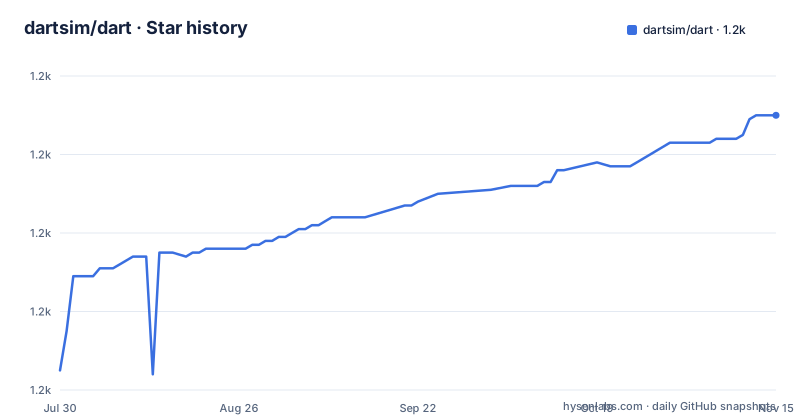
- dartsim/dart1,230 ★ · +65
| Repository | 2026-07-30 | 2026-11-15 |
|---|---|---|
| dartsim/dart | 1.2k | 1.2k |
65 Stars in the last 108 days, measured from the daily GitHub snapshot. Compare with other projects
Editorial analysis
What DART 7 changes and who it targets
DART is a physics engine with a long history: it powers Gazebo and has been used in research labs. The main branch now tracks DART 7, a redesign that is not yet recommended for production use. The README is explicit about this. DART 7 targets researchers in robotics, animation, and machine learning who need more than a black-box simulator. The promise is transparent kinematics, dynamics, collision, and constraint solving. The key difference from DART 6 is a Python-first facade: the quick-start example builds a world, adds a rigid body, locks topology, and steps the simulation in a few lines of Python. This is a deliberate shift toward accessibility, but it comes with a cost: the C++ API is still in flux.
The mechanism: generalized coordinates and Featherstone
DART uses generalized coordinates for articulated rigid body systems and Featherstone's Articulated Body Algorithm for dynamics. This is a specific choice. Many engines use maximal coordinates with constraint solvers; DART instead computes joint-space dynamics directly. The benefit is accuracy and stability for articulated chains, which matters for robot arms and humanoid animation. The README lists this as a research-grade feature. The Python example shows a simple box, but the engine is designed for complex kinematic trees. The new API exposes RigidBodyOptions and a World object with enter_simulation_mode and step methods. The workflow is to add bodies, lock topology, then step. This is a concrete data flow: you build a model, freeze its structure, then simulate.
Getting it running: pixi is the path to DART 7
The README gives exact commands. For Python on DART 7, you must build from source: pixi run build. After that, you can run a smoke test with PYTHONPATH=build/default/cpp/Release/python pixi run python - <<'PY'. The example creates a world, adds a rigid body with default options, enters simulation mode, steps once, and prints time and position. For demos, pixi run py-demos -- --scene rigid_body --headless --frames 1 runs a headless rigid-body scene. There is also a GUI verifier: pixi run py-demos -- --scene rigid_solver_compare. The README warns that PyPI currently serves the stable DART 6 line as the latest non-yanked dartpy package. So if you install dartpy with pip today, you get DART 6, not DART 7. The DART 7 wheel lane builds CPython 3.14 wheels, but they are not published yet. This is a real friction point.
The C++ API is not ready, and that is a limitation
The README states that the DART 7 C++ simulation facade is available in source builds, but the final public header transaction is still in progress. That means the C++ API shape is not stable. If you are a C++ user, you cannot rely on DART 7 headers yet. The documentation points to docs/design/simulation_cpp_api.md for current examples, but that is a design document, not a stable reference. For a C++ physics engine, this is a significant limitation. Production C++ projects should stay on the release-6.* branches, where the API is fixed. The README also says DART 7 C++ package smoke checks are not yet published. So if you need C++ for a product, DART 7 is the wrong tool today.
A genuine alternative: DART 6 LTS
The alternative is not a competitor like Bullet or MuJoCo; it is DART's own stable line. DART 6 LTS is maintained on the release-6.20 branch and is what you get from conda-forge, apt, brew, and vcpkg. The README directs stable users to the stable documentation site. The difference in approach is stark: DART 6 has a mature C++ API and a Python binding that works, but it does not have the new Python-first facade. DART 7 is a rewrite that may eventually unify the API, but today it is a research preview. If you want the DART engine without the instability, install dartsim-cpp from conda-forge or use the system package. The Python package dartpy from conda-forge is DART 6. This is the practical choice for anyone who needs a working engine now.
Maintenance and upgrade cost: what to expect
The repository is active: the last push was August 2026, with a v6.19.4 release in July 2026. There are also verification media releases for GUI docking and memory diagnostics, which suggests a rigorous testing workflow. The README mentions a 36-row rigid-body visual verification workflow. This is a sign of engineering discipline, but it also means the project is investing in DART 7 quality, not just DART 6 maintenance. The upgrade cost from DART 6 to DART 7 is high: the API changes, the build system uses pixi, and the Python package is not yet on PyPI. You will need to build from source and track the latest documentation. The license is BSD-2-Clause, which is permissive and allows commercial use. No legal advice here, but that is a straightforward license.
Editorial conclusion
Adopt DART 7 only if you are a researcher or developer who needs the new Python-first API, can build from source with pixi, and is comfortable with a moving target. Do not use it for production robotics or simulation work; the README itself warns it is not recommended for production. Before adopting, verify that the dartpy wheel for DART 7 has been published on PyPI, and confirm that the C++ API you need is stable, since the header transaction is still in progress. If you need a dependable engine today, use DART 6 LTS from conda-forge or your system package manager.
Frequently asked questions
What does DART stand for in the dartsim/dart repository?
Dynamic Animation and Robotics Toolkit. It is an open-source library of data structures and algorithms for kinematic and dynamic applications in robotics and computer animation, using generalized coordinates for articulated rigid body systems and Featherstone's Articulated Body Algorithm to compute motion dynamics.
Is the DART Python package on PyPI going away?
The README marks `pip install dartpy` as deprecated and states that the PyPI package is being deprecated to reduce maintenance, with contributions welcome. It recommends Conda and Pixi for the Python interface, and Conda or Pixi for the C++ libraries as well.
How do I install DART on Windows?
Through vcpkg, with `vcpkg install dartsim:x64-windows`. The other routes listed are conda-forge and Pixi for cross-platform use, apt on Ubuntu, an Arch package, a FreeBSD package, and Homebrew on macOS. The C++ libraries and the Python interface use different package names.
Why does DART pin its CMake version?
Because CMake 4.3.4 regressed GLUT and OpenGL detection in DART 6 wheel builds: `find_package(GLUT)` failed, the GUI library was skipped, and the Python package aborted. The build requires cmake at 4.4.3 or newer and below 4.4.4, and a comment beside it says that pin is not yet validated in the wheel build environment.
Does DART's CI test the pip install path?
No, and the project says so. The build-system comment describes the CMake requirement as a fallback for isolated source builds with `pip install .`, and states that the Pixi wheel tasks use the Pixi CMake package directly so CI does not exercise it. Build workflows are listed for Ubuntu, macOS and Windows, plus a documentation, coverage and linting workflow.
Official sources
Add this badge to your README
If you maintain this project, the badge below links readers to this analysis and shows its maintenance status from the daily GitHub snapshot. Paste the markdown into your README; add ?metric=license or ?metric=stars to the image URL for a different field.

[](https://hysenlabs.com/projects/dartsim-dart)Star history chart for your README
[](https://hysenlabs.com/projects/dartsim-dart)Was this useful?