Hello-Agents: A Datawhale Course That Builds Agents From First Principles
Hello-Agents: a hands-on tutorial on building AI agents from scratch, covering their principles and practice.
At a glance
- What is it?
- Datawhale's Hello-Agents is a free, open-source Chinese-language tutorial that walks readers from LLM basics to building their own agent framework and training models with GRPO. It suits self-learners who want theory and hands-on code, but its depth and language limit its audience.
- Who is it for?
- Adopt Hello-Agents if you are a Chinese-speaking developer or student who wants a structured, free path from LLM basics to building a custom agent framework and training models with GRPO. Skip it if you need an English resource or a quick API reference, because the material is tutorial prose, not a library you install.
- Can I use it commercially?
- Check first. The repository uses a licence we do not classify automatically, so read its LICENSE file before any commercial use.
- Is it still maintained?
- Yes. The repository received new commits within the last day.
- What is it written in?
- Mainly Python, according to GitHub's language statistics.
Answers come from the project's GitHub data, last synced on November 13, 2026, and from our analysis. They are not legal advice.
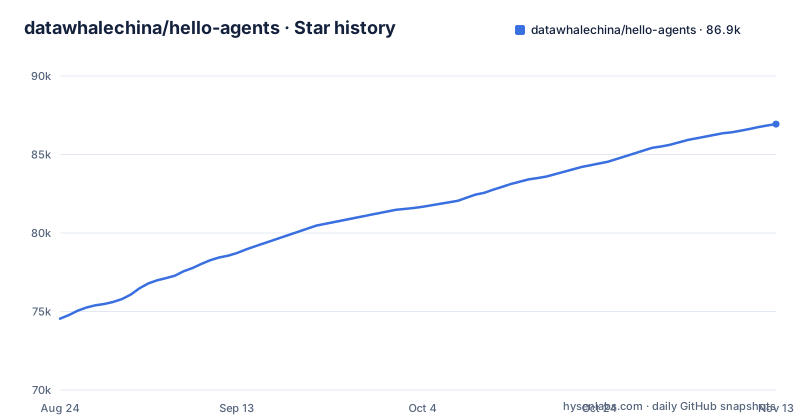
Star history
- datawhalechina/hello-agents86,938 ★ · +12,394
| Repository | 2026-08-24 | 2026-11-13 |
|---|---|---|
| datawhalechina/hello-agents | 74.5k | 86.9k |
12,394 Stars in the last 81 days, measured from the daily GitHub snapshot. Compare with other projects
Editorial analysis
What Hello-Agents Actually Is
The repository is a textbook, not a package. It is written in Chinese and organized as Markdown files under docs/. The README frames it as a response to a lack of systematic, practice-heavy agent tutorials. It distinguishes between software-engineering agents like Dify and AI-native agents, and focuses on the latter. The audience is someone who already uses LLMs and wants to build agents from scratch. You will not find a setup.py or a CLI. Instead, you get chapters that mix explanation with code snippets you are meant to type and run yourself.
The Core Mechanism: From ReAct to Your Own Framework
The tutorial's backbone is a progression from theory to construction. Chapter 4 implements classic paradigms by hand: ReAct, Plan-and-Solve, and Reflection. That means you write the loop that lets an LLM reason, act, and observe, rather than calling a framework that hides it. Chapter 7 then has you build your own agent framework, named HelloAgents, using only the OpenAI native API. The README says the goal is to see through the surface of frameworks and understand the core architecture. This is a deliberate pedagogical choice. Many tutorials show you how to use LangGraph or AutoGen, but few force you to reproduce the underlying mechanism. The trade-off is that you spend time on plumbing that a framework would give you for free, but the understanding sticks. Later chapters add memory, retrieval, context engineering, and protocols like MCP and A2A.
How to Get Started: Reading and Running the Examples
You do not install Hello-Agents. You read it online or clone the repository. The README gives two URLs for online reading: a GitHub Pages site at datawhalechina.github.io/hello-agents for international access, and hello-agents.datawhale.cc for faster access in China. For local reading, you clone the repo and open the Markdown files. The docs folder contains each chapter as a .md file, and code examples are embedded. Each chapter may assume certain libraries, such as openai for the API calls, but you will need to manage those yourself. The repository also includes an Extra-Chapter folder with practical guides, including one on environment configuration (Extra07-环境配置.md). So the first step is to clone, then read the preface and chapter 1, and follow the code as you go.
What Makes It Different: Agentic RL and Full-Stack Coverage
Most agent tutorials stop at prompting and tool use. Hello-Agents goes further. Chapter 11 covers Agentic-RL, taking you from supervised fine-tuning (SFT) to GRPO, a reinforcement learning method used to train LLMs for agentic tasks. This is rare in a free tutorial. The README claims you will master the full process of training an LLM with GRPO. Chapter 12 covers performance evaluation with metrics and benchmarks. The final chapters apply everything to real projects: a travel assistant using MCP and multi-agent collaboration, a DeepResearch agent reproduction, and a cyber town that simulates social dynamics. This breadth is both a strength and a risk. A learner who wants a focused introduction to agents may find the RL and game-simulation chapters overwhelming. But for someone aiming to understand agents end to end, from model weights to application, this is a comprehensive map.
Maintenance and Community Contributions
The repository is actively maintained. The latest release, V1.0.3, was pushed on 2026-07-17, and there are earlier releases from February 2026 and November 2025. That cadence suggests ongoing updates. The README also lists a community blog section where contributors add extra chapters, such as interview questions, Dify tutorials, and GUI agent guides. These are marked as community contributions, so quality may vary. The main chapters are all marked with a checkmark, indicating they are complete. The project is affiliated with Datawhale, a well-known Chinese open-source education community, which gives it a base of contributors and reviewers. However, the license is listed as NOASSERTION in the repository metadata. That means GitHub did not identify a standard license, although the repository has a LICENSE.txt file. The README says the content is free to learn, but if you want to reuse or redistribute the material, you should read LICENSE.txt in the repository or contact the maintainers. This is a real concern for anyone considering incorporating the text into their own course or product.
Limitations: Language, Depth, and Non-Package Format
The biggest limitation is the language. The README is primarily in Chinese, with an English README link, but the chapter content is Chinese. Non-Chinese readers will struggle unless they use translation tools. The second limitation is the format. The chapters live as Markdown under docs/, with a separate code directory at the repository root. The README mentions an environment configuration extra chapter, but it is not part of the main flow. Third, the breadth means each topic is covered at a tutorial depth, not a reference depth. For example, Chapter 10 covers MCP, A2A, and ANP protocols, but a production engineer may need more detail than a single chapter provides. The tutorial is also opinionated: it pushes the AI-native agent paradigm and de-emphasizes low-code platforms. If your use case is building a quick workflow with Dify, this is not the right resource. It is for deep learning, not quick prototyping.
Alternatives and How They Differ
If you want a more code-centric, English-language introduction to agent frameworks, consider the official documentation of LangGraph or AutoGen. Those are actual libraries with installable packages, API references, and runnable examples. LangGraph, for instance, provides a graph-based state machine for building agents, and you can start with a pip install and a few lines of code. AutoGen from Microsoft offers multi-agent conversation patterns with a higher-level API. The difference is approach: Hello-Agents teaches you to build the machinery yourself, while LangGraph gives you the machinery and asks you to configure it. For a practitioner who needs to ship an agent quickly, a framework is more direct. For someone who wants to understand what happens inside that framework, Hello-Agents is the better starting point. The choice depends on whether your goal is comprehension or deployment.
Maintenance and Upgrade Cost
The maintenance cost for a reader is low: you clone the repo and read. But the upgrade cost is real. The code examples rely on external APIs, such as OpenAI, and those APIs change. If you follow the book in 2026, the API may have changed since the last release. You will need to adapt the code. The repository itself is maintained, with releases every few months, but the pace of LLM tooling means the content may lag. For example, the chapter on protocols covers MCP and A2A, but new protocols or updates could make parts obsolete. The license issue also adds a cost if you want to reuse the content: you should read LICENSE.txt and ask the maintainers if it is unclear. Overall, the cost is not in installation but in keeping the examples current with the fast-moving ecosystem.
Editorial conclusion
Adopt Hello-Agents if you are a Chinese-speaking developer or student who wants a structured, free path from LLM basics to building a custom agent framework and training models with GRPO. Skip it if you need an English resource or a quick API reference, because the material is tutorial prose, not a library you install. Before starting, verify that the docs are current for your LLM API versions, and check the repository's license status, which is listed as NOASSERTION, so clarify reuse terms if you plan to redistribute content.
Frequently asked questions
What is Hello-Agents from Datawhale?
It is a free, community-run course on building AI agents from scratch, published by the Datawhale community. It runs sixteen chapters from agent definitions and history through memory, RAG, context engineering, agent protocols, Agentic RL, and evaluation, ending in a capstone project.
Is Hello-Agents available in English?
Partly. The repository carries a separate English README, and there is an English section link, but the sixteen chapter files are written in Chinese. Two online reading URLs are offered, one for readers outside China and one described as accelerated for readers in China.
Does Hello-Agents teach Dify, Coze, or n8n?
Yes, in part: Chapter 5 covers using low-code platforms such as Coze, Dify and n8n, although the course centres on AI-native agents. The README divides agent work into flow-driven software-engineering agents such as Dify, Coze, and n8n, where the LLM is a data-processing backend, and AI-native agents, which is what the course is written to teach.
What framework does Hello-Agents use?
The course teaches you to build an agent framework from zero, and points to a companion framework called HelloAgents built from scratch on top of the OpenAI native API. That framework lives in its own repository, separate from the course repository, and the course also covers AutoGen, AgentScope, and LangGraph.
How much code does the Hello-Agents course include?
The repository root contains a code directory alongside the docs, and one outcome the course lists is implementing ReAct, Plan-and-Solve, and Reflection yourself rather than importing them. A contributed environment configuration guide and a file about writing good skills also sit in the community chapters.
Official sources
Add this badge to your README
If you maintain this project, the badge below links readers to this analysis and shows its maintenance status from the daily GitHub snapshot. Paste the markdown into your README; add ?metric=license or ?metric=stars to the image URL for a different field.

[](https://hysenlabs.com/projects/datawhalechina-hello-agents)Star history chart for your README
[](https://hysenlabs.com/projects/datawhalechina-hello-agents)Was this useful?