ESPHome Home Assistant Add-on: What the Repository Actually Contains and How to Use It
ESPHome Home Assistant Add-on
At a glance
- What is it?
- This repository hosts the Home Assistant add-on for ESPHome, not the ESPHome source itself. It packages the ESPHome tooling for Home Assistant OS and Supervised installations, with a release cadence tied to ESPHome versions.
- Who is it for?
- Adopt this add-on if you run Home Assistant OS or Supervised and want a tightly integrated way to manage ESPHome devices without a separate installation. Do not use it if you need the full ESPHome source code, custom components, or if you run Home Assistant Core in a venv or Docker without the Supervisor.
- Can I use it commercially?
- Not without permission. GitHub finds no licence file in the repository, and without a licence all rights are reserved by default: you may read the code but not reuse it. Check the README, or ask the authors, before using it.
- Is it still maintained?
- Yes. The repository last received commits 1 day ago.
- What is it written in?
- Mainly Python, according to GitHub's language statistics.
Answers come from the project's GitHub data, last synced on October 22, 2026, and from our analysis. They are not legal advice.
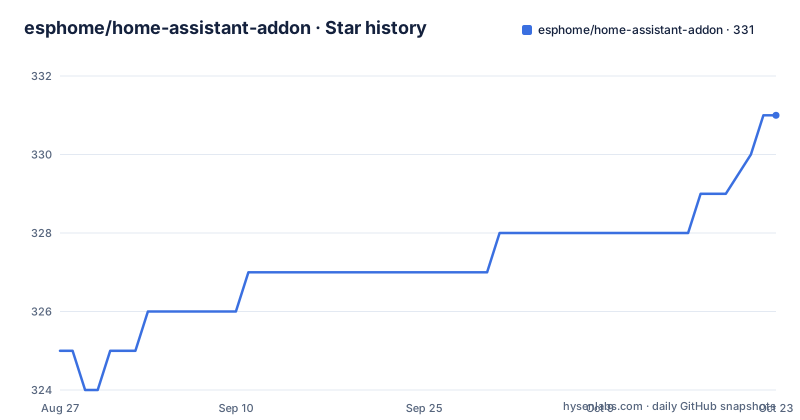
Star history
- esphome/home-assistant-addon331 ★ · +6
| Repository | 2026-08-27 | 2026-10-22 |
|---|---|---|
| esphome/home-assistant-addon | 325 | 331 |
6 Stars in the last 56 days, measured from the daily GitHub snapshot. Compare with other projects
Editorial analysis
A Packaging Repository, Not the Core Project
The first thing to understand is that this repository is not where ESPHome development happens. The README states plainly: "This is the Home Assistant App repository for ESPHome. For the ESPHome source please go to esphome." That means the code here is the add-on wrapper, the integration layer that lets Home Assistant's Supervisor run ESPHome as an add-on. The primary language is listed as Python, which makes sense because the add-on is essentially a Python-based service that the Supervisor manages. If you are looking for the compiler, the dashboard, or the YAML configuration engine, you want the main esphome repository. This one is about packaging and delivery inside Home Assistant.
Who This Is For and the Problem It Solves
The add-on solves a specific problem: getting ESPHome running on a Home Assistant installation without manual dependency management. On Home Assistant OS or a Supervised install, add-ons are the standard way to run supplementary services. The ESPHome add-on gives you a dashboard, an API, and a way to compile firmware directly from the Home Assistant interface. The target user is someone who already runs Home Assistant and wants to manage ESP8266, ESP32, and similar devices with ESPHome, but does not want to maintain a separate Python environment or Docker container. The README does not say this explicitly, but the existence of the add-on implies that integration with the Supervisor is the core value. If you are not on a Supervisor-based Home Assistant, this repository is not for you.
How the Add-on Works: Release Cadence and Versioning
The repository's releases are tagged with version numbers that mirror ESPHome's own releases. The most recent releases are 2026.8.1, 2026.8.0, and 2026.8.0b6. The beta version, 2026.8.0b6, was published on 2026-08-19, followed by the stable 2026.8.0 on 2026-08-20, and then a patch 2026.8.1 on 2026-08-23. This pattern suggests the add-on is updated in lockstep with ESPHome releases, with a short delay for stabilization. The add-on itself likely wraps the ESPHome command-line tool and exposes it through the Supervisor's add-on API. The README does not describe the internal data flow, but the versioning strongly implies that each add-on release bundles a specific ESPHome version. That is a useful fact for planning upgrades: you can infer which ESPHome features you get by looking at the add-on release number.
Getting It Running: What the README Does and Does Not Tell You
The README is extremely sparse. It provides a link to the documentation at https://esphome.io/ and a link to the issue tracker. It does not include installation commands, configuration keys, or a quick start guide. That is a significant gap for a technical audience. In practice, installing an add-on in Home Assistant is done through the Supervisor's add-on store, where you add this repository URL and then install the ESPHome add-on. But the README does not even give that URL. You have to know that the repository is meant to be added as a custom repository in Home Assistant. The documentation link is the only real pointer. For configuration, you would need to consult the ESPHome documentation, which is separate. This brevity is common for add-on repositories, but it means the README alone is not enough to get started.
A Real Limitation: No Source, No Customization
The most obvious limitation is that this repository is not the place to go if you want to modify ESPHome itself. The README explicitly redirects you to the main esphome repository for source code. That means if you need to patch the compiler, add a custom component, or debug an ESPHome internal, this add-on repository will not help you. Another limitation is that the add-on is tied to the Home Assistant Supervisor. If you run Home Assistant Core in a Python venv, or in a plain Docker container without the Supervisor, this add-on is useless. The add-on also assumes you are comfortable with the release cadence: you get ESPHome updates when the add-on maintainers publish them, not necessarily on the same day as the upstream release. The 2026.8.0b6 to 2026.8.0 gap of one day is short, but there is still a delay. For users who need bleeding-edge ESPHome features immediately, this lag could be a problem.
Alternative Approach: Running ESPHome Standalone
If this add-on is too constrained, the alternative is to run ESPHome directly on your own machine or server. The main esphome repository provides a Python package that you can install with pip, and you can run the ESPHome dashboard as a standalone service. That approach gives you full control over the version, the Python environment, and the update timing. It also works on any platform, not just Home Assistant OS. The trade-off is that you lose the tight integration with Home Assistant's Supervisor: no automatic add-on updates, no unified dashboard, and no simple way to see logs in the Home Assistant UI. The add-on is a convenience layer; the standalone route is for users who want independence from Home Assistant's release schedule. The README does not mention this, but the distinction is clear from the repository split.
Maintenance and Upgrade Cost
The repository shows active maintenance. The last push was on 2026-08-23, and there are three releases within a week in August 2026. That suggests the maintainers are responsive to upstream ESPHome changes. The upgrade cost for a user is low if you use the Supervisor's add-on update mechanism, which presumably handles the new version. The cost is higher if you rely on the add-on for critical infrastructure, because you have to test each new ESPHome release against your device configurations. The README does not provide a changelog, so you would need to check the ESPHome release notes for each version. The license is listed as unknown, which is a concern for legal review. The README does not state a license, and the repository metadata does not show one. That is a real issue for organizations that require a clear open-source license. You should check the actual repository files for a LICENSE file before adopting it in a commercial context.
Editorial conclusion
Adopt this add-on if you run Home Assistant OS or Supervised and want a tightly integrated way to manage ESPHome devices without a separate installation. Do not use it if you need the full ESPHome source code, custom components, or if you run Home Assistant Core in a venv or Docker without the Supervisor. Before adopting, verify that your Home Assistant version supports the add-on architecture and that the add-on release matches your desired ESPHome version, since the repository tracks ESPHome releases with a delay. The repository is actively maintained with recent releases, but the README is minimal, so check the ESPHome documentation for configuration details.
Frequently asked questions
what is home assistant add on
An add-on is a packaged application Home Assistant can install and run. In this repository the add-on is the ESPHome application, built from a source project that lives in a separate repository. The readme states plainly that this repository is the app repository and directs anyone looking for the source to that other one.
how to create home assistant addon
The repository root contains a directory named for a template, which is the conventional starting point for a new add-on in this packaging format. The root also holds the repository descriptor file that Home Assistant reads to list installable add-ons, and a scripts directory that holds the packaging pipeline.
What are the three directories in esphome/home-assistant-addon for?
They are three release channels of the same add-on, named for stable, development and beta. The release list confirms all three ship: the most recent releases are a beta build, the stable build that followed about seven hours later, and a patch thirteen days after that. The readme does not explain what the channels mean in practice.
Where should I report a bug in the ESPHome Home Assistant add-on?
Not here. The readme sends issues to the tracker of the source repository and feature requests to a discussions board at the organisation level. This repository takes neither. It contains no source code and its root carries no Python file.
How is the ESPHome add-on versioned?
By calendar, as a year, a month and a patch number, with a letter suffix for pre-releases. The recent sequence is a beta, the stable build seven hours later on the same day, and a patch thirteen days afterwards. Nothing in the readme states which upstream firmware release a given build wraps.
Official sources
Add this badge to your README
If you maintain this project, the badge below links readers to this analysis and shows its maintenance status from the daily GitHub snapshot. Paste the markdown into your README; add ?metric=license or ?metric=stars to the image URL for a different field.

[](https://hysenlabs.com/projects/esphome-home-assistant-addon)Star history chart for your README
[](https://hysenlabs.com/projects/esphome-home-assistant-addon)