Freqtrade: A Python Trading Bot That Demands More Than a Config File
GitHub describes it as Free, open source crypto trading bot. The repository metadata lists Python as its primary language. The metadata lists the GPL-3.0 license. This article stays within the project description and details documented in the GitHub repository README.
At a glance
- What is it?
- Freqtrade is a GPL-3.0 Python bot for spot and futures crypto trading with backtesting, hyperopt, and FreqAI. It is powerful but expects coding knowledge, and the README warns you to start in dry-run.
- Who is it for?
- Adopt Freqtrade if you are a Python developer who wants a self-hosted, customizable trading bot and are willing to read source code and run dry-run first. Avoid it if you expect a plug-and-play tool or lack coding experience, as the README explicitly says.
- Can I use it commercially?
- Yes, with conditions. GPL-3.0 is a copyleft licence: if you distribute software that includes it, you must release that software's source code under the same licence. Running it internally without distributing it does not trigger that obligation.
- Is it still maintained?
- Yes. The repository received new commits within the last day.
- What is it written in?
- Mainly Python, according to GitHub's language statistics.
Answers come from the project's GitHub data, last synced on November 15, 2026, and from our analysis. They are not legal advice.
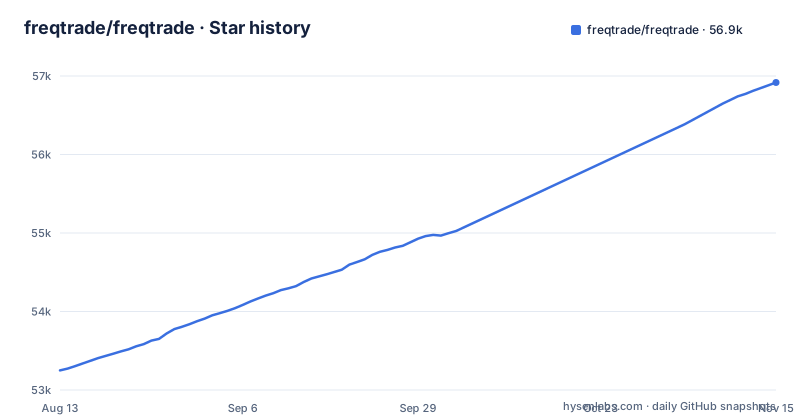
Star history
- freqtrade/freqtrade56,917 ★ · +3,667
| Repository | 2026-08-13 | 2026-11-15 |
|---|---|---|
| freqtrade/freqtrade | 53.3k | 56.9k |
3,667 Stars in the last 94 days, measured from the daily GitHub snapshot. Compare with other projects
Editorial analysis
What Freqtrade Actually Solves
Freqtrade addresses a specific problem: running automated trading strategies on cryptocurrency exchanges without paying for a proprietary bot. It is for people who can write Python and want to control their own trading logic, data, and execution. The README lists support for major spot exchanges like Binance, Kraken, and OKX, plus futures on Binance, Bybit, and Hyperliquid. It also includes backtesting, plotting, money management, and machine learning optimization. The target user is not a casual trader. The disclaimer says you should have coding and Python knowledge and read the source code to understand the mechanism. That is a clear signal: this is a developer tool, not a retail product.
The Architecture: Persistence, Dry-Run, and Control Interfaces
Freqtrade's visible architecture has three layers. First, persistence is handled through sqlite, so trades and state survive restarts. Second, a dry-run mode lets you run the bot without paying money, which is essential for testing. Third, you control the bot through a built-in WebUI or Telegram. The Telegram RPC commands are extensive: /start, /stop, /status, /profit, /forceexit, /performance, and /balance. The WebUI is built in, so you do not need a separate dashboard. The bot also supports dynamic whitelists and blacklists for selecting which cryptocurrencies to trade. The data flow starts with exchange data, which you download using the download-data command, then you run backtesting, then you deploy in dry-run, then live. The command list shows a clear separation between data preparation, strategy testing, and live trading.
Getting It Running: Commands and Configuration
The README points to a Docker quickstart for the fastest setup, and the README points to a separate Installation page for native installation methods. The usage string shows a large set of subcommands: trade, create-userdir, new-config, show-config, new-strategy, download-data, convert-data, backtesting, hyperopt, edge, list-exchanges, list-pairs, list-strategies, plot-dataframe, plot-profit, webserver, and more. A typical workflow would be: create-userdir to set up your workspace, new-config to generate a config file, download-data to fetch historical candles, backtesting to test a strategy, and then trade to run live or in dry-run. The README mentions exchange-specific notes and leverage documentation on the website. The presence of show-config and new-config implies a structured JSON config. The README describes the bot as based on Python 3.12+ and usable on Windows, macOS and Linux.
The Machine Learning Layer: FreqAI and Hyperopt
Freqtrade includes two optimization features. Hyperopt is a parameter optimizer for your buy and sell strategy, using real exchange data. FreqAI is a separate subsystem for adaptive prediction modeling. The README describes FreqAI as a way to build a smart strategy that self-trains to the market via adaptive machine learning methods. The commands list includes list-freqaimodels and list-hyperoptloss, so both subsystems have their own management tools. The trade-off is complexity. The README links to separate FreqAI documentation for details. This is a genuine limitation: the machine learning features are powerful but not turnkey.
Exchange Support and Its Caveats
The README lists supported spot and futures exchanges, but it also warns that potentially many others from the CCXT library may work, without a guarantee. Community-tested exchanges like Bitvavo and Kucoin are listed separately, meaning they are not officially supported. This distinction matters. If you trade on an exchange that is not on the official list, you may hit API changes or missing features. The README also says to read exchange-specific notes, which implies that each exchange has quirks. For example, some exchanges require special configurations for futures or leverage. Hyperliquid is listed as a DEX, which is unusual for a bot that typically uses centralized exchange APIs. The practical takeaway is that exchange support is not uniform. You cannot assume a strategy that works on Binance will work on Kraken without adjustments. The community-tested label is a softer guarantee than the official checkmark.
Where Freqtrade Is the Wrong Tool
Freqtrade is the wrong tool if you want a fully automated bot that runs without supervision. The README's disclaimer is blunt: do not risk money you are afraid to lose, and always start in dry-run. The bot is not a set-and-forget system. It requires you to monitor trades, understand profit/loss, and intervene via Telegram commands like /forceexit. Another wrong case is if you have no Python experience. The README says you should have coding knowledge and read the source code. A third case is if you need guaranteed exchange support. The README explicitly says many CCXT exchanges may work but cannot be guaranteed. If you trade on a niche exchange, you may be on your own. Finally, the GPL-3.0 license is a constraint if you plan to build a proprietary trading product on top of it. That is a legal consideration, not a technical one, but it matters for commercial use.
Alternatives and How They Differ
A direct alternative is the CCXT library itself, which Freqtrade uses under the hood. CCXT is a lower-level library that provides unified exchange APIs, but it does not include backtesting, strategy optimization, or a bot loop. With CCXT, you write your own trading logic from scratch. That is a different approach: Freqtrade gives you a framework with persistence, Telegram control, and backtesting, while CCXT gives you building blocks. The key difference is that Freqtrade is open source and GPL-3.0, so you can inspect and modify every line.
Maintenance and Upgrade Costs
The repository has a develop branch and a stable branch. The README says develop may have breaking changes, while stable is generally well tested. This means you must be careful about which branch you run in production. The release cadence is monthly, with recent releases 2026.10, 2026.9 and 2026.8, so updates come frequently. Each update may introduce new features or change configuration formats. The presence of a strategy-updater command suggests that strategies may need migration between versions. There is also a lookahead-analysis and recursive-analysis command, which are tools to check for common strategy errors. These are maintenance aids, but they add to the learning curve. The GPL-3.0 license means if you modify the code and distribute it, you must share your changes. That is a cost if you want to keep your strategy proprietary. The maintenance cost is real: you need to track releases, read changelogs, and test before upgrading. The project appears active, with a recent push on 2026-10-04, but that does not guarantee future maintenance.
Editorial conclusion
Adopt Freqtrade if you are a Python developer who wants a self-hosted, customizable trading bot and are willing to read source code and run dry-run first. Avoid it if you expect a plug-and-play tool or lack coding experience, as the README explicitly says. Before live trading, verify your exchange's specific notes, test your strategy in backtesting, and run the bot in dry-run for a sufficient period. The project's own disclaimer says you risk money at your own responsibility, so treat it as educational software until you have proven your setup.
Frequently asked questions
What is Freqtrade used for?
It is a free, open source crypto trading bot written in Python, designed to support all major exchanges and be controlled through Telegram or a built-in web UI. It includes backtesting, plotting, money management and strategy optimisation by machine learning, with persistence through SQLite and dry-run support.
How do I install Freqtrade?
The quick start points at a Docker quickstart page, and further native installation methods are documented separately. The project targets Python 3.12 and newer, and the repository ships both a shell setup script and a PowerShell one for Windows. There is also a systemd unit and a watchdog unit in the tree.
Is Freqtrade safe?
The project does not claim that, and asks you to verify it yourself. The disclaimer says the software is for educational purposes only, that you should not risk money you are afraid to lose, and that the authors assume no responsibility for your trading results. It instructs you to start in dry-run and to read the source code to understand the mechanism.
Is Freqtrade profitable?
The disclaimer explicitly disclaims responsibility for trading results. What the project offers is the tooling to evaluate a strategy yourself: backtesting, hyperopt for parameter search, and separate commands for lookahead and recursive analysis to detect strategies that only look good in simulation.
Official sources
Add this badge to your README
If you maintain this project, the badge below links readers to this analysis and shows its maintenance status from the daily GitHub snapshot. Paste the markdown into your README; add ?metric=license or ?metric=stars to the image URL for a different field.

[](https://hysenlabs.com/projects/freqtrade-freqtrade)Star history chart for your README
[](https://hysenlabs.com/projects/freqtrade-freqtrade)Was this useful?