fuels-rs: A Rust SDK for the Fuel Network, from Contract Deployment to Type-Safe Bindings
GitHub describes it as Fuel Network Rust SDK. The repository metadata lists Rust as its primary language. The metadata lists the Apache-2.0 license. This article stays within the project description and details documented in the GitHub repository README.
At a glance
- What is it?
- fuels-rs is the official Rust SDK for the Fuel Network, covering contract compilation, deployment, interaction, and type-safe binding generation. It is an actively developed tool that requires the Sway toolchain and has notable gaps in wallet integration and event monitoring.
- Who is it for?
- Adopt fuels-rs if you are building on the Fuel Network with Rust and need to compile, deploy, and test Sway contracts, or if you want generated type-safe bindings for contract methods. Do not adopt it if you require wallet integration or event querying, as those are explicitly unchecked in the README.
- Can I use it commercially?
- Yes. Apache-2.0 is a permissive licence: you can use, modify and sell software built on it, as long as you keep its copyright and licence notices.
- Is it still maintained?
- Yes. The repository last received commits 27 days ago.
- What is it written in?
- Mainly Rust, according to GitHub's language statistics.
Answers come from the project's GitHub data, last synced on November 15, 2026, and from our analysis. They are not legal advice.
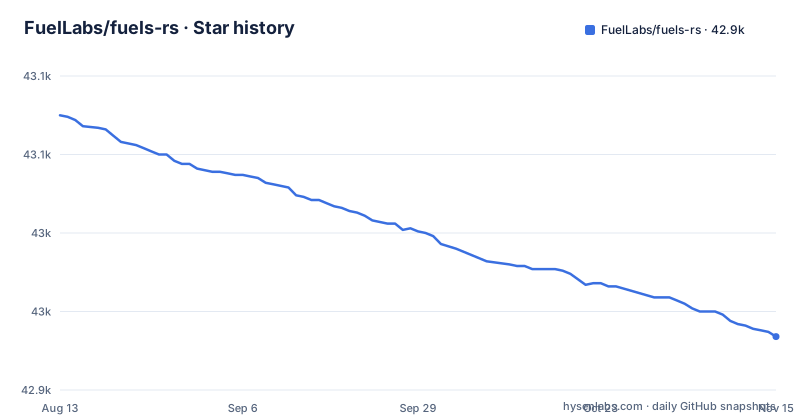
Star history
- FuelLabs/fuels-rs42,934 ★ · -141
| Repository | 2026-08-13 | 2026-11-15 |
|---|---|---|
| FuelLabs/fuels-rs | 43.1k | 42.9k |
-141 Stars in the last 94 days, measured from the daily GitHub snapshot. Compare with other projects
Editorial analysis
What fuels-rs Solves and Who It Serves
fuels-rs addresses a specific gap: developers building on the Fuel Network need a way to compile, deploy, and interact with Sway smart contracts from Rust. Without an SDK, a developer would have to manually craft transaction payloads, manage node connections, and write boilerplate for contract calls. This SDK centralizes those tasks into a single Rust crate. It is aimed at Rust developers who are working on Fuel-based decentralized applications, particularly those who want to test contract logic in a local environment or generate bindings that reduce runtime errors. The README lists its intended uses: compiling, deploying, and testing Sway contracts; launching a local Fuel network; crafting and signing transactions; and generating type-safe Rust bindings. That last item is a strong draw for teams that want compile-time safety when calling contract methods, as opposed to stringly-typed interfaces common in other ecosystems.
The Mechanism: From Sway Source to Type-Safe Rust
The core workflow in fuels-rs is built around the Sway compiler and the Fuel node. You start with a Sway contract, which you compile using forc, the Sway compiler. The SDK then takes the compiled artifact and can generate Rust bindings for the contract's methods. These bindings are type-safe, meaning the Rust compiler checks method names and argument types at compile time. When you interact with a deployed contract, the SDK constructs and signs transactions, sends them to a Fuel node, and decodes the results. The README mentions that you can also craft transactions with hand-crafted scripts or contract calls, which gives developers low-level control when needed. The SDK also includes a CLI for common operations, though the README does not detail which operations. The presence of a local test wallet feature suggests that the SDK can create and manage accounts for testing, but the 'Wallet integration' checkbox remains unchecked, so this is likely limited to test scenarios rather than production key management.
Getting Started: Dependencies and Setup
The README is explicit about what you need before you can use fuels-rs. You must have the latest stable Rust toolchain, and you need the forc and fuel-core binaries, which are installed via fuelup. The setup commands are straightforward. To run the SDK's own tests, you first build the test projects with `forc build --release --path e2e`, then run `cargo test`. You can filter tests, for example running integration tests in `types.rs` that contain `in_vector` with `cargo test --test types in_vector -- --show-output`. For WASM tests, you add the wasm32 target with `rustup target add wasm32-unknown-unknown`, install wasm-pack via `cargo install wasm-pack`, then navigate to `packages/wasm-tests` and run `wasm-pack test`. If tests fail on the master branch, the README suggests a sequence: `cargo clean`, `rm Cargo.lock`, `forc build --release --path e2e`, and `cargo test`. This is a common pattern for Rust projects where stale lock files or cached builds can cause issues. The dependency on external binaries like forc and fuel-core means your environment must be set up correctly before the SDK can function.
Testing and Documentation: A Book and a Test Suite
Documentation is provided via a book hosted at fuellabs.github.io/fuels-rs/latest, which you can build locally with mdbook. The commands are `cargo install mdbook`, then `mdbook serve --open` in the docs folder to view it in a browser, or `mdbook build` to produce static files. The test suite is extensive, as indicated by the e2e test directory and the ability to run specific tests with output. The README mentions running SDK tests with `cargo test`, which suggests a standard Rust test harness. The fact that there are separate WASM tests indicates that the SDK has some WebAssembly support, which is useful for browser-based or edge environments. However, the README does not specify what parts of the SDK are WASM-compatible, so you would need to check the wasm-tests package to see the coverage. The book is likely the best place to learn the API, but the README gives enough to get started.
Limitations and Failure Modes
The most obvious limitation is stated in the feature list: wallet integration and events querying/monitoring are unchecked. That means the SDK cannot manage real wallets or subscribe to contract events out of the box. If your application relies on listening to events, you would need to build that yourself or use a different tool. Another limitation is the dependency on the Sway toolchain. If you are not using Sway or if you have a version mismatch between forc and the SDK, you will hit compilation errors. The README's troubleshooting section for failing tests on master suggests that the project can break with stale lock files or cached builds, which is a sign that the codebase is evolving quickly. The release history shows v0.77.0 in April 2026, but v0.76.0 was from October 2025, a six-month gap, which could indicate a slower release cadence or significant changes. The SDK is in active development, so APIs may change between versions, and you should pin your dependencies to a specific version to avoid surprises.
Alternatives and How They Differ
The README explicitly mentions that the fuels-* family is inspired by ethers.js, which is a JavaScript/TypeScript SDK for Ethereum. If you are working in a JavaScript environment, you would use fuels-ts, which is the TypeScript counterpart. The difference is the language and the type system. fuels-rs gives you Rust's compile-time guarantees, while fuels-ts gives you TypeScript and easier integration with web frontends. If you are not using Rust, fuels-rs is not for you; you would look at fuels-ts or other language SDKs. The choice comes down to your stack and your need for type safety versus ecosystem integration.
Maintenance, Licensing, and Upgrade Cost
The project is licensed under Apache-2.0, which is permissive and allows commercial use with attribution. There are no obvious license restrictions that would hinder adoption. The maintenance status is active, with recent releases and a last push on 2026-10-19. The README's FAQ and troubleshooting sections suggest a community-driven process, but there is no mention of a formal maintenance policy or deprecation schedule. Upgrade cost is a real concern because the SDK is under active development. The six-month gap between v0.76.0 and v0.77.0 could mean significant changes, and you will need to review changelogs and possibly update your code when upgrading. The README's advice to run `cargo clean` and remove `Cargo.lock` if tests fail on master indicates that the project sometimes has breaking changes that require a clean rebuild. For a production project, you should pin the version and test upgrades in a CI environment before deploying. The documentation book is a good resource for tracking changes, but it is not a substitute for reading release notes.
Editorial conclusion
Adopt fuels-rs if you are building on the Fuel Network with Rust and need to compile, deploy, and test Sway contracts, or if you want generated type-safe bindings for contract methods. Do not adopt it if you require wallet integration or event querying, as those are explicitly unchecked in the README. Before committing, verify that your Rust toolchain is stable, install forc and fuel-core via fuelup, and confirm that the latest release (v0.77.0) works with your target Fuel node version, since the SDK is under active development and may change APIs between releases.
Frequently asked questions
How do I run the fuels-rs SDK tests?
Build the test projects with the Sway compiler first by running forc build --release --path e2e, then run cargo test. To narrow the run, the README uses cargo test --test types in_vector -- --show-output to hit integration tests in types.rs whose names contain in_vector.
Why is the crate called fuels and not fuel?
The project chose the trailing s so the SDK for Fuel feels familiar to people coming from the ethers.js ecosystem. It says the fuels-* family of SDKs is inspired by The Ethers Project.
What does fuels-rs need installed before I can build Sway contracts?
The latest stable Rust toolchain, plus the forc and fuel-core binaries. The workspace additionally sets rust-version 1.94.1 and edition 2024, so the stable toolchain has to be new enough to build the crates themselves.
Official sources
Add this badge to your README
If you maintain this project, the badge below links readers to this analysis and shows its maintenance status from the daily GitHub snapshot. Paste the markdown into your README; add ?metric=license or ?metric=stars to the image URL for a different field.

[](https://hysenlabs.com/projects/fuellabs-fuels-rs)Star history chart for your README
[](https://hysenlabs.com/projects/fuellabs-fuels-rs)Was this useful?