gantry5: a theme framework for WordPress, Joomla and Grav
:rocket: Next Generation Template / Theme Framework
At a glance
- What is it?
- Gantry 5 is a template and theme framework that runs on three content management systems, and the current 5.6 line dropped Joomla 4 support, restricts PHP to 8.1 through 8.3 and adds native Joomla 5 compatibility. The project changed hands to Tiger12, the build is four separate yarn installs, and version 6.0 is already in planning with MCP support on the list.
- Who is it for?
- Adopt Gantry 5 if you build sites on WordPress, Joomla or Grav and want one theming layer with a shared administrator across the three, especially if you are starting a new project on PHP 8.1 to 8.3 and Joomla 5. Do not adopt it for a site still on Joomla 4, on PHP 8.4, or on Internet Explorer, all three of which the current release excludes.
- Can I use it commercially?
- Not without permission. GitHub finds no licence file in the repository, and without a licence all rights are reserved by default: you may read the code but not reuse it. Check the README, or ask the authors, before using it.
- Is it still maintained?
- Yes. The repository last received commits 3 days ago.
- What is it written in?
- Mainly PHP, according to GitHub's language statistics.
Answers come from the project's GitHub data, last synced on November 7, 2026, and from our analysis. They are not legal advice.
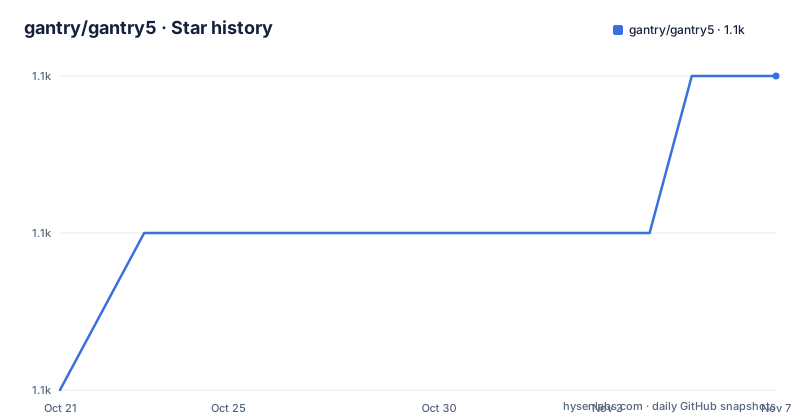
Star history
- gantry/gantry51,064 ★ · +2
| Repository | 2026-10-21 | 2026-11-07 |
|---|---|---|
| gantry/gantry5 | 1.1k | 1.1k |
2 Stars in the last 17 days, measured from the daily GitHub snapshot. Compare with other projects
Editorial analysis
One theming layer across three content management systems
Gantry 5 is described in the repository as a next generation template and theme framework, and its reach is the point of it. The same framework powers themes on WordPress, Joomla and Grav, and the repository topics list all three alongside php, themes and framework.
The structure is worth being precise about, because the words template and theme are used in overlapping ways in this ecosystem. Gantry 5 is a framework by which Gantry powered themes are made. In order for a Gantry theme to work you need to install both the framework and the theme, and the theme named in the documentation is Hydrogen.
On top of that framework sits the Gantry Administrator, which is the graphical configuration surface for the theme, and the README describes it as having multiple administrative tools you can flip through to configure how the theme looks and functions. The four tools it names are the Menu Editor, which lets you alter the styling of the platform's menu, rearrange links and create menu items outside the CMS's own Menu Manager, the About page with the theme's name, version, creator, support links and features, Platform Settings, which in Joomla is the Permissions configuration page, and Clear Cache, which clears the cache files related to Gantry.
The framework is not maintained by the company that created it. The README records that Gantry's success was built on the vision of Andy Miller and the team at RocketTheme, and that RocketTheme has officially chosen Tiger12 to carry the legacy forward. Gene Teigland of Tiger12 signs the update, and the repository is not archived with the last push on 2026-09-03.
Version 5.6.0 dropped Joomla 4 and capped PHP at 8.3
The compatibility story of the current line is the most concrete thing in the README, and it is worth reading as a set of boundaries rather than a feature list.
Gantry 5.6.0 was released on February 24, 2026, with full native compatibility with Joomla 5, dropping Joomla 4 support. PHP is restricted to 8.1.0 through 8.3.x, with PHP 8.4 and above not supported yet. There were platform specific improvements and fixes across Joomla, WordPress and Grav, and an updated compatibility matrix with admin notices for smoother upgrades. The recent commits listed are Joomla 5 native changes, WordPress page assignment fixes, code cleanups and version bumps.
So the 5.6 line is a Joomla 5 line. A site on Joomla 4 is not a candidate for this release, and a site on PHP 8.4 is not either. Neither of those is a criticism, it is the ordinary consequence of a framework that has to support three platforms and cannot be current on all of them at once.
The tags tell you how the line has moved since then. There is 5.6.2 from 2026-06-04, 5.6.3 from 2026-08-18 and 5.6.4 from 2026-09-03, and the last push to the repository is on the same day as the newest tag.
The project describes itself as actively developed and maintained by the Tiger12 team, explicitly not in maintenance-only mode and not abandoned, and it notes that the public communication was lighter than ideal for a while after taking over stewardship, with the last major updates being quieter after October 2025.
One loose end is visible in the repository itself. The package manifest still declares version 5.4.0 while the released tags have reached 5.6.4, so the version field inside the tree is not a reliable guide to which release you are running.
Installing the framework and the theme separately
The installation path in the README is short, and it is a download rather than a command line operation.
You download the latest build of Gantry 5 and Hydrogen, either from the links in the documentation or via GitHub, and the documentation provides a step-by-step guide in its Installation portion. Two download links are offered, one for the stable build and one for CI builds, both hosted on gantry.org.
The requirement to install both the framework and the theme is the part that trips people up. A Gantry theme cannot run on its own, because the theme is a configuration layer and the framework is the runtime that interprets it, and the Gantry Administrator is part of the framework.
Once both are installed and activated, in the case of Joomla you reach the Gantry 5 administrator by navigating to Components > Gantry 5 Templates from the back end. That page lists the installed Gantry powered themes, and from there you can Preview a theme or select Configure to go directly into the Gantry Administrator.
The browser requirements for the back end administration are listed in order of preference: Google Chrome 60 and above, Firefox 60 and above, Safari 12 and above, Opera 47 and above, and MS Edge, with the note that Internet Explorer is no longer supported.
The other thing the repository asks for is a documentation habit rather than a technical step. Each section of the getting started page has a Learn More button at the bottom that takes you to the detailed documentation for that tip, and the underlying documentation lives at docs.gantry.org.
The build is four separate yarn installs
Gantry 5 ships as PHP, but the JavaScript and CSS side of it is built with a gulp and yarn toolchain, and the package manifest shows how unusual that setup is.
The manifest is named gantry5 with the description Gantry 5 / JS and CSS bundler, and the main entry is gulpfile.js. The dependency list is short, with npm as the only runtime dependency, and the development dependencies are the bundler stack: browserify, gulp 4, gulp-if, gulp-jsonminify, gulp-rename, gulp-sass 5 with sass 1.77, gulp-sourcemaps, gulp-uglify, gulp-util, merge-stream, vinyl-buffer, vinyl-source-stream, watchify and yargs. There is also a resolutions entry for graceful-fs, and a preinstall script that runs npm-force-resolutions to enforce it.
The build script is the part to look at, because it explains the shape of the repository. The list-paths script prints four paths, the root, assets/common, platforms/common and engines/common/nucleus, and the build-assets script removes node_modules from all four trees and then runs yarn install in each one in turn.
So the framework is not one JavaScript project, it is four, and a full build is a wipe and reinstall of every one of them. That is the cost of a codebase where the shared assets, the per platform code and the nucleus engine each carry their own dependency tree, and it is why the yarn.lock and package-lock.json files sit side by side at the root.
The repository layout follows the same division, with assets/, platforms/, engines/, themes/, src/, bin/ and tests/ at the top level, alongside a hebe.json file, a CSP-REQUIREMENTS.md document and an UPGRADE-5.5.md note for people moving between versions.
The legacy RocketTheme theme migration addon
The most interesting thing in the 2026 plan is not a feature, it is a migration tool, and it addresses a specific audience.
The team is actively working on a theme migration addon to help convert legacy RocketTheme Gantry themes, with Quasar, Dominion, Galatea and Versla named as examples from the older catalog, to current Gantry using Helium, or Hydrogen, as the base, while preserving as much of the original design, layout and styling as possible.
The scope extends to the bundled legacy RocketTheme addons and plugins. The list given is specific: RokSprocket, RokGallery, RokNavMenu, RokCandy, RokQuickCart and RokFeatureTable, each of which was common in RocketTheme themes, and the migration tool has to adapt or replace them.
The README is careful about expectations, and that honesty is a good sign. There are no firm promises on 100% perfect one to one fidelity, because legacy extensions plus platform changes can be complex, but the team believes it can cover most common scenarios and make upgrades far easier for sites still on older RocketTheme setups.
That is the honest shape of the work. A theme is a set of layout overrides and styles, and a theme plus a handful of bundled plugins is a set of assumptions about markup that the current framework may not make. An automatic conversion can get the page structure and the styling most of the way there, and the residue has to be fixed by hand.
For an evaluator, the question is whether your site is in that population. A site still running a legacy RocketTheme theme on Joomla is exactly who this addon is for, and a site that would start on Hydrogen today is not.
Gantry 6.0 is planned and the core stays open
The forward-looking parts of the README are short but they answer the two questions an adopting team asks first, which is what happens to the project and what happens to the price.
Gantry remains free and open-source forever, under MIT or GPL, and the stated focus areas for 2026 are developer tools plus AI assisted features, described as smarter particle and outline workflows and AI integration points. There is also a plan for optional premium add-on packages to expand core capabilities without gating anything, which is the way a free project funds itself without closing the core.
Gantry 6.0, the next major version, is in planning and active development, with deeper modern integrations including MCP support, and the README says a detailed feature list and roadmap will be shared via GitHub discussions and gantry.org.
The AI and MCP framing is worth a moment of scepticism from an adopting team, because it is the kind of direction that turns into churn if it is not matched by a stable core. The stated principle, though, is the right one. Core capabilities are not to be gated, and the paid part is add-ons that extend rather than unlock. A framework that keeps its core open and monetises extensions is a more durable arrangement than one that moves features behind a licence check.
The other change in tone is about process rather than code. The README promises better regular updates on GitHub discussions and announcements, gantry.org/blog, and possibly X, and it says the backlog review and merges are the current priority now that 5.6.0 is out. For a project that changed hands, that is the part that matters, since the code is only as maintained as the queue behind it.
Editorial conclusion
Adopt Gantry 5 if you build sites on WordPress, Joomla or Grav and want one theming layer with a shared administrator across the three, especially if you are starting a new project on PHP 8.1 to 8.3 and Joomla 5. Do not adopt it for a site still on Joomla 4, on PHP 8.4, or on Internet Explorer, all three of which the current release excludes. Verify first that the branch you check out is develop rather than a release branch, that the framework and the Hydrogen theme are both installed, and that the version you deploy matches the tag you tested, since the package manifest still reads 5.4.0 while the newest release is 5.6.4.
Frequently asked questions
Which PHP and Joomla versions does Gantry 5.6 support?
Version 5.6.0 brought full native compatibility with Joomla 5 and dropped Joomla 4 support, and restricts PHP to 8.1.0 through 8.3.x, with PHP 8.4 and above not supported yet. The release was on February 24, 2026, with 5.6.2, 5.6.3 and 5.6.4 following through September 2026.
Do I need to install both Gantry 5 and a theme?
Yes. Gantry 5 is a framework by which Gantry powered themes are made, so a Gantry theme needs the framework installed as well. The documentation uses Hydrogen as the theme, and both are downloaded from the stable or CI build links on gantry.org.
What is in the Gantry Administrator?
The README lists a Menu Editor for altering the platform menu's styling, rearranging links and adding items outside the CMS Menu Manager, an About page with the theme's details, Platform Settings, which in Joomla is the Permissions configuration page, and a Clear Cache button that clears the cache files related to Gantry.
How is the Gantry 5 JavaScript and CSS built?
With gulp, browserify and yarn across four separate dependency trees. The build-assets script in package.json removes node_modules from the root, assets/common, platforms/common and engines/common/nucleus and runs yarn install in each of them, with sass and gulp-sass handling the styles.
Official sources
Add this badge to your README
If you maintain this project, the badge below links readers to this analysis and shows its maintenance status from the daily GitHub snapshot. Paste the markdown into your README; add ?metric=license or ?metric=stars to the image URL for a different field.

[](https://hysenlabs.com/projects/gantry-gantry5)Star history chart for your README
[](https://hysenlabs.com/projects/gantry-gantry5)Was this useful?