gfodor/legal-skills: Markdown Agent Skills for U.S. Utility-Patent Work
Replacing lawyers with markdown files
At a glance
- What is it?
- legal-skills is a repository of agent instructions, checklists and Python scripts for exploring U.S. utility-patent drafts. Its simulated audit and examination outputs can miss prior art, deadlines or legal issues and are not a substitute for independent verification or qualified patent advice.
- Who is it for?
- Treat these skills as experimental aids for organizing questions and reviewing drafts, not as evidence that an application is patentable, complete or ready to file. Verify current USPTO sources, deadlines and results independently, protect confidential invention details when using any model provider, and consult a registered patent practitioner for advice on consequential decisions.
- Can I use it commercially?
- Yes, with conditions. GPL-3.0 is a copyleft licence: if you distribute software that includes it, you must release that software's source code under the same licence. Running it internally without distributing it does not trigger that obligation.
- Is it still maintained?
- Yes. The repository last received commits 105 days ago.
- What is it written in?
- Mainly Python, according to GitHub's language statistics.
Answers come from the project's GitHub data, last synced on November 25, 2026, and from our analysis. They are not legal advice.
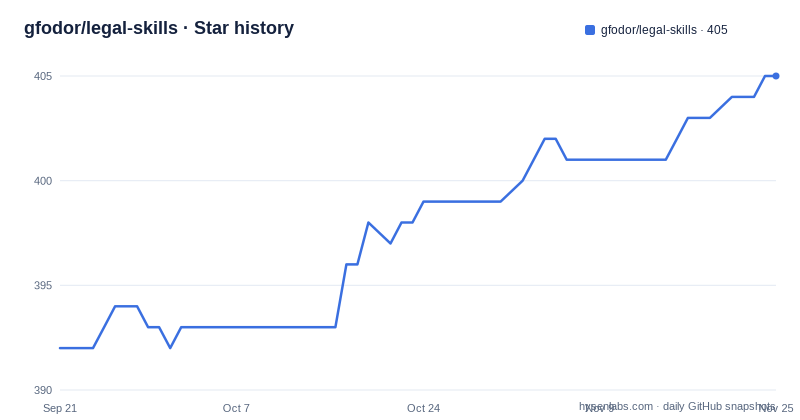
Star history
- gfodor/legal-skills405 ★ · +13
| Repository | 2026-09-21 | 2026-11-25 |
|---|---|---|
| gfodor/legal-skills | 392 | 405 |
13 Stars in the last 65 days, measured from the daily GitHub snapshot. Compare with other projects
Editorial analysis
The billable process that legal-skills is aimed at
The README frames patent work as a document pipeline: facts that are not in the draft, a specification and claims that either enable the invention or do not, a search that either found the dead-ringer or did not, an examiner who rejects under 35 U.S.C. 101, 102, 103 or 112 until the claims are allowable, and a competitor who keeps the value proposition while dropping the limitation you treated as essential. The claim is that firms wrap that pipeline in scarcity, letterhead and a rate card, and that the wrapper is what the repository removes.
The intended user is narrow. The README names inventors, founders and in-house engineers, and says the goal is to displace legal fees rather than assist counsel. It also draws a line: lawyers who work on judgment, strategy and courtroom work keep their work, while lawyers whose product is walking a known statute and filling known forms are the target. That is a positioning statement, not a feature list, and it should be read as one.
Three skills, run in order, each with a SKILL.md contract
The repository holds three directories: patent-audit, patent-examine and patent-workaround, plus LICENSE and README.md. Each is described as a complete agent skill: each with a SKILL.md, supporting templates and scripts intended to guide the agent. Script checks and model instructions cannot guarantee complete or legally correct results. The pipeline is sequential. patent-audit is intended to flag potential filing defects and statutory bars, producing ranked defects and a parsed.json. patent-examine runs a recurrent simulated USPTO examination and amends only after a simulated Office Action. patent-workaround runs adversarial design-around testing.
The iteration rule is the interesting part. The README states you iterate examine against workaround until two examiners and two adversaries clear the same packet, and that a prior audit is not a substitute for examination, nor a prior examination a substitute for workaround testing. patent-examine and patent-workaround will use patent-audit's parser and mechanical checks if that sibling skill is installed. The audit itself is described as 316 checklist items with a deterministic pre-pass, and the claims work as a 64-item claims part plus a mechanical parser that builds the dependency graph. The stated reason for the scripts is blunt: models cannot count, cannot do date arithmetic, and will report all numerals consistent after finding 19 of 20.
Installing the skills and running a first audit
The README describes these as agent skills: a directory with a SKILL.md the model is instructed to follow, pointing at the Anthropic agent-skills documentation. The install section in the README begins by saying to copy the three skill directories. The repository layout is the reliable reference: clone it and you have patent-audit/, patent-examine/ and patent-workaround/ as top-level directories.
git clone https://github.com/gfodor/legal-skills.git
cd legal-skills
ls patent-audit patent-examine patent-workaround
Each of those three directories is expected to contain a SKILL.md. The current README lists Claude Code's user or project skills directories and instructs users to install all three skills for sibling lookups. Verify the host's current installation instructions and inspect third-party skill instructions before enabling them.
A first real use follows the pipeline order. Feed inventor facts and the draft into patent-audit and expect ranked defects plus parsed.json; treat any flagged statutory bar as a question requiring prompt verification against current law and the facts; a missed flag is not clearance. Only then move to patent-examine, and only after a simulated Office Action should claims be amended. The README does not document a CLI entry point, flags, ports or environment variables for any of the three skills, so there is nothing to invent here: the interface is the SKILL.md contract the orchestrator reads.
What the skills refuse to do, and where they can hurt you
The disclaimer is long and specific, and it is the most useful part of the repository for anyone deciding whether to adopt it. The project states it is not a law firm, creates no attorney-client relationship, and produces no patentability, infringement or freedom-to-operate opinion. The skills do not file applications, do not sign inventor declarations, do not submit Information Disclosure Statements, do not contact the USPTO and do not appear before any tribunal. The README reserves consequential actions and judgments to appropriate humans. Requirements for who may act vary by action and circumstance; inventors may file their own applications, while representation of others before the USPTO generally requires appropriate authorization or registration. Consult current USPTO guidance for the specific situation.
The failure modes named in the README are the ones to plan around. Models hallucinate cites, miss art and invent confidence. Fee amounts, form names, PTO mechanics and 101 case law move, so the examination and workaround skills are instructed to refresh statutes, rules, MPEP pages and examination memoranda on every run, but an instruction to refresh sources does not guarantee retrieval or accuracy; independently verify the current authoritative sources. It also names the consequences plainly: a bad claim set, a missed statutory bar, a false entity-status claim or an omitted material reference can destroy rights. This is the wrong tool if you cannot check primary sources, or if the stakes are high enough that a missed deadline is something you would sue over. The README's own answer for that case is to hire a registered practitioner and use the repository to make that person cheaper.
How this differs from a patent drafting tool or a legal chatbot
The README contrasts the repository with a chatbot wrapper and with a talk-to-a-lawyer landing page, and the structural difference is real: the product is files, not a service endpoint. A drafting tool typically takes a disclosure and returns prose. Here, patent-audit returns ranked defects and a parsed.json, patent-examine returns a version-locked candidate only after a simulated Office Action, and patent-workaround returns an adversarial attack on the claims. The gate is procedural rather than generative.
The second difference is the counting. Deterministic Python handles the mechanical checks, and the README says the scripts exist precisely because models cannot count or do date arithmetic. Other tools vary in their parsers and review workflows; the project's stated distinction is its own checklist and mechanical dependency-graph checks. The trade-off is that the pipeline is opinionated: three skills run in a fixed order, each with its own SKILL.md contract, and the README states that skipping a stage is not a substitute for running it. If you want a single prompt that drafts an application, this is not that, and the README does not pretend otherwise.
Maintenance, licence and the cost of keeping the files current
The repository is not archived and the last push was on 2026-08-12. The repository has no published GitHub releases, so pin a Git commit if you need a reproducible snapshot and review changes before updating. The README argues the maintenance model is the point: if a better model ships, the same files get cheaper and sharper, and if the PTO changes a form, you edit a markdown file instead of waiting for a CLE. That is a genuine advantage over a hosted tool whose behaviour you cannot edit, but it moves the upkeep to you. The examination and workaround skills are instructed to re-fetch statutes, rules, MPEP pages and examination memoranda on every run, which means your results depend on sources outside the repository being reachable and current at run time.
The licence is GPL-3.0, stated in the README and present as LICENSE in the top-level layout. The README notes that the GPL-3.0 license already disclaims warranty. Copyleft obligations attach if you redistribute the skills or a derivative, which matters if you were planning to fold them into a proprietary internal product; whether your specific use triggers those obligations is a question for your own counsel, and nothing here is legal advice. There is no homepage, so the repository itself is the distribution channel.
Editorial conclusion
Treat these skills as experimental aids for organizing questions and reviewing drafts, not as evidence that an application is patentable, complete or ready to file. Verify current USPTO sources, deadlines and results independently, protect confidential invention details when using any model provider, and consult a registered patent practitioner for advice on consequential decisions. The project's simulated examiners and adversaries are not USPTO examiners and cannot grant rights.
Frequently asked questions
What is gfodor/legal-skills?
It is a public repository of agent skills for U.S. utility-patent work: three SKILL.md-based skills, patent-audit, patent-examine and patent-workaround, plus checklists, intake questionnaires and deterministic Python. The README describes it as an executable playbook rather than a chatbot wrapper or a talk-to-a-lawyer page.
How do I add legal-skills to Claude?
The current README says to copy the skill folders to the agent's skills directory; for Claude Code it lists `~/.claude/skills/` or the project's `.claude/skills/`. Verify the current agent documentation and inspect third-party instructions before installing. PDF and DOCX parsing require the optional dependencies listed in the README.
How do I use gfodor/legal-skills?
The README proposes an audit, simulated examination and design-around review. These are model-generated simulations, not USPTO decisions or a guarantee that statutory bars, prior art or claim defects have been found. Verify outputs against current primary sources and involve a registered patent practitioner for consequential decisions.
Official sources
Add this badge to your README
If you maintain this project, the badge below links readers to this analysis and shows its maintenance status from the daily GitHub snapshot. Paste the markdown into your README; add ?metric=license or ?metric=stars to the image URL for a different field.

[](https://hysenlabs.com/projects/gfodor-legal-skills)Star history chart for your README
[](https://hysenlabs.com/projects/gfodor-legal-skills)Was this useful?