WeatherNext 2: Google DeepMind's open-source medium-range weather and cyclone model
weathernext
At a glance
- What is it?
- WeatherNext 2 (WN2) is a global, medium-range atmospheric and cyclone forecasting model with released code and weights. This review covers its architecture, setup, limitations, and who should run it versus who should just consume its forecasts.
- Who is it for?
- Adopt WeatherNext 2 if you need to run a state-of-the-art medium-range forecast model locally, have TPU access, and accept research-grade code with no API stability guarantees. Do not adopt it if you just need forecasts, since the data feeds on Google Cloud, WeatherLab, and OpenMeteo are simpler.
- Can I use it commercially?
- Yes. Apache-2.0 is a permissive licence: you can use, modify and sell software built on it, as long as you keep its copyright and licence notices.
- Is it still maintained?
- Yes. The repository last received commits 72 days ago.
- What is it written in?
- Mainly Python, according to GitHub's language statistics.
Answers come from the project's GitHub data, last synced on November 15, 2026, and from our analysis. They are not legal advice.
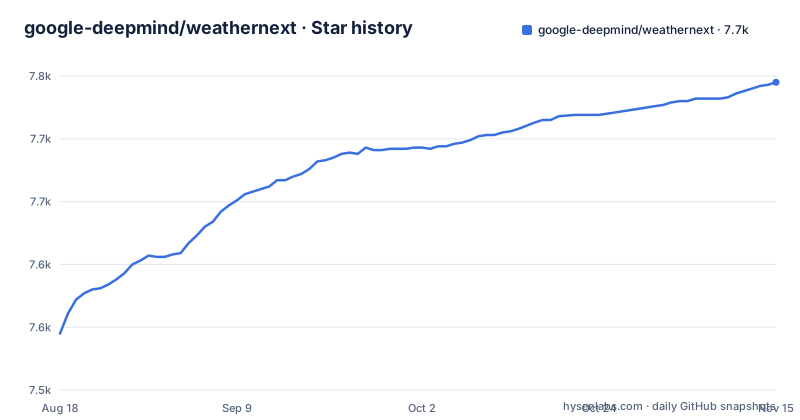
Star history
- google-deepmind/weathernext7,745 ★ · +200
| Repository | 2026-08-18 | 2026-11-15 |
|---|---|---|
| google-deepmind/weathernext | 7.5k | 7.7k |
200 Stars in the last 89 days, measured from the daily GitHub snapshot. Compare with other projects
Editorial analysis
What WeatherNext 2 actually solves
WeatherNext 2 (WN2) is a global, medium-range atmospheric and cyclone forecasting model from Google DeepMind and Google Research. It solves the problem of generating deterministic and probabilistic weather forecasts, including tropical cyclone tracks, without running traditional numerical weather prediction (NWP) solvers. The target user is a researcher or engineer who needs to run the model itself, not someone who just wants a forecast. The README explicitly offers data feeds for the latter group via Google Cloud, WeatherLab, and OpenMeteo. WN2 also forecasts cyclones with the same algorithm as the separate WeatherNext Cyclones models, but with different weights due to independent training runs. This is a research codebase, not a production service. The README states there are no guarantees of API stability and future updates may introduce breaking changes without notice.
The FGN architecture and what the code actually runs
The repository contains code for WeatherNext 2, which the README calls the FGN architecture. What is clear is that WN2 is a joint probabilistic forecasting model, referenced in the technical report 'Skillful joint probabilistic weather forecasting from marginals' (arXiv:2506.10772). The model runs auto-regressive rollout steps: you load initial state weather data (e.g., HRES initial conditions), initialize the WN2 architecture, and then step forward to generate a forecast. The notebook demonstrates how to load weights from a Google Cloud bucket, run rollout steps, visualize outputs like temperature and wind speed, run a direct tracker on model outputs for cyclone tracks, and compute training loss on predictions versus targets. The code is optimized for TPU, as the README recommends TPU where possible. On GPU, you must switch the attention implementation, as shown in the demo notebook.
Getting it running: install, weights, and the Colab path
The quickest start is the interactive Colab notebook at docs/weathernext2/wn2_demo.ipynb. It defaults to WeatherNext Cyclones Mini, which runs on a free v5e-1 runtime. For installation outside Colab, the README gives a pip command: pip install git+https://github.com/google-deepmind/[email protected]. The @v0.3.0 pins to the latest release, which is important given the no-stability warning. Pretrained weights and sample data are on the Google Cloud bucket dm_graphcast. The model variants have specific weight files. WeatherNext2_<2025 is the operational 0.25 degree model, fine-tuned on ECMWF HRES data and designed to initialize directly from operational HRES initial conditions, not ERA5 reanalysis. WeatherNextCyclones models come in <2025, <2024, and <2023 versions; <2025 ran live in the 2025 Atlantic hurricane season, and <2024 and <2023 reproduce the paper's results on 2024 and 2023. The Mini variants are 1 degree resolution and intended for lower memory and compute, such as local testing or single TPUs and GPUs.
Hardware constraints: TPU, GPU VRAM, and the Mini fallback
The README is blunt about hardware. Non-Mini models require H100 for sufficient VRAM on GPU. The Mini models should manage inference on a P100. The attention implementation must be switched when running on GPU, which is a concrete code change you have to make. This is not a plug-and-play library. The recommendation to use TPU reflects that the implementation is optimized for it, but the README does not say GPU is unsupported, only that you must switch the attention. For an engineer evaluating this, the practical takeaway is that you need either a TPU (v5p for non-Mini, v5e-1 for Mini) or a high-end GPU like H100. The Mini models are explicitly not expected to match the performance of the larger versions, so they are for testing the pipeline, not for real forecast skill. That is a genuine trade-off: you can run something on modest hardware, but the output is not production-grade.
Where it is the wrong tool: data feeds exist for a reason
If your goal is to get a forecast, running this model is overkill. The README lists data feeds on Google Cloud (Earth Engine, BigQuery, Vertex AI), WeatherLab (including cyclone tracks), and OpenMeteo (with an API and interactive builder). These give you daily feeds of WN2 model outputs without running anything. The codebase is research code, with no stability guarantees. That means you should not build a production pipeline on an unpinned version. The README explicitly says to pin to a specific release. Also, the model is trained on data through a certain year, so for current operational use you need the <2025 checkpoint, but even that is not a live model. The Nature paper on operational cyclone forecasting describes a model that ran live during the 2025 Atlantic hurricane season, but that is a specific checkpoint, not the general code. If you need real-time forecasts, the feeds are the intended path.
Alternatives: GraphCast, GenCast, and the operational feeds
This repository also contains code for the prior generation models GraphCast and GenCast. GraphCast is a deterministic medium-range forecaster using graph neural networks. GenCast is a diffusion-based ensemble forecaster. These are alternatives within the same repo, so you can run them side by side. The difference in approach is clear: GraphCast gives a single deterministic forecast, GenCast gives an ensemble via diffusion, and WN2 is a joint probabilistic model that also handles cyclones. If you need a deterministic model, GraphCast is the earlier option. If you need ensembles, GenCast is the older option. Outside this repo, traditional NWP models like ECMWF's HRES are the non-AI alternative. The operational feeds are also an alternative in the sense that they replace running the model entirely. The choice between running WN2 and using the feeds is the biggest decision an engineer faces.
Maintenance, upgrades, and license implications
The project is under Apache-2.0, which allows commercial use, modification, and distribution with attribution. The README carries a clear warning: no API stability guarantees, breaking changes without notice. The release history shows v0.1.1 in October 2024, v0.2 in March 2026, and v0.3.0 in August 2026. That is a slow but steady cadence. The last push was in September 2026, so the project is active. For maintenance cost, you must pin to a release and plan to update when new versions come out, because the API may change. The code is optimized for TPU, so if your infrastructure is GPU-only, you will need to switch the attention implementation as the demo notebook shows. Expect to read the notebook and release notes when upgrading. The model weights are separate from the code, so you must also track weight updates. This is a research codebase, so you should budget time for debugging and adapting to changes.
Editorial conclusion
Adopt WeatherNext 2 if you need to run a state-of-the-art medium-range forecast model locally, have TPU access, and accept research-grade code with no API stability guarantees. Do not adopt it if you just need forecasts, since the data feeds on Google Cloud, WeatherLab, and OpenMeteo are simpler. Before committing, verify your accelerator fits the model variant: Mini models run on a P100, non-Mini models require H100 VRAM on GPU. Pin a specific release like v0.3.0, because the README warns of breaking changes without notice.
Frequently asked questions
What is Google WeatherNext?
It is Google DeepMind and Google Research's family of global medium-range atmospheric and cyclone forecasting models, published as a Python library so the models can be run locally. The repository hosts WeatherNext 2 along with the earlier GraphCast and GenCast models.
What is WeatherNext 2?
It is the current generation model in that family. The operational checkpoint WeatherNext2_<2025 runs at 0.25 degree resolution, is fine-tuned on ECMWF HRES data, and is designed to be initialized from operational HRES initial conditions rather than ERA5 reanalysis. Unlike the cyclone models, it also predicts 100m wind.
How do I use WeatherNext 2?
Start with the Colab notebook at docs/weathernext2/wn2_demo.ipynb, which defaults to the Cyclones Mini checkpoint and is meant for the free v5e-1 runtime. Other models need a v5p accelerator, and TPU is recommended; on GPU you must switch the attention implementation as the notebook shows.
How do I access WeatherNext 2 outputs?
Either run the model yourself, or read the daily data feeds of its outputs, which are offered through Google Cloud including Earth Engine, BigQuery and Vertex AI, through WeatherLab including cyclone tracks, and through OpenMeteo with an API and an interactive builder.
How does WeatherNext 2 differ from GraphCast?
GraphCast remains in the repository under docs/weathernext1_graph as WeatherNext Graph, deterministic medium-range forecasting with graph neural networks. WeatherNext 2 is the newer global model and adds probabilistic cyclone output plus 100m wind, while GraphCast is kept as the earlier generation.
Official sources
Add this badge to your README
If you maintain this project, the badge below links readers to this analysis and shows its maintenance status from the daily GitHub snapshot. Paste the markdown into your README; add ?metric=license or ?metric=stars to the image URL for a different field.

[](https://hysenlabs.com/projects/google-deepmind-weathernext)Star history chart for your README
[](https://hysenlabs.com/projects/google-deepmind-weathernext)Was this useful?