Mikan Project Flutter App: Features, Distribution, and Limits
蜜柑计划( https://mikanani.me ),🚧 持续开发中...
At a glance
- What is it?
- Mikan Project is a Flutter client associated with mikanani.me, distributed through Google Play and GitHub releases. Its repository confirms a multi-platform structure, but the README leaves most features and runtime behavior undocumented.
- Who is it for?
- Mikan Project is suitable for users who recognize the mikanani.me service and want a Flutter-based client available through Google Play or GitHub releases. It is a poor choice for developers who need documented APIs, local setup instructions, or clear feature behavior before adoption.
- Can I use it commercially?
- Yes. Apache-2.0 is a permissive licence: you can use, modify and sell software built on it, as long as you keep its copyright and licence notices.
- Is it still maintained?
- Yes. The repository last received commits 43 days ago.
- What is it written in?
- Mainly HTML, according to GitHub's language statistics.
Answers come from the project's GitHub data, last synced on November 6, 2026, and from our analysis. They are not legal advice.
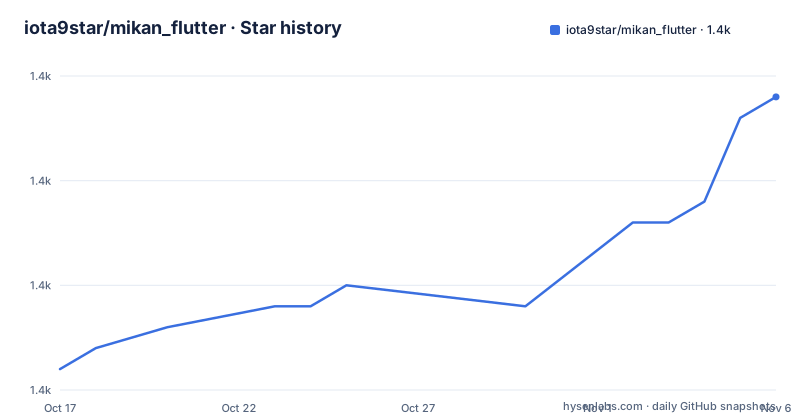
Star history
- iota9star/mikan_flutter1,384 ★ · +13
| Repository | 2026-10-17 | 2026-11-06 |
|---|---|---|
| iota9star/mikan_flutter | 1.4k | 1.4k |
13 Stars in the last 20 days, measured from the daily GitHub snapshot. Compare with other projects
Editorial analysis
Mikan Project's Client Role and Intended Audience
Mikan Project is a Flutter application connected by name and repository metadata to the mikanani.me service. The repository includes the application identifier `io.nichijou.flutter.mikan`, while the README directs readers to mikanani.me and labels the project with Flutter-specific topics. This makes it a client application rather than a general-purpose software development library. The apparent audience is people who already use or intend to use mikanani.me and want access through a mobile application.
The README does not state exactly which service actions the app supports. It does not list subscription management, downloading, searching, notifications, account synchronization, or offline behavior as named features. The fifteen screenshots may show those functions, but the README supplies no captions or walkthrough. It would therefore be misleading to infer a complete feature set from the screenshot count or filenames alone.
The repository layout does establish that this is a full Flutter application rather than a command-line utility. It contains application code under `lib/`, API-related content under `api/`, assets under `assets/`, automated tests, and platform projects for Android, iOS, Linux, macOS, and Windows. That breadth suggests a shared Flutter codebase with platform-specific packaging, but the README does not explain which platforms currently receive working releases or whether every target uses identical features.
Flutter Codebase and Repository Architecture
The visible structure separates the Flutter project configuration from platform implementations. `pubspec.yaml` is the standard Flutter package manifest, `.fvmrc` records the project's Flutter tool configuration, and `analysis_options.yaml` defines Dart analysis settings. Source code resides under `lib/`, while `android/`, `ios/`, `macos/`, `linux/`, and `windows/` provide platform-specific project files. This is a conventional Flutter arrangement in which shared Dart code can support native platform shells.
The presence of `integration_test/` indicates that the repository has a place for application-level integration tests, while `test_driver/` contains driver-related test files. The `cockpit/` and `devtools_options.yaml` entries also point toward Flutter development tooling. None of these paths is explained in the README, so the repository layout supports the existence of development infrastructure but not any claim about test coverage, passing status, or release quality.
API content is isolated in `api/`, which may indicate a client-facing interface or API-related tooling. Without source excerpts or a documented request flow, the relationship between the app, that directory, and mikanani.me cannot be established. In particular, the README does not document authentication, request endpoints, caching, background work, notification delivery, or data synchronization. Those omissions matter more than the presence of the directory because an engineer cannot determine integration behavior or failure modes from the published overview alone.
Google Play and GitHub Release Distribution
Mikan Project provides two documented acquisition paths. The first is the Google Play listing for the application identifier `io.nichijou.flutter.mikan`. The second is the repository's latest GitHub release page. These paths differ in packaging and audience: Google Play provides store-managed Android distribution, while a GitHub release can provide a downloadable artifact selected for the reader's platform.
The README does not provide a build-from-source tutorial. It gives no `git clone`, Flutter version, dependency retrieval, platform setup, or build command that can be copied without guessing. The `.fvmrc` file may select a Flutter configuration, but its contents are not included in the README. Consequently, the following is the full installation guidance that can be stated reliably: choose Google Play for the documented Android listing, or open the latest GitHub releases page and select an artifact if the release contains one for the required operating system.
For a first use, install the Google Play build, open it, and compare the visible interface with the linked service at mikanani.me. This is a verification procedure rather than a documented feature tutorial. The README does not state whether login is required, whether an account must already exist, or what should appear after first launch. It also does not identify artifact names, checksums, supported architectures, or signing details in the release instructions.
Documentation Gaps That Block Feature Evaluation
The largest limitation is the absence of a product feature specification. The README names Mikan Project, links to its service, and displays screenshots, but it does not explain the user journey represented by those images. A reader cannot determine whether this is a complete service client, a focused subset, or a shell connected to an external backend. There is no documented offline model, data export path, notification behavior, or account migration process.
There is also no changelog narrative for the recent releases. Versions `v2.3.6`, `v2.3.5`, and `v2.3.4` are listed with dates, but the release notes are not included. Release numbering alone does not establish upgrade compatibility or whether database migrations occur between versions. Android users may receive store-managed updates, but the README does not say how GitHub release users are expected to update or whether platform artifacts share a common version policy.
These gaps are especially relevant for an application that may interact with a remote service. The project provides no privacy summary in the README itself, despite a top-level `PrivacyPolicy.md` file. That file needs separate review before an engineer or user can understand data collection and permissions. The README also does not document how to report a security issue, recover a locked account, or troubleshoot a failed connection to mikanani.me.
Browser Service Versus Packaged Flutter Client
The relevant alternative approach is to use the browser-based mikanani.me service directly. Mikan Project's homepage is already identified as a web service, whereas this repository packages an associated experience as a Flutter application with native platform directories and store or release distribution. The browser route requires no client installation beyond a web browser and keeps the interface and update cycle on the server side.
The Flutter client may be preferable when native packaging and store installation matter, but the README does not establish a specific benefit such as offline access, background notifications, local media handling, or reduced network use. Those are common reasons to package an application, but none can be claimed for this project from the available documentation. The README also does not describe whether browser and app features are equivalent.
For source evaluation, another constraint is that this repository is not presented as a reusable API package. Its `pubspec.yaml`, platform runners, application package identifier, and user-facing download links position it as an end-user application. Adopting the Flutter code would require evaluating the application as a product and checking its dependency and build requirements, not merely installing it as a library.
Release Cadence, License Text, and Upgrade Work
The repository is not archived, and its last push was on 2026-09-25. It also has three recent tagged releases: `v2.3.6` on 2026-09-12, `v2.3.5` on 2026-08-26, and `v2.3.4` on 2026-07-15. This is evidence of recent repository activity, but the release notes are not included, so it is not possible to determine whether each version contains user-visible changes, fixes, or platform work.
Upgrade cost cannot be quantified from the README. There are no migration instructions, dependency compatibility notes, supported Flutter versions, or minimum operating-system requirements. The multi-platform layout also means that an upgrade may involve platform packaging, although the repository does not state which platforms are shipped. Users choosing GitHub artifacts need a matching release for their operating system; the README does not explain what to do if one is absent.
The license record presents a notable inconsistency. The repository identifies `Apache-2.0`, and the embedded license grants rights and conditions under the Apache License, Version 2.0. The surrounding README text also says the project is for learning and exchange, must be deleted within 24 hours after download, and must not be used unlawfully. Those additional restrictions are not part of the standard `Apache-2.0` identifier. Anyone considering redistribution, modification, or release use should examine the complete `LICENSE` file and obtain appropriate guidance rather than relying on the README summary. This article does not provide legal advice.
Editorial conclusion
Mikan Project is suitable for users who recognize the mikanani.me service and want a Flutter-based client available through Google Play or GitHub releases. It is a poor choice for developers who need documented APIs, local setup instructions, or clear feature behavior before adoption. Review PrivacyPolicy.md, inspect the release assets for the intended platform, and resolve the licensing statements before distributing or modifying the application. Based on the available repository documentation, the clearest adoption boundary is whether the listed binary fulfills a specific user need without requiring undocumented implementation details.
Frequently asked questions
How can I install Mikan Project?
The README offers a Google Play link for the Android application and a GitHub latest-release page for downloadable builds. It does not provide source-build commands or required Flutter setup instructions.
What features does the Mikan Project Flutter app provide?
The README links the app to mikanani.me and includes screenshots, but it does not name or explain individual features. The repository contains Flutter code, API-related content, assets, and platform projects, but those entries do not establish the app's runtime behavior.
Is Mikan Project available outside Android?
The repository contains directories for iOS, Linux, macOS, and Windows, indicating platform targets in the source tree. The README documents Google Play distribution and GitHub downloads, but it does not confirm that every release contains a usable build for each target platform.
Official sources
Add this badge to your README
If you maintain this project, the badge below links readers to this analysis and shows its maintenance status from the daily GitHub snapshot. Paste the markdown into your README; add ?metric=license or ?metric=stars to the image URL for a different field.

[](https://hysenlabs.com/projects/iota9star-mikan-flutter)Star history chart for your README
[](https://hysenlabs.com/projects/iota9star-mikan-flutter)Was this useful?