Diaphora binds two IDA databases by porting types and names and diffing microcode, not just bytes
Diaphora, the most advanced Free and Open Source program diffing tool.
At a glance
- What is it?
- Diaphora is an IDA plugin that diffs two program databases and carries types, symbol names and comments across the pair, with Hex-Rays microcode diffing alongside. It is built for analysts answering one question: which function in this patch actually changed.
- Who is it for?
- Analysts patching one build against another should adopt Diaphora, since porting structs, enums and typedefs has no equivalent in the free tooling. Teams doing whole-program semantic comparison with their own pipeline, or anyone whose company rejects its copyleft terms, should stay away and ask the author about a commercial arrangement first.
- Can I use it commercially?
- Yes, with strict conditions. AGPL-3.0 is a network copyleft licence: if people use a modified version over a network, for example as a hosted service, you must offer them its source code under the same licence.
- Is it still maintained?
- Yes. The repository last received commits 21 days ago.
- What is it written in?
- Mainly Python, according to GitHub's language statistics.
Answers come from the project's GitHub data, last synced on November 15, 2026, and from our analysis. They are not legal advice.
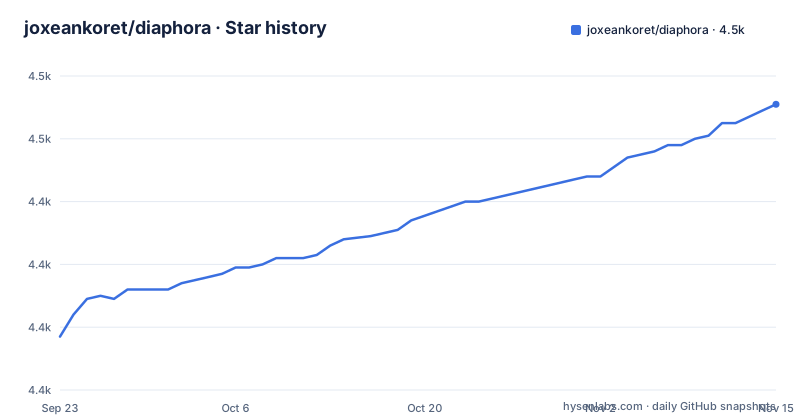
Star history
- joxeankoret/diaphora4,471 ★ · +74
| Repository | 2026-09-23 | 2026-11-15 |
|---|---|---|
| joxeankoret/diaphora | 4.4k | 4.5k |
74 Stars in the last 53 days, measured from the daily GitHub snapshot. Compare with other projects
Editorial analysis
The binding-diff problem: one patched build, two databases
You have a vulnerable binary and the fixed one. Both are open in IDA. The question is not whether the file changed; it is which function changed and how. A byte-level comparison answers neither, because a recompile shifts every address. A text dump of the decompiled listing does not survive either, since one renamed variable changes a line that matters.
Diaphora takes the databases themselves as the input and produces a comparison of functions, structures and control flow. It was released in 2015 and has since been ported to every minor version of IDA from 6.8 through 9.5, with support declared for 7.4 and above. The audience is narrow and technical: reverse engineers doing patch diffing, exploit developers, and anyone auditing a firmware update for the one commit that closed a CVE.
The tool's own name comes from the Greek word for difference, and its own description calls it the most advanced program diffing tool available as of 2026. That is a claim by the author, not a measured result, and nothing in the repository backs it with a benchmark. Judge it on what it ports instead.
What actually crosses between the two databases
Most bindiff tools move names and comments. Diaphora moves more, and that is the whole design. The repository ships separate modules for the import side (diaphora_import.py, diaphora_load.py, diaphora_load_and_import.py), the heuristics (diaphora_heuristics.py), and the IDA glue (diaphora_ida.py), which is why a diff can carry payloads that are not text.
Types travel. Structs, enums, unions and typedefs found in the reference binary are ported into the target, so a function reverse engineered once keeps its structure layout after being matched. Function names and comments follow the same path. Call graph matching calculation aligns functions by what they call as well as what they look like, which matters in stripped firmware where names carry no signal.
Two capabilities go further than text. Hex-Rays microcode diffing compares below the level of decompilation, so a fix that only changes the microcode condition is still visible when the pseudo-code looks identical. And pseudo-code patches can be generated from the diff, giving you the before and after decompiled text side by side with syntax highlighting.
For patched builds there is a further payoff: Diaphora highlights potentially fixed vulnerabilities for patch diffing sessions, and the README's screenshots show it finding the exact function where CVE-2020-1350 and CVE-2023-28231 were fixed.
Installing through the Hex-Rays plugin manager pins you to one tag
The shortest documented path is the Hex-Rays plugin manager, and note that the command names an exact tag rather than the master branch:
hcli plugin install https://github.com/joxeankoret/diaphora/archive/refs/tags/3.5.0.zipPin that tag deliberately.
There is no pip package and no setup.py at the top level. What lives in the repository is a set of Python files you run inside IDA.
The dependencies are short and unversioned:
cdifflib
scikit-learn
joblib
pandas
numpy
Those five lines are the whole of requirements.txt. None of them is pinned, so the same install on two machines can resolve different versions.
Running diaphora.py on the command line only diffs exported databases
There are two documented ways to install Diaphora: the Hex-Rays plugin manager command above, or a manual install where you download the code and place it into your plugins/ directory.
Both export and diffing can be scripted, and the wiki is where the automation recipes live rather than the README. Batch automation is listed as a built-in feature.
Heuristics decide what matches, and every match is only a candidate
diaphora_heuristics.py is where the matching lives, and the README names the inputs: graph theory, assembler, bytes, function features, and pseudo-code based heuristics. A similarity ratio is calculated for each candidate pair. Call graph matching is used alongside that, so a function that changed its own body but kept its callers can still be paired.
This matters for how you read the output. A similarity ratio is a score, not a proof, and manual matches can be added by hand when the heuristics get it wrong.
Diffing assembler and control flow graphs gives you two views to cross-check, and diffing pseudo-codes with syntax highlighting gives the third. Compilation unit support finds and diffs compilation units.
Where Diaphora stops: IDA only, Python 3 only, AGPL since 2.0
The hard boundary is the host. Diaphora is an IDA plugin. The README describes it as working as an IDA plugin and names no other disassembler. If your pipeline does not end in an IDA database, this tool does not join it.
The second boundary is Python 3. Support is declared for IDA 7.4 and above because the code only runs in Python 3.X, and the README states that Python 3.11 was the last version being tested. An older IDA, or a system without a Python 3 interpreter available to IDA, is out.
Licensing is the third boundary and the one that stops deployments. Diaphora is AGPL-3, and for companies that do not allow the AGPL the README offers commercial licences from the author.
Maintenance is not the concern. The last push was on 2026-10-25 and releases 3.4.3, 3.4.4 and 3.5.0 landed on 2026-10-11, 2026-10-20 and 2026-10-25.
BinDiff answers which functions correspond, Diaphora rewrites your types
The comparison worth making is with BinDiff, the older tool most analysts reach for first. The approaches diverge at the input and at the output. BinDiff works on exports of disassembly and assembles its match scores from function metadata, so it stays tied to the binary's structure and works on several reverse engineering hosts. Diaphora works inside IDA, on the live database, which is what lets it port structs and typedefs rather than just rename functions and add comments.
So the practical split: BinDiff answers which functions correspond, and does it across ecosystems. Diaphora answers which functions correspond and then rewrites your type definitions, enums and comments to match, and shows you the microcode where the real change sits. If your workflow ends in a renamed function and a ratio, BinDiff covers it. If your workflow ends in a decompiler you have to read, the type porting is the reason to stay.
For patch diffing specifically, Diaphora's fixed-vulnerability highlighting and pseudo-code patch generation have no counterpart in the free BinDiff workflow.
Editorial conclusion
Analysts patching one build against another should adopt Diaphora, since porting structs, enums and typedefs has no equivalent in the free tooling. Teams doing whole-program semantic comparison with their own pipeline, or anyone whose company rejects its copyleft terms, should stay away and ask the author about a commercial arrangement first. Before anything else, check that your IDA build falls in the 7.4 to 9.5 range the port has covered, because the code only runs on Python 3 and Python 3.11 was the last version tested.
Frequently asked questions
how to install diaphora
Install it through the Hex-Rays plugin manager with hcli plugin install on the 3.5.0 tag archive, or download the code and place it into your plugins/ directory.
how to use diaphora ida
Install it as an IDA plugin, through the Hex-Rays plugin manager or by placing the code into your plugins/ directory. For automating the export or diffing process, the README points to the project wiki.
how to use diaphora
Load the reference binary in IDA and export its database, then load the second binary and run the diff so Diaphora calculates similarity ratios and call graph matches. Heuristics based on graph theory, assembler, bytes and pseudo-code drive the matching, and manual matches can be added by hand.
diaphora vs bindiff
Diaphora is an IDA plugin that also ports structs, enums, unions and typedefs, supports Hex-Rays microcode diffing and generates pseudo-code patches. BinDiff is the separate tool most analysts reach for first, focused on matching functions rather than rewriting type definitions.
Official sources
Add this badge to your README
If you maintain this project, the badge below links readers to this analysis and shows its maintenance status from the daily GitHub snapshot. Paste the markdown into your README; add ?metric=license or ?metric=stars to the image URL for a different field.

[](https://hysenlabs.com/projects/joxeankoret-diaphora)Star history chart for your README
[](https://hysenlabs.com/projects/joxeankoret-diaphora)Was this useful?