CV Parsing with spaCy 3: A Tutorial Repo, Not a Production Tool
Resume and CV Summarization and Paring with Spacy in Python
At a glance
- What is it?
- This GitHub repository is a teaching companion for a YouTube video on resume parsing with spaCy 3. It is a Jupyter notebook and data preparation guide, not a deployable library.
- Who is it for?
- Adopt this repository if you are a beginner following the linked YouTube video and want the exact notebook and data preparation steps. Do not adopt it as a production resume parser; it is a tutorial with no package structure, no license, and no maintenance.
- Can I use it commercially?
- Not without permission. GitHub finds no licence file in the repository, and without a licence all rights are reserved by default: you may read the code but not reuse it. Check the README, or ask the authors, before using it.
- Is it still maintained?
- Probably not. The repository last received commits 52 months ago, on June 17, 2022.
- What is it written in?
- GitHub does not report a main language for this repository.
Answers come from the project's GitHub data, last synced on October 4, 2026, and from our analysis. They are not legal advice.
Star history
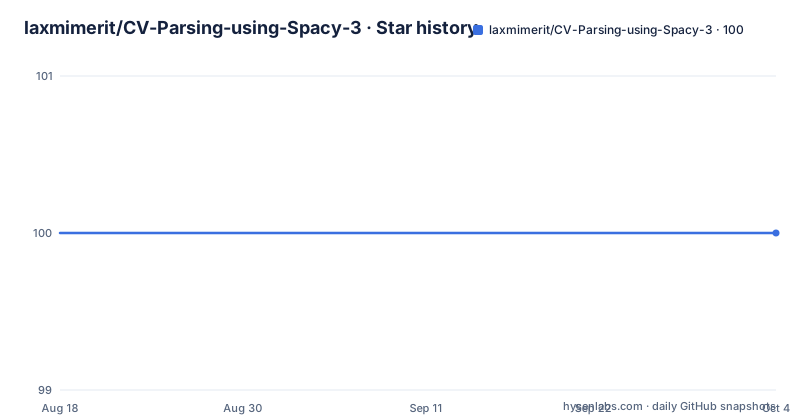
- laxmimerit/CV-Parsing-using-Spacy-3100 ★ · +0
| Repository | 2026-08-18 | 2026-10-04 |
|---|---|---|
| laxmimerit/CV-Parsing-using-Spacy-3 | 100 | 100 |
0 Stars in the last 47 days, measured from the daily GitHub snapshot. Compare with other projects
Editorial analysis
What This Repository Actually Provides
This is not a software library. It is a set of code files, likely a Jupyter notebook, that accompanies a YouTube tutorial. The README says to download a required file and follow along with the video for a line-by-line code explanation. The repository name says spaCy 3, so the code targets that specific version. The intended user is someone learning natural language processing, not an engineer integrating resume parsing into an application. There is no installation guide, no API documentation, and no package manifest. You get the code and a warning about data preparation.
The Core Mechanism: spaCy and Data Preparation
The README does not describe the parsing mechanism in detail, but the repository name and the description point to using spaCy for named entity recognition. In a typical spaCy NER pipeline, you train a model on labeled examples to recognize entities like name, email, phone, and skills. The README stresses that data preparation is the most difficult part and that without a large dataset you might not get good results. That is the real mechanism here: you must build a training dataset, convert it to spaCy's format, and run training. The repository likely contains the notebook that does this, but the README gives no specifics on the entity types or the training loop.
Getting It Running: What the README Tells You
The README gives no direct commands. It says to download a required file and follow the video. The video link is https://youtu.be/HJy11kOlgvk. The working code is said to be in the video description, and the Jupyter notebook can be downloaded from GitHub. So to run this, you would clone the repository, open the notebook, and install spaCy 3. The README does not list dependencies, but spaCy 3 is implied. You will also need a dataset of resumes. The README warns that unless you have a large dataset, results may be poor. That is the only practical guidance.
The Data Problem Is the Real Bottleneck
The README openly states: 'Data preparation is the most difficult task in this lesson. Unless you have large dataset you might not get good result.' That is a genuine limitation. This repository does not provide a pre-built dataset. You must source resumes and label them manually. That is time-consuming and error-prone. For a production system, you would need thousands of labeled examples across different resume formats. This tutorial likely works with a small sample, which means the trained model will not generalize. If you are looking for a ready-to-use resume parser, this is the wrong tool.
Alternatives: spaCy's Built-In Approaches vs. Custom Training
A real alternative is to use spaCy's pre-trained models or rule-based matching instead of custom NER training. spaCy ships with models like en_core_web_sm, which can identify common entities but not resume-specific fields. For skills, job titles, or education, you would need to write custom rules or train a model. Another alternative is to use a dedicated resume parsing service or library like pyresparser, which uses spaCy under the hood but comes with pre-trained models for resume fields. The difference is that pyresparser offers a higher-level API and pre-built entity extraction, while this repository expects you to build the training pipeline from scratch.
Maintenance and License: What You Are Not Told
The repository has no license file, and the README does not mention one. That means you have no legal clarity on how you can use the code. The last push date is unknown, and there are no recent releases. The default branch is master, which is an older convention. The repository appears to be a static tutorial artifact, not an actively maintained project. If you use the code, you are on your own for bug fixes and spaCy version updates. The README is mostly promotional, with links to the author's other video series and a request to like and subscribe. That is a sign that the primary purpose is teaching, not software delivery.
Who Should Skip This and Why
If you are an engineer evaluating resume parsing for a product, skip this repository. It lacks packaging, documentation, and a license. If you are a student following the video, it may be exactly what you need. The value is in the walkthrough, not in the code itself. The README says the working code is in the video description, so the GitHub repo may be incomplete without the video. That is a dependency you should accept before cloning. The biggest risk is the data preparation step; the README warns about it, and you should take that warning seriously. Without a large, diverse dataset, the resulting model will likely overfit to the small sample used in the tutorial.
Editorial conclusion
Adopt this repository if you are a beginner following the linked YouTube video and want the exact notebook and data preparation steps. Do not adopt it as a production resume parser; it is a tutorial with no package structure, no license, and no maintenance. Before using it, verify that the spaCy version in the notebook matches your environment, and check the data preparation section carefully, as the README warns that poor data leads to poor results.
Frequently asked questions
What does CV parsing mean in this project?
The project is titled Resume and CV Summarization and Parsing with Spacy in Python, so the lesson covers both extracting structure from resume and CV documents and summarising them, using spaCy in Python.
Is spaCy still relevant to this CV-Parsing-using-Spacy-3 lesson?
The lesson targets spaCy 3 and ships an nlp_model directory for it, but nothing in the repository addresses a later major version of the library. The last push to master is dated 2022-06-17 and there are no releases.
What is resume parsing software, and does this repository contain it?
The repository is the companion material for one spaCy 3 lesson rather than a parser you can install. Its top level holds only README.md, a data directory, and an nlp_model directory, and the working code is given in the video description.
What API can I use to parse resumes with this project?
The repository documents no API. It points to a YouTube video for the line by line explanation and says the working code is in the video description, with the Jupyter notebook downloaded from GitHub.
Official sources
Add this badge to your README
If you maintain this project, the badge below links readers to this analysis and shows its maintenance status from the daily GitHub snapshot. Paste the markdown into your README; add ?metric=license or ?metric=stars to the image URL for a different field.

[](https://hysenlabs.com/projects/laxmimerit-cv-parsing-using-spacy-3)Star history chart for your README
[](https://hysenlabs.com/projects/laxmimerit-cv-parsing-using-spacy-3)