CPlusPlusThings: A Structured C++ Learning Repository for Interview Prep and Modern C++
GitHub describes it as C++ Things: notes and examples on C++ language features and techniques. The repository metadata lists C++ as its primary language. This article stays within the project description and details documented in the GitHub repository README.
At a glance
- What is it?
- CPlusPlusThings is a Chinese-language C++ learning repository that bundles basic syntax, modern features, STL internals, concurrency, and design patterns. It targets beginners and interview candidates, with a clear directory structure and multiple build options.
- Who is it for?
- Adopt CPlusPlusThings if you are a C++ beginner or interview candidate who wants a structured, topic-by-topic walkthrough of core language features, modern C++ additions, and STL internals, and you can work with Chinese-language material. Do not use it as your only reference if you need a formal textbook or a maintained, versioned codebase.
- Can I use it commercially?
- Not without permission. GitHub finds no licence file in the repository, and without a licence all rights are reserved by default: you may read the code but not reuse it. Check the README, or ask the authors, before using it.
- Is it still maintained?
- Yes. The repository last received commits 33 days ago.
- What is it written in?
- Mainly C++, according to GitHub's language statistics.
Answers come from the project's GitHub data, last synced on November 15, 2026, and from our analysis. They are not legal advice.
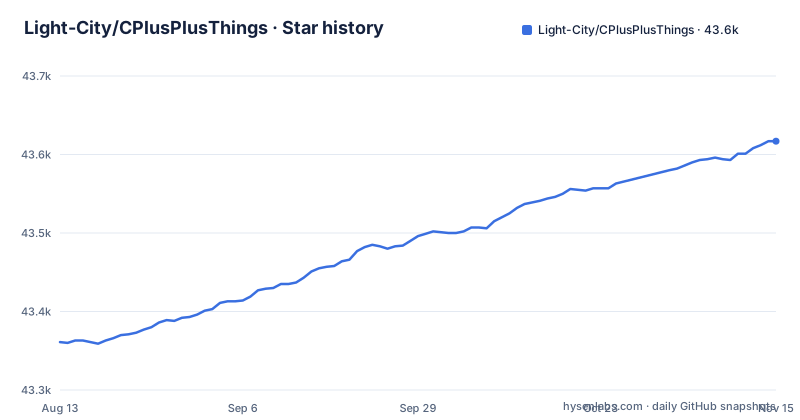
Star history
- Light-City/CPlusPlusThings43,617 ★ · +256
| Repository | 2026-08-13 | 2026-11-15 |
|---|---|---|
| Light-City/CPlusPlusThings | 43.4k | 43.6k |
256 Stars in the last 94 days, measured from the daily GitHub snapshot. Compare with other projects
Editorial analysis
What This Repository Solves and Who It Serves
CPlusPlusThings, also titled "Stories About C Plus Plus," is a learning repository rather than a software library. It addresses a common problem for C++ learners and interview candidates: knowing the language syntax is not the same as understanding how the language behaves under the hood. The README states it is for "beginners from entry to advanced" and solves the problem of "how to get into C++" and "how to go deeper into C++." The intended audience is explicit: C++ beginners, people preparing for interviews, and developers who want to systematically study Modern C++. The repository covers C++11/14/17/20 features, STL source analysis, design patterns, and concurrency programming. If you are looking for a curated path through these topics with code examples, this repository gives you that path. If you need a library to link against, this is not that.
How the Repository Is Organized: A Topic-by-Topic Walkthrough
The repository's structure is its main mechanism for learning. The README lists directories such as basic_content, cpp2.0, practical_exercises, and others. The basic_content folder contains individual subdirectories for language features: const, static, this, inline, sizeof, virtual, volatile, extern, struct, union, enum, decltype, and more. Each subdirectory likely contains explanation files and code examples, though the README does not detail the file contents. The cpp2.0 folder covers new features, with sections for C++11 and C++14/17/20. The practical_exercises folder includes a "10-day practice" sequence that moves from basic syntax to file I/O, plus key exercises like operator overloading, templates, and exception handling. This organization lets a learner pick a topic, read the explanation, and run the associated code. The repository also links to a companion blog and a Feishu knowledge base with interview questions, which suggests the content is meant to be consumed alongside external resources.
Getting It Running: Three Documented Paths
The README offers three ways to run the examples. The first is Visual Studio Code with Bazel. The README does not give the exact commands, only the label "vscode + bazel." The second is Docker. The README provides a pull command: docker pull xingfranics/cplusplusthings:latest. This is the most concrete setup instruction. The third is plain g++. Again, no specific command is shown. For a beginner, the Docker path is the most approachable because it avoids local compiler setup. The g++ path assumes you have a compiler and can compile individual .cpp files. The Bazel path is less common for learning C++ and may be unfamiliar to beginners. The lack of explicit build commands beyond the Docker pull is a gap. You will need to inspect the repository's build files or individual example directories to see how to compile each example.
The Content Breadth: From const to STL Source Analysis
The repository covers a wide range of topics. The basic_content section alone lists 25 language features, including const, static, this, inline, sizeof, function pointers, virtual functions, vptr_vtable, volatile, assert, bit fields, extern, struct, union, explicit, friend, using, and enum. The cpp2.0 section covers C++11 and C++14/17/20 features. The README's video section links to walkthroughs of HashTable, enable_shared_from_this, thread, condition_variable, mutex, and RAII lock. These are advanced topics that go beyond typical tutorial coverage. The concurrency section references "C++ Concurrency in Action" and includes both multithreading and multiprocess topics. This breadth makes the repository useful for interview preparation, where questions often probe these exact areas. However, the depth of each topic is not uniform. The README gives no indication of how much explanation accompanies each code sample.
A Real Limitation: Language and Maintenance Uncertainty
The repository is primarily in Chinese. The README has a link to an English version, but the content descriptions and likely the explanations are in Chinese. For non-Chinese speakers, this is a significant barrier. The README also does not specify a license. The badge in the README links to a LICENSE file, but the top-level files do not include one and GitHub reports the license as unknown. This is a problem if you want to reuse any code in a commercial project. The last push was on 2026-10-13, and the repository has no GitHub releases. The code examples are likely standalone files, not part of a unified build system. This is fine for learning, but it means you cannot treat it as a dependency. You must copy and adapt code yourself. The lack of a stated license is a genuine risk for any serious use.
Alternative Approaches: Textbooks, Online Courses, and Official Docs
A structured alternative is a textbook like "C++ Primer" or "Effective Modern C++." These provide a consistent narrative, exercises, and editorial review. Another alternative is an online course like those on Coursera or edX, which offer video lectures, graded assignments, and a community. The difference in approach is that CPlusPlusThings is a self-directed collection of notes and examples, while a textbook or course gives you a sequential curriculum and feedback. Official C++ reference sites like cppreference.com provide precise language and library documentation, but they do not offer the interview-focused walkthrough that this repository does. If your goal is to pass a C++ interview, this repository's topic organization aligns well with common question categories. If your goal is to build a production system, you would use official documentation and a compiler, not this repository.
Maintenance and Upgrade Cost: What to Expect
Because this is a learning repository, the maintenance cost is on you. There is no package to update, no API to track. The cost is in verifying that the examples compile with your compiler and C++ standard. The repository covers C++11 through C++20, so some examples may require a recent compiler. The Docker image, if current, would provide a consistent environment, but you would need to pull updates manually. The absence of releases means there is no versioned build to pin; the last push was on 2026-10-13. The license is unspecified, so you cannot legally reuse the code without asking the author. For a learner, this is acceptable. For a team evaluating this as a training resource, you need to check the license and the freshness of the content. The repository's value is in its curated list of topics and code snippets, not in ongoing support.
Editorial conclusion
Adopt CPlusPlusThings if you are a C++ beginner or interview candidate who wants a structured, topic-by-topic walkthrough of core language features, modern C++ additions, and STL internals, and you can work with Chinese-language material. Do not use it as your only reference if you need a formal textbook or a maintained, versioned codebase. Before relying on it, verify that the specific code examples compile with your compiler and C++ standard, since the repository appears to be a collection of standalone examples rather than a single buildable project. The value lies in its breadth and organization, not in its rigor as a maintained library.
Frequently asked questions
Does CPlusPlusThings ship a C++ compiler, or do I install one myself?
You supply the toolchain unless you take the docker route. Three ways to run the project are listed, vscode + bazel, docker, and g++, and only the docker one is written as a command.
Can I run the CPlusPlusThings examples on macOS or Windows?
The docker image is described as the way to avoid setting up a development environment, and the pull line is the only command given.
Is the code in CPlusPlusThings licensed for me to reuse?
The badge row links to a LICENSE file, but the top-level files do not include one and GitHub reports the license as unknown. Read that file before copying code out of basic_content/ or practical_exercises/.
Official sources
Add this badge to your README
If you maintain this project, the badge below links readers to this analysis and shows its maintenance status from the daily GitHub snapshot. Paste the markdown into your README; add ?metric=license or ?metric=stars to the image URL for a different field.

[](https://hysenlabs.com/projects/light-city-cplusplusthings)Star history chart for your README
[](https://hysenlabs.com/projects/light-city-cplusplusthings)Was this useful?