Lilishop: a Spring Boot 4 back end, front ends in separate repositories, and a tag from 2022
An open-source Java e-commerce system: B2B2C multi-vendor mall source code based on Spring Boot, Spring Cloud, Vue and Uniapp, with support for mini-program storefronts, microservices, distribution/affiliate sales, live streaming, flash sales and private Docker deployment.
At a glance
- What is it?
- Lilishop is an open source B2B2C mall system in Java, with Vue and uni-app clients and a docker-compose path for private deployment. The README describes a Spring Boot 4 (Java 21) back end, the newest tag dates from 2022, and the front ends live in the separate lilishop-ui and lilishop-uniapp repositories.
- Who is it for?
- Adopt Lilishop when a self-hosted multi-merchant mall is the goal and your team can carry a Java service estate plus its own client work. Do not adopt it expecting one repository that runs end to end, because the README splits the code across four repositories: back end, `lilishop-ui`, `lilishop-uniapp` and `docker`.
- Can I use it commercially?
- Yes, with strict conditions. AGPL-3.0 is a network copyleft licence: if people use a modified version over a network, for example as a hosted service, you must offer them its source code under the same licence.
- Is it still maintained?
- Yes. The repository last received commits 36 days ago.
- What is it written in?
- Mainly Java, according to GitHub's language statistics.
Answers come from the project's GitHub data, last synced on November 14, 2026, and from our analysis. They are not legal advice.
Star history
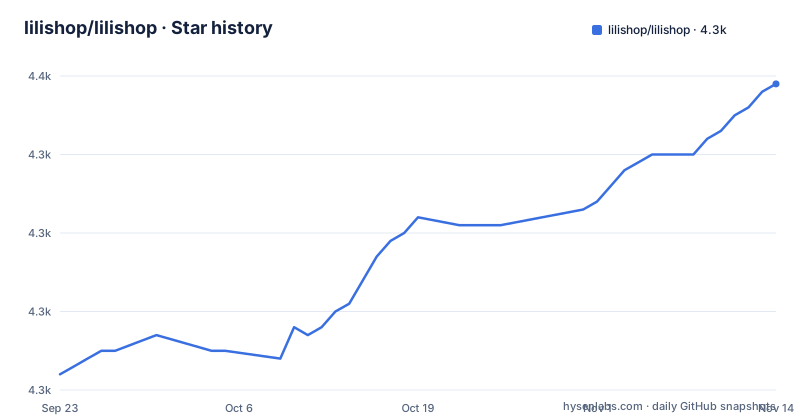
- lilishop/lilishop4,349 ★ · +37
| Repository | 2026-09-23 | 2026-11-14 |
|---|---|---|
| lilishop/lilishop | 4.3k | 4.3k |
37 Stars in the last 52 days, measured from the daily GitHub snapshot. Compare with other projects
Editorial analysis
The newest tag is v4.2.4 from 2022, yet the README pins Spring Boot 3.5.6
Pinning a version in Lilishop means choosing between two different stacks, and the repository does not tell you which one a tag gives you.
The tags on record are v4.2.4 dated 2022-02-15, v4.2.2 dated 2021-09-22 and v4.2.0 dated 2021-06-30. The README now says the back end is built on Spring Boot 4 with Java 21.
That stack is years past the date on the newest tag, so master and v4.2.4 are not the same codebase.
The default branch is master, and the demo environment runs from that same branch. That is why the live demo can show behavior no tag reproduces. Resolve the real versions by reading `pom.xml` at the root of whichever commit you check out, since the README says it no longer maintains a technology stack table.
The root holds eight module directories and no front-end directory
Everything you can inspect sits in a Maven multi-module layout. The top level lists buyer-api, framework, im-api and manager-api as directories, plus DB/, config/, pom.xml, pushGithub.sh, LICENSE, README.md, README.en.md and .gitignore.
The README says the back end is built on Spring Boot 4, and that clients cover PC, H5, mini program and APP on Vue and uni-app, with every end shipped as open code. No Vue or uni-app project appears in this root listing because the README places them in separate repositories: `lilishop-ui` for PC, merchant, operations and IM web, and `lilishop-uniapp` for H5, mini program and APP.
Three entries invite questions the README does not answer. `im-api` is never described in the prose. Open it and see what is actually inside before you plan a team around it.
Spring Cloud is named in the summary but absent from the version table
Open the repository description and the first thing in it is a stack name: Spring Boot, then Spring Cloud, then Vue, then Uniapp. The README's feature list also names a SpringCloud microservices mall.
The README no longer carries a technology stack table. Its architecture section says the front page stopped maintaining an incomplete architecture diagram and stack table to avoid drifting from the actual source, deployment shape and branches, and points readers to the official documentation and four source repositories: `lilishop` for the back end, `lilishop-ui` for PC, merchant, operations and IM web, `lilishop-uniapp` for H5, mini program and APP, and `docker` for deployment, SQL, images and startup scripts.
A reader checking whether the microservices promise holds has to look at `pom.xml` and the module directories for Spring Cloud artifacts.
Deployment forks into two paths: docker-compose, or a SQL script from Gitee
The README gives one recommended route and one manual route, and the difference between them is who initialises MySQL.
The recommended route is the docker-compose configuration shipped with the project. It brings up the databases, listing MySQL and Redis among them, and initialises them as part of startup. The repository root does not include a compose file; the README says deployment, SQL, image and startup scripts live in the separate `docker` repository.
The manual route is a set of SQL files, and the README is specific about one rule: the script must match the code version. Those files live outside the repository, in the docker repository at https://gitee.com/beijing_hongye_huicheng/docker/tree/master/init/mysql. Loading a script from a different commit than your code is the failure mode the README warns about.
For the actual sequence, the README sends you to the deployment page at https://docs.pickmall.cn/deply/deply.html rather than repeating the steps. One root-level script, `pushGithub.sh`, sits beside the modules with nothing said about it.
Every demo account answers the same verification code 111111
The demo section hands you three logins and one universal code, which is the fastest way to see the buyer and seller sides before installing anything.
Platform admin at https://admin-b2b2c.pickmall.cn uses account `admin` and password `123456`. The store admin at https://store-b2b2c.pickmall.cn uses `13011111111` and `111111`. The public storefront sits at https://pc-b2b2c.pickmall.cn and the README gives no credentials for it. One phone verification code covers all of them, and it is `111111`.
Read one detail before you trust any of it. The demo is deployed from the master branch, so nothing you see there corresponds to v4.2.4. The WeChat mini program entry is listed as a target with no address after it, so that claim has no link to open.
The README links the project on both GitHub (github.com/lilishop/lilishop) and Gitee (gitee.com/beijing_hongye_huicheng/lilishop).
AGPL-3.0 restricts resale and hands commercial use to the vendor
Five numbered clauses in the README's agreement section decide who may run this code, and the vendor sells a way around the restriction.
Clause one states that the project follows `AGPL-3.0`. Clause two limits use to personal study, research and non-commercial purposes. Clause three forbids selling the code and its resources in any commercial form. Clause four requires official authorisation for commercial use, which the vendor describes as a one-off permanent grant with continuing version upgrades, and directs enquiries to the official website's customer service. Clause five records a software copyright registration, 2021SR0805085.
For a team that needs a commercial deployment, that paid authorisation is the alternative path, and it is the only one the project describes. No permissive variant of the code is offered alongside it, and no other open source mall is pointed to for teams that want to avoid the vendor entirely.
Two details deserve a decision before any code is written. A platform that onboards paying merchants sits somewhere the text above does not define, and the promise of continuing upgrades is the vendor's commitment rather than a schedule the repository controls.
The feature list is a spreadsheet link, and support runs through WeChat
Functional coverage is the weakest documented part of this project, and the way it is handled says something about how the work is organised.
Section 6 of the README does not list features. It links to a Feishu spreadsheet for the feature inventory, so the module inventory you plan against lives outside the repository and can change without a commit. Section 9, the upgrade plan, does mark features as done or planned, such as two-level distribution and scheduled task management done, and wallet ledger and Douyin store integration planned. A short feature checklist at the top of the file names Java, SpringBoot, SpringCloud, B2B2C, Vue, Docker and multilingual support, which is a keyword list rather than a module map.
The support routes are equally concrete: an online customer service link hosted on WeChat Work and a WeChat discussion group entry. Before you file a question the README asks you to read the documentation at https://docs.pickmall.cn/ and a guide on asking questions well.
None of that tells you how upgrade work reaches your checkout. The root listing holds no test directory and no continuous integration configuration, and the README does not document a procedure for moving a database between two commits. The repository is not archived and the last push was on 2026-10-10, so read the commit list since your fork point before you plan any merge.
Editorial conclusion
Adopt Lilishop when a self-hosted multi-merchant mall is the goal and your team can carry a Java service estate plus its own client work. Do not adopt it expecting one repository that runs end to end, because the README splits the code across four repositories: back end, `lilishop-ui`, `lilishop-uniapp` and `docker`. Check three things before anyone writes code: which commits of `lilishop-ui` and `lilishop-uniapp` match your back end, which tag or branch you will build from, and whether the SQL script you load was written for that same commit. Expect to settle the commercial terms with a lawyer rather than from the README alone.
Frequently asked questions
What is Lilishop and what stack does it use?
Lilishop is a Java B2B2C multi-merchant mall system built on Spring Boot 4 (Java 21), with a Vue front end and uni-app mobile clients kept in separate repositories. The repository description also names Spring Cloud.
How do I deploy Lilishop on my own server?
The README recommends the project's docker-compose configuration, which deploys and initialises the databases, listing MySQL and Redis among them. For a manual deployment it points to SQL scripts in a separate Gitee repository and warns that the script has to match your code version.
Which version of Lilishop should I build?
The default branch is master, and the README there describes a Spring Boot 4 (Java 21) back end. The newest tag is v4.2.4, dated 2022-02-15, so tagged code and the current branch are not the same stack.
Can I use Lilishop for a commercial website?
The README states that the project follows AGPL-3.0, allows use only for personal study, research and non-commercial purposes, and forbids selling the code and its resources in any commercial form. Commercial use requires official authorisation from the vendor, offered as a one-off permanent grant with continuing version upgrades.
Does Lilishop include the front-end source code?
The README says the front end covers the PC and H5 web, the WeChat mini program and APP builds on Vue and uni-app. This repository holds the back end; the README places the front ends in separate repositories, `lilishop-ui` (PC, merchant, operations and IM web) and `lilishop-uniapp` (H5, mini program and APP).
What accounts can I use on the Lilishop demo site?
The platform admin demo uses account admin with password 123456, and the store admin demo uses 13011111111 with 111111. One phone verification code, 111111, covers the demo, which the README says is deployed from the master branch.
Official sources
Add this badge to your README
If you maintain this project, the badge below links readers to this analysis and shows its maintenance status from the daily GitHub snapshot. Paste the markdown into your README; add ?metric=license or ?metric=stars to the image URL for a different field.

[](https://hysenlabs.com/projects/lilishop-lilishop)Star history chart for your README
[](https://hysenlabs.com/projects/lilishop-lilishop)Was this useful?