Zygisk Next: a standalone Zygisk implementation for KernelSU and Magisk
Standalone implementation of Zygisk
At a glance
- What is it?
- Zygisk Next re-implements the Zygisk API outside of Magisk, so a module can load on a KernelSU system or on Magisk with its built-in Zygisk turned off. It fits developers of Zygisk modules and root power users, and it does not fit anyone who needs to modify or redistribute it, because the project reserves all rights and forbids both.
- Who is it for?
- Adopt Zygisk Next if you write Zygisk modules and want them to work on a KernelSU device or on Magisk with built-in Zygisk disabled, and you are prepared to treat the binary as a closed dependency you cannot patch. Skip it if your plan involves forking the implementation, vendoring it into a build, or shipping it to end users, because those are exactly what the licence forbids.
- Can I use it commercially?
- Not without permission. GitHub finds no licence file in the repository, and without a licence all rights are reserved by default: you may read the code but not reuse it. Check the README, or ask the authors, before using it.
- Is it still maintained?
- Yes. The repository last received commits 25 days ago.
- What is it written in?
- Mainly C, according to GitHub's language statistics.
Answers come from the project's GitHub data, last synced on November 6, 2026, and from our analysis. They are not legal advice.
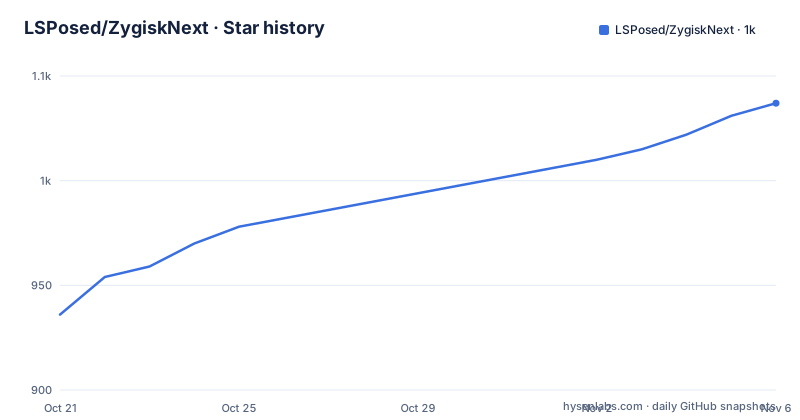
Star history
- LSPosed/ZygiskNext1,037 ★ · +101
| Repository | 2026-10-21 | 2026-11-06 |
|---|---|---|
| LSPosed/ZygiskNext | 936 | 1k |
101 Stars in the last 16 days, measured from the daily GitHub snapshot. Compare with other projects
Editorial analysis
Zygisk without depending on Magisk's copy of it
Zygisk Next is described in the repository description as a standalone implementation of Zygisk, and the documentation spells out what that means in practice: it provides Zygisk API support for KernelSU, and it acts as a replacement for Magisk's built-in Zygisk.
That is the whole point of the project. Zygisk is the mechanism that lets a module inject itself into the app process space rather than running as a separate app, and until now the usual way to get that API was to install Magisk and accept Magisk's implementation of it. Zygisk Next removes that dependency, which matters for two audiences. The first is KernelSU users, who run a different root solution and had no Zygisk API to build against. The second is Magisk users who would rather run a smaller, independent implementation than the one bundled with their root manager.
The implementation is C, and the repository is deliberately small: README.md, docs/, module.yaml and zygisk_next_api.h, plus a .github directory. That header file is the API surface for anyone writing a module, and the documentation points to a separate sample repository, ZygiskNextModuleSample, for example usage. The interface between the framework and a module is therefore a documented C header rather than a Java API, which shapes who can actually target it.
Version floors decide whether it runs at all
The requirements are stated as a compatibility matrix, and they are strict enough to read before anything else.
For KernelSU, the minimum KernelSU version is 10940 and the minimum KernelSU Manager, ksud, version is 11575. For Magisk, the minimum version is 26402 and the built-in Zygisk must be turned off. There is also a general requirement that no multiple root implementation is installed, which is the same constraint any root setup imposes.
The Magisk line is the one that catches people out. Turning off Magisk's built-in Zygisk is a prerequisite, not a recommendation, so an installation with both the built-in Zygisk and Zygisk Next active is not a supported configuration. The KernelSU line also pairs two version numbers rather than one, which tells you the framework talks to the KernelSU manager as well as to the kernel module, so a manager that is older than the required build will not do even if the kernel side is new enough.
Nothing in the repository describes what happens on a mismatch. There is no compatibility table for intermediate versions and no fallback mode, so the sensible check is the version list itself before you flash anything.
A native API, and a separate path for HyperOS
Zygisk Next provides an API for injecting into init-oriented processes, and the details live in zygisk_next_api.h in the repository root. Example usage is in the linked sample project, which is the reference a module developer should start from.
Alongside that, the project documents support for application callbacks for HyperOS Rust Runtime in docs/hyos_runtime.md. Two properties of that API are stated explicitly and both matter. It is a native-only API, and it does not provide ART or JNI compatibility to regular Zygisk modules. So a module written against it cannot be reused as an ordinary Zygisk module, and a module written the ordinary way will not reach the HyperOS callbacks. The two surfaces are separate code paths rather than one API with an extra feature.
That constraint is worth weighing before choosing a target. If your module is a Java or Kotlin Xposed-style module that relies on hooking ART methods, the HyperOS runtime path is not for you, and the regular Zygisk API header is the relevant document. If your module is native code and your users are on HyperOS, the native callbacks are the reason to pick this implementation at all.
No installation steps are given, so the flashing path is on you
Here the documentation stops. The project notes contain requirements, the API pointer, the sample project, the translation note and the licence, but no installation instructions. There is no command to run, no recovery procedure, no zip to flash and no documented way to uninstall.
What the repository does show is the shape of the artefact. A module.yaml file sits at the top level, which is the descriptor format used by root frameworks for a flashable module package, and the top level contains docs/ alongside the header. The WebUI mentioned in the translation note is a user interface inside the module, and its translations are contributed through pull requests to a separate i18n branch rather than to main, which is a detail that tells you the translation workflow is decoupled from the code branch.
The honest reading is that installation here follows the standard procedure for a root module package on your chosen framework, and this repository does not document it beyond publishing the module. If a project does not tell you how to install it, that is a cost you should price in rather than a gap you can paper over with a tutorial elsewhere.
The licence forbids modification, redistribution and reuse
This is the sharpest fact in the repository, and it changed. The copyright notice states that Zygisk Next, starting from version v4-0.9.2, is no longer under the GPL-3.0 licence. Instead, all rights to the software are reserved by the owner. Copyright is attributed to the Zygisk Next developers for 2024 to 2026.
Four conditions follow. The software may not be modified in any way, which includes changing, adding or removing any part of its code or functionality. It may not be redistributed in any form, including renaming, selling, or including it as part of another project. No part of it may be extracted and submitted to other projects, and the text is explicit that this covers code snippets, functions and released binaries. Finally, a fork created before the licence change may not claim to be an official or unofficial successor, including any use of the name, branding or reputation to imply a connection.
This is a source-available licence in name only for most practical purposes: you can read it, and you can run the published binary. Compare that with the earlier GPL-3.0 terms, under which modification and redistribution were permitted. Note also the version mismatch: the licence change is tied to v4-0.9.2, a numbering scheme from before the current v1.5.x releases, so the terms predate the version line you would actually install. The repository licence field is not filled in, so that statement is the authoritative text here.
Release pace and what a dependency on it costs
The repository is not archived and the last push was on 2026-10-13, the same day as release v1.5.2. The recent history is three releases inside about a month: v1.5.0 on 2026-09-20, v1.5.1 on 2026-10-12 and v1.5.2 on 2026-10-13. Point releases arriving days apart suggests active work on a stable 1.x line.
The cost of depending on it is different from the cost of depending on a normal open source library, and it comes from the licence rather than from the API. If you write a module that needs Zygisk Next, you are building on a binary you cannot patch, cannot vendor and cannot redistribute as part of your own project. That rules out several ordinary workflows: bundling it into a custom ROM or a rooted-device image, shipping it with your own installer, or maintaining a private fix for a device-specific problem.
The module ecosystem is the mitigation. Because the API is a header and there is a sample module, a module author can develop against the documented interface and target whichever implementation the user has installed, which keeps the coupling on the API surface rather than on the binary. That is workable, but it does mean you are targeting a moving implementation whose licence can change again, in a repository whose licence field is still unset.
Editorial conclusion
Adopt Zygisk Next if you write Zygisk modules and want them to work on a KernelSU device or on Magisk with built-in Zygisk disabled, and you are prepared to treat the binary as a closed dependency you cannot patch. Skip it if your plan involves forking the implementation, vendoring it into a build, or shipping it to end users, because those are exactly what the licence forbids. Verify first the minimum versions on your device, KernelSU 10940 with ksud 11575, or Magisk 26402 with built-in Zygisk off, and that only one root implementation is installed.
Frequently asked questions
What does Zygisk Next do and how is it different from Magisk Zygisk?
Zygisk Next is a standalone implementation of the Zygisk API. It provides Zygisk API support for KernelSU and acts as a replacement for Magisk's built-in Zygisk, so a module can run on either root solution without depending on the implementation bundled with Magisk.
What are the minimum requirements for Zygisk Next?
On KernelSU, version 10940 or newer is required along with KernelSU Manager ksud 11575 or newer. On Magisk, version 26402 or newer is required with the built-in Zygisk turned off. No multiple root implementation may be installed.
Can I modify or redistribute Zygisk Next?
No. Since version v4-0.9.2 the project is no longer under GPL-3.0 and all rights are reserved. The stated conditions forbid modification, forbid redistribution in any form, forbid extracting parts into other projects, and forbid a pre-change fork from claiming to be a successor to the project.
How do I write a module against the Zygisk Next API?
The API is documented in zygisk_next_api.h in the repository, and the documentation points to ZygiskNextModuleSample for example usage. It is a native C interface for injecting into init-oriented processes, and separate HyperOS Rust Runtime callbacks are documented in docs/hyos_runtime.md as native-only, with no ART or JNI compatibility for regular Zygisk modules.
Official sources
Add this badge to your README
If you maintain this project, the badge below links readers to this analysis and shows its maintenance status from the daily GitHub snapshot. Paste the markdown into your README; add ?metric=license or ?metric=stars to the image URL for a different field.

[](https://hysenlabs.com/projects/lsposed-zygisknext)Star history chart for your README
[](https://hysenlabs.com/projects/lsposed-zygisknext)Was this useful?