emoji-regex: a Unicode-derived pattern for matching emoji sequences
A regular expression to match all Emoji-only symbols as per the Unicode Standard.
At a glance
- What is it?
- emoji-regex is a single dependency that generates its pattern from the Unicode emoji test data at build time, which makes every release deterministic, and it exports a factory function rather than a mutable global regular expression.
- Who is it for?
- Use emoji-regex when the set of characters you match has to be pinned, for example when a build step replaces every emoji with an asset and you need to know that an asset exists for each match. Use the lighter alternative instead when you only need to recognise emoji roughly and care more about bundle size, since it follows the same API without the determinism guarantee.
- Can I use it commercially?
- Yes. MIT is a permissive licence: you can use, modify and sell software built on it, as long as you keep its copyright and licence notices.
- Is it still maintained?
- Yes. The repository last received commits 38 days ago.
- What is it written in?
- Mainly JavaScript, according to GitHub's language statistics.
Answers come from the project's GitHub data, last synced on October 23, 2026, and from our analysis. They are not legal advice.
Star history
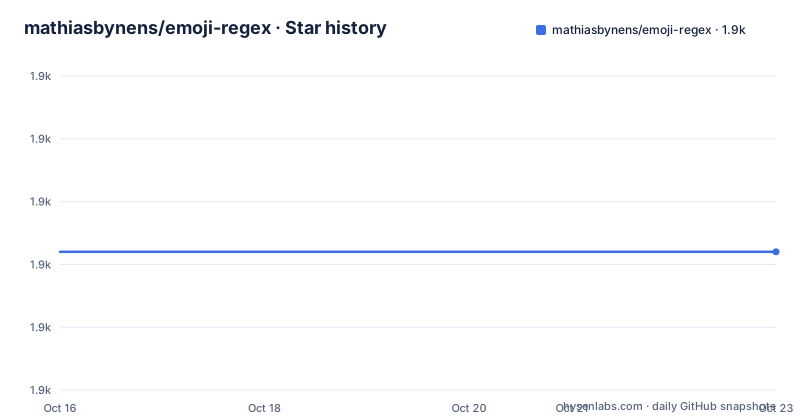
- mathiasbynens/emoji-regex1,912 ★ · +0
| Repository | 2026-10-16 | 2026-10-23 |
|---|---|---|
| mathiasbynens/emoji-regex | 1.9k | 1.9k |
0 Stars in the last 7 days, measured from the daily GitHub snapshot. Compare with other projects
Editorial analysis
The pattern is generated from the Unicode test data
The package offers a regular expression that matches emoji symbols and sequences, including the textual representations of emoji, as defined by the Unicode Standard. The important detail is where the pattern comes from. It is based on the emoji-test-regex-pattern project, which generates the regular expression pattern at build time from the Unicode Standard itself, and that is why the package can be updated whenever new emoji are added to Unicode without anyone hand editing a character class. The repository is thin by design. The published files are a licence file, a type declaration and one module, and the build lives in a script directory with the source and tests alongside. What you install is small; what it knows is not.
Determinism is the reason the pattern is this big
Each release of emoji-regex is tied to the latest Unicode version at the time of release, and the documentation explains why that matters with a concrete case. For use cases like image replacement, you want the guarantee that an image asset is available for every emoji the pattern can possibly match. A pattern that silently gains new matches when Unicode moves forward would break that guarantee, so the package pins its results instead. If you do not need a deterministic regex, the documentation points at a lighter-weight, general emoji pattern published as emoji-regex-xs, which follows the same API. The difference is exactly the trade you would expect: one gives you a stable, complete set of matches, the other gives you a smaller pattern that moves with the standard.
The package exports a factory, not the regex itself
The import looks like importing any other module, but the shape of the export is deliberate. Because the regular expression has the global flag set, the module exports a function that returns the regex rather than exporting the regular expression itself, and the documentation says the reason is to make it impossible to accidentally mutate the original regular expression. A global regex carries state in its lastIndex property, so a shared instance used with a loop and a reset can produce surprises. Handing out a fresh instance per call removes that class of bug.
import emojiRegex from 'emoji-regex';

const regex = emojiRegex();
for (const match of text.matchAll(regex)) {
The package ships TypeScript declarations alongside the module, and the manifest points its main entry at the ES module file with the declaration file as its types entry.
Matches are sequences, and the code point count shows it
The worked example in the documentation feeds a small block of text to the pattern and prints each match with its number of code points. The results are what make the point about sequences. A watch is one code point, but the left-right arrow with its variation selector is two, because the selector is what asks for the emoji presentation rather than the default text one. The base of a modifier sequence, the woman figure, matches on its own as one code point, and the same figure followed by a skin tone modifier matches as a single two code point sequence. That is the behaviour you want for replacement logic, because replacing the modifier sequence as a unit is the only way the result still renders.
Updating after a Unicode release is a four step routine
The maintainer instructions describe the full loop, and it is worth reading even if you never maintain the package, because it shows what the version numbers mean. First, the upstream emoji-test-regex-pattern project is updated following its own instructions. Then that dependency is bumped to the latest version. Then the Unicode data dependency in the manifest is replaced, for example moving from the Unicode 13 package to the Unicode 14 one.
# Example: updating from Unicode v13 to Unicode v14.
npm uninstall @unicode/unicode-13.0.0
npm install @unicode/unicode-14.0.0 --save-dev
The new output is generated with the build script and the tests are run to confirm nothing broke.
npm run buildnpm testPublishing then means bumping the version in the manifest, with patch, minor or major as needed, which produces a commit and a tag, and pushing both the commit and the tags. The CI pipeline publishes to npm automatically after that.
Versions are npm versions, with no GitHub releases
The manifest records version 11.0.0, with the build script running a file in the script directory and the tests run through the Node test runner rather than a framework. The development dependencies show exactly what the pattern is built from, a specific Unicode data package and the emoji-test-regex-pattern generator, plus a formatter. The repository itself has no GitHub releases at all, because the package is distributed through npm, and the CI workflow publishes there. The last push to the repository was on 2026-09-15, the project is not archived, and the licence is MIT, which requires keeping the copyright notice when you redistribute it.
Editorial conclusion
Use emoji-regex when the set of characters you match has to be pinned, for example when a build step replaces every emoji with an asset and you need to know that an asset exists for each match. Use the lighter alternative instead when you only need to recognise emoji roughly and care more about bundle size, since it follows the same API without the determinism guarantee. Before you upgrade, note that the package version tracks the Unicode version it was built from, so a new release can add matches that your asset pipeline has never seen, and check your replacement table against the new pattern.
Frequently asked questions
How do I install emoji-regex?
Install it from npm with `npm install emoji-regex`. It is published as an ES module with TypeScript declarations alongside it.
Why does emoji-regex export a function instead of the regex?
The regular expression has the global flag set, so the module exports a function that returns the regex to make it impossible to accidentally mutate the original regular expression, which carries state between uses.
What is the difference between emoji-regex and emoji-regex-xs?
emoji-regex is tied to the Unicode version at release time so its results are deterministic, while emoji-regex-xs is a lighter-weight, general pattern that follows the same API and is the option when you do not need that guarantee.
How is the pattern kept up to date with new Unicode emoji?
The upstream emoji-test-regex-pattern project generates the pattern at build time from the Unicode Standard, and the maintainer steps are to update that dependency, replace the Unicode data package in the manifest, run the build and run the tests.
Official sources
Add this badge to your README
If you maintain this project, the badge below links readers to this analysis and shows its maintenance status from the daily GitHub snapshot. Paste the markdown into your README; add ?metric=license or ?metric=stars to the image URL for a different field.

[](https://hysenlabs.com/projects/mathiasbynens-emoji-regex)Star history chart for your README
[](https://hysenlabs.com/projects/mathiasbynens-emoji-regex)Was this useful?