Lithium C++17 HTTP Server: Platform Support and Project Structure
Easy to use C++17 HTTP Server with no compromise on performances. https://matt-42.github.io/lithium
At a glance
- What is it?
- Lithium is a C++17 HTTP server and database library for Linux and macOS developers. Its repository offers native builds, single-header distribution, SQL drivers, and an ORM, but Windows is explicitly unsupported.
- Who is it for?
- Adopt Lithium when a C++17 service needs a native HTTP server, database integration, or repository-managed single-header distribution. Do not choose it for Windows or when you require documented releases, automated release notes, or a complete first-server tutorial.
- Can I use it commercially?
- Yes. MIT is a permissive licence: you can use, modify and sell software built on it, as long as you keep its copyright and licence notices.
- Is it still maintained?
- Yes. The repository received new commits within the last day.
- What is it written in?
- Mainly C++, according to GitHub's language statistics.
Answers come from the project's GitHub data, last synced on October 23, 2026, and from our analysis. They are not legal advice.
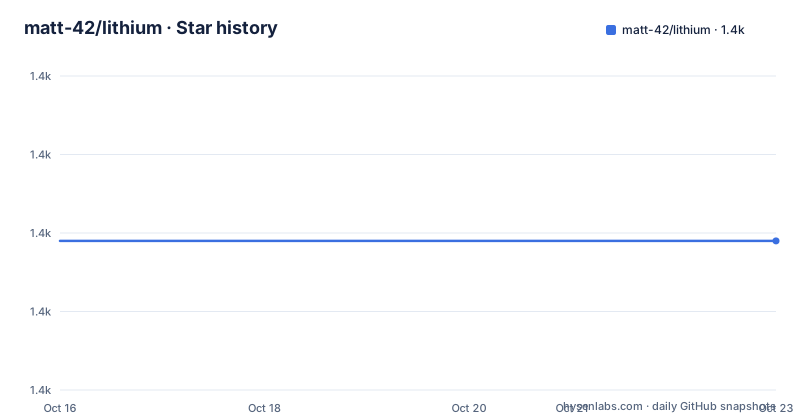
Star history
- matt-42/lithium1,409 ★ · +0
| Repository | 2026-10-16 | 2026-10-23 |
|---|---|---|
| matt-42/lithium | 1.4k | 1.4k |
0 Stars in the last 7 days, measured from the daily GitHub snapshot. Compare with other projects
Editorial analysis
Lithium's C++17 HTTP and Database Scope
Lithium addresses the need for HTTP and database functionality inside a C++17 codebase without introducing a runtime language separate from C++. Its repository topics include `http-server`, `http-client`, `asynchronous`, `webframework`, `sql-driver`, `object-relational-mapper`, `json`, `mysql`, `postgresql`, and `sqlite3`. This makes the project relevant to engineers building native network services, APIs, or data-backed C++ applications.
The scope is broader than a single HTTP listener. The README identifies Lithium as a C++17 HTTP server and also mentions SQL drivers. The repository layout supports that description through separate `libraries`, `single_headers`, `cli`, `test`, `vcpkg`, and `conan` directories. That separation indicates distinct library sources, generated-header distribution, command-line material, tests, and two package-management paths.
Lithium is most relevant when the application owner wants direct access to C++ libraries rather than a separately deployed application framework. The README does not document a conventional application layout, configuration-file format, deployment model, or production operations guide. Engineers looking for a complete service template may therefore need more from the project documentation than a library-oriented repository provides.
Native CMake and Single-Header Distribution
Based on the top-level repository entries, Lithium supports several visible distribution paths. `CMakeLists.txt`, `CMakePresets.json`, the `cmake` directory, and `cmake_project_template` are oriented toward CMake-based native integration. The `single_headers` directory provides another apparent distribution route through single-header files. The presence of `vcpkg` and `vcpkg.json` also indicates a vcpkg manifest path, while the `conan` directory indicates Conan packaging support.
This layout offers distinct integration choices. A CMake project can use the repository as part of its native build configuration. A consumer that prefers generated single headers can use the files exposed under `single_headers`. Package-manager users have separate `vcpkg` and `conan` directories rather than depending on an undocumented integration mechanism.
However, the README does not provide the names of generated headers, CMake targets, package options, Conan recipe commands, vcpkg feature names, or installation commands. Those values cannot be inferred from directory names. The project includes `INSTALL.md` as its explicit installation document, so that file is the first place to verify the build procedure.
Lithium Compiler and Operating System Boundaries
Lithium's supported compiler list is specific. For Linux, the README lists G++ 9.2 and Clang++ 9.0. For macOS, it lists Apple clang version 12.0.0. These entries identify documented compiler versions, but the README does not say whether later versions are tested, unsupported, or expected to work.
Windows is an explicit project boundary. The README says, "Windows: Not supported. Waiting for a bugfix in the MSVC C++ compiler." The presence of a `vcpkg` directory does not change that platform statement. A Windows deployment would therefore conflict with the project's documented support policy unless its maintainers have changed that policy.
That limitation makes Lithium unsuitable for teams that require one codebase and one native build across Linux, macOS, and Windows. It also makes compiler validation a precondition. Compare the selected G++ or Clang version with the listed versions, then consult `INSTALL.md` for dependencies not described in the README.
Lithium HTTP, SQL, and ORM Boundaries
The repository combines HTTP functionality with SQL-related components, but the README does not explain their internal APIs or data flow. It does not show an event loop, request handler callback, connection lifecycle, database connection setup, query API, ORM model definition, migration mechanism, or transaction example. The topics support the conclusion that these capabilities belong to the project, but they do not establish how they interact at runtime.
The `test` directory provides a logical place to look for executable examples of those mechanisms. The `libraries` directory should contain the relevant implementation, while `single_headers` is intended for the generated-header route. The README does not identify individual filenames, so naming a particular listener, ORM type, or query function would go beyond its documentation.
There is also no documented deployment topology. Lithium may be embedded into an application, but the README does not explicitly describe process management, TLS termination, reverse proxies, configuration loading, health endpoints, or graceful shutdown. Those omissions matter when selecting an HTTP server for a deployed service. Lithium appears strongest as a source-level C++ library, while operational responsibilities may remain with the embedding application.
Lithium First Use and Installation Path
The project provides `INSTALL.md`, `CMakePresets.json`, `cmake_project_template`, `install.sh`, `vcpkg.json`, and a `conan` directory as concrete entry points. The README links to the documentation site at `https://matt-42.github.io/lithium`, but it does not quote installation commands or a minimal server program. Reproducing an unverified command or inventing a handler API would make the tutorial unreliable.
A first adoption pass should begin with `INSTALL.md` to determine the supported build route. A CMake-based user should then inspect `CMakeLists.txt`, `CMakePresets.json`, and `cmake_project_template` for the actual target names and options. A vcpkg or Conan user should inspect `vcpkg.json` and the corresponding package files for dependency and feature declarations. For the single-header route, inspect the contents of `single_headers` rather than assuming that every library component has a corresponding header.
The next step is to use request examples in `test` or `docs` as the first implementation source. Identify a concrete HTTP endpoint, compile it with a documented compiler configuration, bind it to a port documented by the project, and observe a response before integrating SQL. Since the README names no port, handler function, package command, or complete example, those values must be copied directly from the repository files.
Lithium Maintenance, Releases, and MIT License
The repository is not archived, and its last push was on 2026-07-31. That supports describing recent repository activity, but the README does not establish a release cadence or long-term support policy. There are no GitHub releases, so there is no release series to reference for upgrade planning.
This creates an upgrade consideration for source checkouts and package-manager consumers. A commit-based integration can change outside a published release stream, while a package-manager version may lag behind `master`. The repository's branches and tags are not described in the README, so choosing a version strategy requires checking the actual branch and tag state. `CMakePresets.json`, `vcpkg.json`, and packaging files may also change when dependencies or build targets are updated.
The project uses the MIT license. Its terms generally permit broad use, modification, distribution, and sublicensing subject to the license text and notice requirements. This is a summary rather than legal advice. Consumers should retain the required license notice when redistributing code or substantial portions and should read `LICENSE` for the authoritative terms. The MIT license does not remove the responsibility of checking dependencies, security information, and compiler compatibility.
Lithium Alternatives Through Architecture and Packaging
An externally managed reverse proxy is a real architectural alternative when the application only needs plain HTTP routing and the operating environment already provides proxy configuration, TLS handling, and request forwarding. In that model, a C++ application can expose an internal service while a separate process owns edge concerns. Lithium takes a different position as a native C++ library with HTTP server, HTTP client, SQL, and ORM-related scope. The README does not document proxy integration, so the two approaches are not interchangeable without application-specific work.
A hand-built collection of low-level C++ libraries is another alternative, but it shifts composition, dependency management, and integration responsibility to the application. Lithium instead exposes multiple concerns in one repository and provides CMake, vcpkg, Conan, and single-header-oriented directories. The tradeoff is source-level cohesion versus a larger native integration surface that must be evaluated against the selected compiler and platform.
The README states that Lithium and its SQL drivers rank first in the TechEmpower composite benchmark. This is the project's stated benchmark claim, not an independently reproduced result. An adopter should treat it as a reason to examine performance, not as proof that every workload will be faster. Request shape, database behavior, payload size, compiler flags, and deployment configuration are not documented.
Editorial conclusion
Adopt Lithium when a C++17 service needs a native HTTP server, database integration, or repository-managed single-header distribution. Do not choose it for Windows or when you require documented releases, automated release notes, or a complete first-server tutorial. Check `INSTALL.md`, your compiler version, the intended distribution method, and the exact database dependency before adoption.
Frequently asked questions
Does Lithium support Windows?
No. The README explicitly says that Windows is not supported because it is waiting for an MSVC C++ compiler bugfix.
Which compilers are documented for Lithium?
For Linux, the README lists G++ 9.2 and Clang++ 9.0. For macOS, it lists Apple clang version 12.0.0.
How can I install matt-42/lithium?
The repository contains `INSTALL.md`, `install.sh`, CMake files, `vcpkg.json`, and a `conan` directory. The README does not include installation commands, so the procedure must be taken from those project files.
Official sources
Add this badge to your README
If you maintain this project, the badge below links readers to this analysis and shows its maintenance status from the daily GitHub snapshot. Paste the markdown into your README; add ?metric=license or ?metric=stars to the image URL for a different field.

[](https://hysenlabs.com/projects/matt-42-lithium)Star history chart for your README
[](https://hysenlabs.com/projects/matt-42-lithium)Was this useful?