Glaurung: A pre-1.0 Rust/Python reverse-engineering framework with agentic AI hooks
Permissive, modern alternative to Ghidra with Rust/Python core and first-class agentic AI integration
At a glance
- What is it?
- Glaurung is a ground-up reverse-engineering framework with a Rust core and Python bindings. It targets automated triage and analysis, not interactive decompilation, and its LLM-assisted workflows are optional.
- Who is it for?
- Adopt Glaurung if you need scriptable, deterministic triage of ELF, PE, or Mach-O binaries and want to experiment with LLM-assisted analysis without committing to a mature interactive tool. Do not adopt it if you need production-grade decompilation or a drop-in Ghidra replacement; the README explicitly warns that decompiler output is experimental.
- Can I use it commercially?
- Yes. Apache-2.0 is a permissive licence: you can use, modify and sell software built on it, as long as you keep its copyright and licence notices.
- Is it still maintained?
- Yes. The repository last received commits 29 days ago.
- What is it written in?
- Mainly Rust, according to GitHub's language statistics.
Answers come from the project's GitHub data, last synced on October 21, 2026, and from our analysis. They are not legal advice.
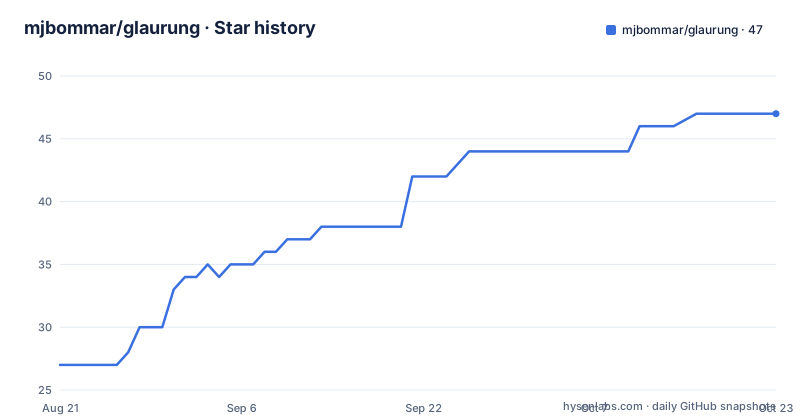
Star history
- mjbommar/glaurung47 ★ · +20
| Repository | 2026-08-21 | 2026-10-21 |
|---|---|---|
| mjbommar/glaurung | 27 | 47 |
20 Stars in the last 61 days, measured from the daily GitHub snapshot. Compare with other projects
Editorial analysis
What Glaurung actually is
Glaurung is a reverse-engineering framework written from scratch, not a Ghidra plugin. The README is explicit: it is a pre-1.0 project with a Rust analysis core, Python bindings, a CLI, and persistent SQLite project files. It is designed for automated binary triage and analysis, not for interactive reverse engineering. The project is useful today for that narrow purpose, but the documentation warns it is not yet a drop-in replacement for mature tools like Ghidra or IDA Pro. The decompiler output is experimental and should be checked against disassembly and runtime behavior. That is a refreshingly honest positioning. If you need a stable, interactive decompiler, this is not the tool yet. If you need to script the first pass over a batch of binaries, it may be.
The Rust core and Python bindings
The architecture is a Rust analysis core with Python bindings, exposed through both a CLI and a Python API. The README shows a Python example that imports `from glaurung import triage` and calls `triage.analyze_path(sample)`. The returned artifact has verdicts, entropy, and other fields. For repeated decompiler queries, the README recommends retaining one immutable `g.ir.DecompilerSession` so that exact discovery and rendered artifacts can be reused. The cache key includes the function address, discovery budgets, type/style options, and normalized architecture address. Diagnostic runs and PDB overlays bypass rendered-output reuse, which means you cannot accidentally hide new evidence behind a stale cache hit. That design choice shows attention to correctness in a tool that is still experimental.
Getting it running from source
Glaurung is not published on PyPI, so you build from source. The prerequisites are Git, CPython 3.11 or newer, Rust 1.88 or newer, and a native C compiler and linker. The README directs you to install `uv`, then run: `git clone https://github.com/mjbommar/glaurung.git`, `cd glaurung`, `uv sync --locked --dev`, and `uv run glaurung --version`. The `uv sync` command creates a `.venv`, resolves the checked-in lockfile, builds the Rust extension, and installs the Python package. After that, every command is invoked with `uv run glaurung ...` from the repository root. The repository includes real sample binaries, so you can run the smoke test without an API key. For example, `uv run glaurung triage "$SAMPLE"` performs a fast first pass, and `uv run glaurung kickoff "$SAMPLE"` runs the deeper deterministic pipeline. The README also lists `strings`, `symbols`, `graph`, and `detect-packer` as other entry points.
What the analysis pipeline covers
The triage and kickoff commands cover ELF, PE/COFF, and Mach-O formats. The analysis includes symbols, strings, IOCs, entropy, packer signals, and hardening metadata. Disassembly is bounded for x86/x86-64, ARM/ARM64, and RISC-V, but the decompiler only lifts x86/x86-64 and ARM/ARM64. RISC-V is disassembly-only. Function discovery, control-flow graphs, call graphs, cross-references, stack-frame analysis, type propagation, DWARF ingestion, and PE/PDB support are listed as working. The decompiler produces C-like pseudocode through an LLIR/SSA/AST pipeline. The persistent `.glaurung` project database stores names, comments, labels, types, prototypes, xrefs, stack variables, bookmarks, and journal entries. That is a substantial feature set for a pre-1.0 tool, but the decompiler caveat is the key limitation.
LLM-assisted workflows and configuration
Glaurung includes optional LLM-assisted workflows through PydanticAI agents for question answering, naming, vulnerability review, and source recovery. The default model is `openai:gpt-5.4-mini` with OpenAI's `flex` service tier. You set `OPENAI_API_KEY` in the environment or in a `.env` file. Override the model with `--model provider:model` or globally with `GLAURUNG_LLM_MODEL`. Anthropic and Google credentials are also supported for explicitly selected models. The README shows an `ask` command: `uv run glaurung ask "$SAMPLE" --route -a "What does this binary do?"`. Deterministic analysis needs no credentials, so the LLM features are clearly additive. The README warns never to commit `.env` or API keys. The complete environment-variable reference, configuration precedence, and cache behavior are in the setup guide.
Limitations and wrong-tool cases
The most obvious limitation is the decompiler. The README states that decompiler output is experimental and should be checked against disassembly and runtime behavior. That means you cannot trust the pseudocode for security-critical analysis without manual verification. RISC-V is disassembly-only, so if your target is RISC-V, you lose the decompiler entirely. The project is also not a drop-in replacement for Ghidra or IDA Pro, which are interactive tools with mature GUIs. Glaurung is designed for automated triage, so if your workflow requires interactive exploration and manual annotation, you will fight the CLI. Resource limits are set via command-line flags like `--max-file-size`, `--max-read-bytes`, `--max-functions`, and `--timeout-ms`, but not every command exposes every limit. You have to check each command's `--help` to know what is available. That is a real usability friction point.
Alternatives and how Glaurung differs
The obvious alternative is Ghidra, which the README itself names. Ghidra is a mature, interactive reverse-engineering suite with a decompiler that has been refined over years. It is written in Java with a Python scripting interface (Jython). Glaurung is a ground-up project written in Rust with Python bindings, not a Ghidra plugin or extension. The architectural difference is significant: Glaurung is designed for automation and scriptability from the start, with a persistent SQLite project format, while Ghidra is built around a GUI and a proprietary project format. For batch triage of many binaries, Glaurung's CLI and Python API may be more convenient. For interactive analysis of a single binary, Ghidra is far more mature. Another alternative is radare2/rizin, which is also scriptable and has a decompiler, but the README does not mention it, so I will not speculate further.
Maintenance, licensing, and upgrade path
The project is licensed under Apache-2.0, which is permissive and allows commercial use, modification, and redistribution, with the caveat that you should consult a lawyer for legal advice. The repository is not archived, and the last push is dated 2026-08-13, so it is actively maintained. The release tags are named `decbench-*`, which suggests the maintainers are using a decoder benchmark to track decompiler quality. The README includes a development section with commands for rebuilding the Rust extension (`uv run maturin develop`) and running the standard checks (`cargo test`, `uv run pytest python/tests/`, `uvx ruff format --check python/`, `uvx ruff check python/`, `uvx ty check python/`). The upgrade cost is tied to the source build: since there is no PyPI package, you must pull the latest source and rerun `uv sync --locked --dev` to get updates. The lockfile should keep dependencies reproducible, but you are on the hook for Rust toolchain upgrades, as the minimum Rust version is 1.88.
Editorial conclusion
Adopt Glaurung if you need scriptable, deterministic triage of ELF, PE, or Mach-O binaries and want to experiment with LLM-assisted analysis without committing to a mature interactive tool. Do not adopt it if you need production-grade decompilation or a drop-in Ghidra replacement; the README explicitly warns that decompiler output is experimental. Before adopting, verify that the architectures you target are covered (RISC-V is disassembly-only), confirm the resource-limit flags you need exist on your chosen commands, and check the development setup guide for platform-specific build requirements. Then run `uv run glaurung kickoff "$SAMPLE" --db trial.glaurung` on a representative sample to see if the pipeline meets your needs.
Frequently asked questions
What does the name glaurung mean for this project?
The repository does not explain the name. What it describes is the software: a pre-1.0 reverse-engineering framework with a Rust analysis core, Python bindings, a command-line interface, persistent SQLite project files and optional LLM-assisted workflows, with its home page at glaurung.dev.
Can Glaurung replace Ghidra for my reverse engineering work?
Not yet, by its own account. It is described as useful today for automated binary triage and analysis, but explicitly not a drop-in replacement for mature interactive tools, and its decompiler output is still experimental and should be checked against disassembly and runtime behaviour.
Which architectures can Glaurung decompile?
Bounded disassembly covers x86, x86-64, ARM, ARM64 and RISC-V, but the decompiler currently lifts only x86, x86-64, ARM and ARM64. RISC-V is disassembly-only, so those binaries can be triaged and graphed but not turned into pseudocode.
How do I install Glaurung from source?
It is not published on PyPI. Install uv, clone the repository, run git lfs install && git lfs pull so the sample binaries are real files rather than pointer text, then run uv sync --locked --dev. A source build needs Git, CPython 3.12 or newer, Rust 1.88 or newer, and a native C compiler and linker.
Official sources
Add this badge to your README
If you maintain this project, the badge below links readers to this analysis and shows its maintenance status from the daily GitHub snapshot. Paste the markdown into your README; add ?metric=license or ?metric=stars to the image URL for a different field.

[](https://hysenlabs.com/projects/mjbommar-glaurung)Star history chart for your README
[](https://hysenlabs.com/projects/mjbommar-glaurung)Was this useful?