Hello Python: A Free Spanish Video Course That Ships Its Code as a Repo
Curso para aprender el lenguaje de programación Python desde cero y para principiantes. 100 clases, 44 horas en vídeo, código, proyectos y grupo de chat. Fundamentos, frontend, backend, testing, IA...
At a glance
- What is it?
- mouredev/Hello-Python is a free, Spanish-language Python course delivered as 100 live-streamed lessons, with code organized into Basic, Intermediate, and Backend directories. The judgment here: it is a learning path, not a library, and its value depends on how well you tolerate video-first instruction.
- Who is it for?
- Adopt Hello-Python if you are a Spanish-speaking beginner who prefers watching a live instructor code over reading documentation, and if you want a structured path from variables to a FastAPI backend. Do not adopt it if you need a maintained, release-driven project, if you cannot follow Spanish audio, or if you expect hands-on exercises with automated grading.
- Can I use it commercially?
- Yes. Apache-2.0 is a permissive licence: you can use, modify and sell software built on it, as long as you keep its copyright and licence notices.
- Is it still maintained?
- Probably not. The repository last received commits 15 months ago, on August 11, 2025.
- What is it written in?
- Mainly Python, according to GitHub's language statistics.
Answers come from the project's GitHub data, last synced on November 15, 2026, and from our analysis. They are not legal advice.
Star history
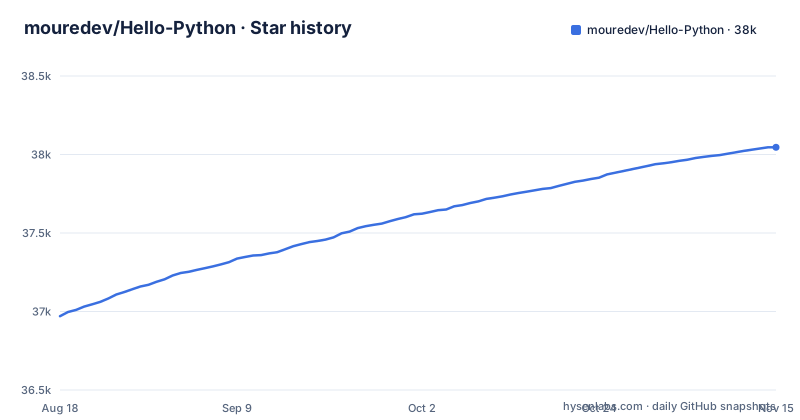
- mouredev/Hello-Python38,046 ★ · +1,076
| Repository | 2026-08-18 | 2026-11-15 |
|---|---|---|
| mouredev/Hello-Python | 37k | 38k |
1,076 Stars in the last 89 days, measured from the daily GitHub snapshot. Compare with other projects
Editorial analysis
What This Repo Actually Is
Hello-Python is not a software project in the usual sense. It is a free, Spanish-language Python course produced by mouredev during live Twitch streams, and the repository exists to hold the code that accompanies those videos. The README lists 100 classes and 44 hours of video, split into three completed blocks: fundamentals, intermediate, and backend. There is also a frontend block, but that content lives in separate repositories, python-web and adeviento-web, which are linked rather than included here. The repo's primary audience is a Spanish-speaking beginner who wants to learn Python from zero, with no assumption of prior programming knowledge. The course is currently paused, which the README states explicitly, so the material is a finished product for the basic, intermediate, and backend blocks, not a continuously updated resource.
The Structure: Directories Mirror the Curriculum
The repository layout is simple and deliberate. The README maps each video course to a directory: Basic, Intermediate, and Backend. The Basic directory contains code for the 15 lessons in the fundamentals course, covering variables, operators, strings, lists, tuples, sets, dictionaries, conditionals, loops, functions, classes, exceptions, and modules. The Intermediate directory continues with dates, list comprehension, lambdas, higher-order functions, error types, file handling, regular expressions, and package management. The Backend directory holds a FastAPI project with authentication, MongoDB integration, and deployment configuration. This mirroring means you can watch a lesson and immediately open the corresponding code file, which is a practical way to learn.
How the Backend Block Works: FastAPI, OAuth2, and MongoDB
The backend course is the most concrete part of the repo. The lessons walk through building a REST API with FastAPI, starting with type hints and configuration, then moving through GET, POST, PUT, and DELETE operations, HTTP status codes, routers, and static resources. The course then adds OAuth2 authorization and JWT tokens, and connects to MongoDB, first locally and then through MongoDB Atlas. The final lesson originally deployed the project to a service called Deta, but the README includes an update stating that Deta no longer exists. The author recommends reading the official FastAPI deployment documentation and provides two files for deploying on Vercel instead: a vercel.json configuration file and a requirements.txt file, both inside the Backend/FastAPI directory. The README gives one concrete deployment instruction: when creating the project on Vercel, select Backend/FastAPI as the root directory.
Getting Started: What You Need to Run the Code
The repository has no requirements.txt at the top level. The fundamentals video has a configuration chapter (Lección 1 - Configuración), and the dependencies for the backend code are listed in the Backend/FastAPI/requirements.txt file. For the backend lessons, you need FastAPI, a MongoDB instance (local or Atlas), and a tool to test HTTP requests.
Limitations: Dead Links, Paused Schedule, and Video Dependency
The most obvious limitation is the Deta deployment lesson. The README itself flags that Deta no longer exists, so that lesson is obsolete as recorded. The author points to FastAPI's official deployment docs and offers a Vercel alternative, but the video content is still there, and a beginner might follow it and hit a dead end. A second limitation is that the entire course is video-first. The README lists lesson titles and timestamps for the videos. If you prefer reading to watching, this course will be slow. Third, the course is paused, so new lessons are not being added. The author says the initial goal was to finish basic, intermediate, and backend, and that goal is met, but if you want a course that tracks Python's evolution, this one is static. Finally, the frontend content is not in this repo, so you must jump to two other repositories to follow that part of the curriculum.
Alternatives: How This Differs from Other Python Courses
The most direct alternative is the official Python tutorial at docs.python.org. That resource is text-based, free, and continuously updated, but it does not include video, live coding, or a progression toward a deployable backend. Another alternative is Automate the Boring Stuff with Python, which is also text-based and project-oriented, but it focuses on practical automation scripts rather than web development. For a video-first approach, freeCodeCamp's Python courses on YouTube cover similar ground but they are in English. The key difference with Hello-Python is that it is in Spanish and its code is kept in directories matching the video courses. If you need a structured, text-based reference, choose the official tutorial; if you need video and Spanish, Hello-Python is a reasonable pick.
Maintenance and License: What You Are Getting Into
The repository is not archived, but the course is paused; the last push was 2025-08-11. There are no recent releases, so you cannot rely on versioned updates. The license is Apache-2.0, which permits free use, modification, and distribution, including for commercial purposes, as long as you include the license notice. This is a permissive license, so you can reuse the code in your own projects without paying, but you should keep the original copyright notice. There is no contribution guide, no issue template, and no code of conduct visible in the README. The maintenance cost for a learner is low: you download the code, run it, and move on. The maintenance cost for someone who wants to use the backend code as a starter template is higher, because you must update dependencies and replace the Deta deployment with a current solution. The README's own update about Deta is a sign that the material requires manual patching over time.
Editorial conclusion
Adopt Hello-Python if you are a Spanish-speaking beginner who prefers watching a live instructor code over reading documentation, and if you want a structured path from variables to a FastAPI backend. Do not adopt it if you need a maintained, release-driven project, if you cannot follow Spanish audio, or if you expect hands-on exercises with automated grading. Before starting, verify that the video timestamps still match the current YouTube URLs, check that the Backend code still runs with your Python version, and replace the dead Deta deployment lesson with the FastAPI deployment docs the README points to. The course is paused, so treat it as a fixed curriculum, not a living one.
Frequently asked questions
How do I say hello in Python?
The Hello-Python basics track covers exactly that in Leccion 2 - Hola Mundo, the second lesson of the fundamentals video, listed at the 1518 second timestamp. The code for that track is kept in the Basic directory of this repository, so the file is there even though the explanation is in Spanish.
What is greet() in Python?
The README does not mention a greet() function. The hello world material the project does cover is Leccion 2 - Hola Mundo in the fundamentals track, and its code lives in the Basic directory.
What does the mouredev Hello-Python repository contain?
The top-level entries are .gitignore, Backend/, Basic/, Images/, Intermediate/, LICENSE, and README.md, with the three directories holding the code for the fundamentals, intermediate, and backend tracks. There is no requirements file at the root and no GitHub release, and the project is licensed under Apache 2.0. The last push to main is dated 2025-08-11.
Can I follow the Hello-Python backend course today?
Mostly, but the final deployment lesson is outdated. The lesson uses Deta, and a correction note in the README states that Deta no longer exists. The replacement is FastAPI's own deployment documentation and its list of free providers, plus a vercel.json and a requirements.txt under Backend/FastAPI, to be deployed from Vercel with that directory as the project root.
Official sources
Add this badge to your README
If you maintain this project, the badge below links readers to this analysis and shows its maintenance status from the daily GitHub snapshot. Paste the markdown into your README; add ?metric=license or ?metric=stars to the image URL for a different field.

[](https://hysenlabs.com/projects/mouredev-hello-python)Star history chart for your README
[](https://hysenlabs.com/projects/mouredev-hello-python)Was this useful?