ninjaframework/ninja: Evaluating the Full Stack Java Web Framework
Ninja is a full stack web framework for Java. Rock solid, fast and super productive.
At a glance
- What is it?
- Ninja is a full stack Java web framework organized as a Maven multi-module project, with servlet, standalone, database, routing, mail, metrics, and WebSocket components. The repository is not archived, but its short README limits adoption decisions because it provides no setup commands or architectural guide.
- Who is it for?
- Adopt Ninja when a Java team specifically wants its Maven-based, full-stack framework structure and can validate the missing setup guidance against the external documentation. Do not choose it merely from this repository page, because the README does not establish deployment requirements, persistence conventions, release history, upgrade procedures, or the operational behavior of its modules.
- Can I use it commercially?
- Yes. Apache-2.0 is a permissive licence: you can use, modify and sell software built on it, as long as you keep its copyright and licence notices.
- Is it still maintained?
- Activity is slowing. The repository last received commits 6 months ago.
- What is it written in?
- Mainly Java, according to GitHub's language statistics.
Answers come from the project's GitHub data, last synced on October 23, 2026, and from our analysis. They are not legal advice.
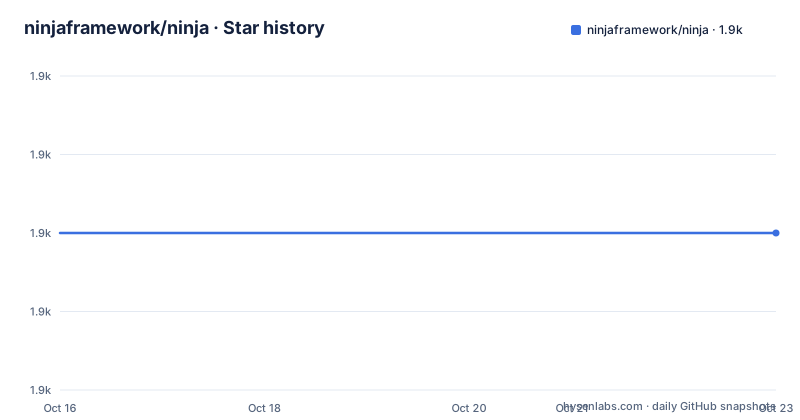
Star history
- ninjaframework/ninja1,900 ★ · +0
| Repository | 2026-10-16 | 2026-10-23 |
|---|---|---|
| ninjaframework/ninja | 1.9k | 1.9k |
0 Stars in the last 7 days, measured from the daily GitHub snapshot. Compare with other projects
Editorial analysis
What Ninja Full Stack Framework Solves
Ninja targets Java developers who need a web framework spanning request handling and supporting application concerns rather than a small routing library. The repository description calls it a “full stack web framework for Java,” while the module layout expands that phrase into concrete areas: `ninja-servlet`, `ninja-standalone`, `ninja-db-classic`, `ninja-jaxy-routes`, `ninja-postoffice`, `ninja-metrics`, and `ninja-websockets-jsr356`.
That makes Ninja a candidate for applications that may need more than controllers and templates. The database module points toward persistence work, `ninja-postoffice` points toward mail integration, and several metrics modules provide integrations named for Graphite, Ganglia, InfluxDB, and Librato. This is evidence of intended breadth, but the README does not explain how these modules are configured or which are optional. The distinction matters. Breadth in the module names can inform an initial shortlist, but it cannot substitute for a feature-by-feature proof of concept.
The repository also includes `ninja-servlet-archetype-simple` and `ninja-servlet-jpa-blog-archetype`. Those names suggest starting points for a servlet application and a JPA blog application, respectively. They may be useful to developers who prefer a project template over an empty setup, although the README does not document how to generate either archetype. No command can be reproduced responsibly from the README.
Ninja is therefore aimed at Java teams seeking one framework ecosystem for web-facing and adjacent services. It is a poor fit for someone choosing from the README alone, because the page gives no runtime prerequisites, supported servlet container, build command, configuration path, or first application example.
Ninja's Maven Module Architecture
Based on the repository layout, Ninja is built as a Maven multi-module project. The root `pom.xml` is the natural aggregation point, while directories such as `ninja-annotations/`, `ninja-core/`, and `ninja-servlet/` divide the framework into separately addressable artifacts. The exact dependency graph is not included in the README, so the word “appears” is important here.
Several entries expose supporting capabilities. `ninja-jaxy-routes/` indicates a separate routing component, while `ninja-maven-plugin/` indicates that Ninja includes build-tool integration rather than limiting itself to runtime libraries. `ninja-test-utilities/` and integration-test modules are also visible, which provides evidence that the repository considers testing part of development. However, neither test framework choices nor test commands are documented in the README.
The module split may help teams adopt only the parts relevant to an application. For example, a servlet deployment may evaluate `ninja-servlet`, while the standalone path corresponds to `ninja-standalone`. The repository does not document whether selecting a module automatically brings in a particular server model, nor does it explain compatibility constraints among modules. Engineers should not infer those relationships from directory names alone.
The lack of GitHub releases is another adoption concern. Maven Central is linked from the README, so published artifacts are expected to be discoverable there, but the repository page does not state which artifact version is current or how Ninja maps versions to the `develop` default branch. The absence of GitHub releases does not prove that versions are unavailable. It means this repository does not provide a release history through GitHub Releases.
Installation Starts Outside This README
The README does not provide installation steps, a sample application, executable Maven commands, or a configuration file. It directs readers to the project website for documentation and to the GitHub repository for source code. A complete installation tutorial therefore cannot be copied or reconstructed from the README without inventing commands.
The only confirmed dependency route is the Maven Central link for the `org.ninjaframework:ninja` artifact shown by the README badge. The repository also contains a root `pom.xml`, but its coordinates, Java baseline, dependency versions, and build commands are not reproduced in the README. Adding an invented dependency block or guessing that `mvn package` starts an application would make the tutorial unreliable.
A first real use therefore begins at the linked documentation, not with a speculative command. A prospective user needs to confirm the current stable artifact version, select the appropriate module such as `ninja-servlet` or `ninja-standalone`, and find the documented application template and run configuration. The README does not say whether templates can be generated with `ninja-maven-plugin`, whether a standalone server is embedded, or which port an application uses.
For teams needing a self-contained kickoff guide, this is a documentation gap rather than a minor omission. The external site must explain dependency setup, application startup, configuration keys, request routing, and a deployable artifact before a developer can reproduce a first service.
Web, Persistence, Messaging, and Metrics Boundaries
Ninja's strongest differentiator in the README is not a documented programming model but the set of boundaries exposed as separate modules. `ninja-servlet/` and `ninja-standalone/` indicate two named web deployment paths. `ninja-db-classic/` is the only database module named in the layout, while `ninja-servlet-jpa-blog-archetype/` suggests a JPA-oriented example. The README does not explain which persistence APIs are supported or whether JPA belongs to the archetype rather than the core framework.
`ninja-postoffice/` gives the project its own module boundary for mail-related functionality. Separately, `ninja-websockets-jsr356/` points to JSR 356 WebSocket support. These names make Ninja more relevant to applications that need several Java web capabilities, but they also create evaluation questions. Is each module optional? What configuration does it require? What happens when a deployment lacks the corresponding service? The README does not answer those questions.
The metrics directories are especially explicit: `ninja-metrics-ganglia/`, `ninja-metrics-graphite/`, `ninja-metrics-influxdb/`, and `ninja-metrics-librato/`. Their existence indicates separate adapters rather than claiming that every service is built into `ninja-core`. It is reasonable to inspect those modules for supported interfaces, but the README does not document metric formats, failure behavior, initialization order, or runtime dependencies.
An alternative architecture would be to choose individual Java libraries for routing, persistence, mail, and metrics, then assemble them around an application. That approach can reduce framework-level coupling, but it also replaces a shared project structure with explicit integration work. Ninja offers a more unified module catalog, while the documentation burden for validating that catalog currently falls on the external website.
Where the Current Evidence Falls Short
The first limitation is documentation depth. The README contains a project description, Maven Central badge, Java workflow badges, and links, but it does not describe request handling, configuration, deployment, extension points, or compatibility. The badges mention Java 8, Java 11, Java 17, and Java 19, although the Java 19 badge links to a workflow file whose displayed label is Java 21. That mismatch should be checked in the repository rather than resolved by assumption.
The second limitation is release visibility. GitHub has no releases for this repository. Maven Central is linked, so artifact discovery is possible, but the README does not provide a version policy, migration guide, support window, or relationship between published versions and `develop`. The presence of `changelog.md` is useful, yet its contents and release cadence are not documented in the README, so upgrade cost cannot be quantified from the repository page.
The third limitation concerns scope. The repository contains many modules, but the README does not explain whether using Ninja requires adopting several of them, how conflicts are resolved, or whether an application can combine the servlet and standalone paths. A team whose primary requirement is one small HTTP API may find a broad framework unnecessary. A team requiring JPA, WebSockets, mail, and metrics in one application may find the module boundaries relevant.
Ninja is also the wrong tool when reproducibility cannot extend beyond the README. Without documented commands and configuration, an engineer cannot establish whether a local startup, deployment packaging, or production run is supported by the project as presented on the repository page.
Maintenance Signals and Apache-2.0 Licensing
The repository is not archived, and its last push was on 2026-04-03. Those are the available maintenance facts. This indicates that the repository has recorded activity, but the README and release metadata do not establish a release cadence, maintainer policy, issue-response practice, or long-term support commitment. The absence of GitHub releases also means activity on the default branch should not be treated as a versioned upgrade schedule.
Upgrade cost appears in several forms. Developers must inspect `pom.xml` for dependency and module compatibility, then review `changelog.md` for documented changes. The Java workflow references show attention to multiple Java lines, but the README does not state which versions are supported by current published artifacts. A migration from one Ninja version to another cannot be estimated without the relevant changelog entries and external documentation.
The project uses the Apache-2.0 license, with the license text stored in `license.txt`. That permits use and modification under the license's stated conditions, including its notice and patent provisions. This review does not interpret those legal terms. Teams still need to account for the licenses of transitive Maven dependencies and any separately distributed runtime services, which the README does not enumerate.
Editorial conclusion
Adopt Ninja when a Java team specifically wants its Maven-based, full-stack framework structure and can validate the missing setup guidance against the external documentation. Do not choose it merely from this repository page, because the README does not establish deployment requirements, persistence conventions, release history, upgrade procedures, or the operational behavior of its modules. Before selection, verify the current documentation, dependency versions, servlet-container requirements, and change-management process in `changelog.md` and the root `pom.xml`.
Frequently asked questions
What is the ninjaframework/ninja project?
It is a full stack web framework for Java. Its module layout includes servlet and standalone web components, along with database, routing, mail, metrics, and WebSocket-related modules.
How do I install ninjaframework/ninja?
The README does not give installation commands or dependency snippets. It directs users to the Ninja documentation website and links Maven Central for the `org.ninjaframework:ninja` artifact.
Does ninjaframework/ninja provide GitHub releases?
No GitHub releases are listed for the repository. Maven Central is linked for artifact discovery, but the README does not explain the release or upgrade policy.
Official sources
Add this badge to your README
If you maintain this project, the badge below links readers to this analysis and shows its maintenance status from the daily GitHub snapshot. Paste the markdown into your README; add ?metric=license or ?metric=stars to the image URL for a different field.

[](https://hysenlabs.com/projects/ninjaframework-ninja)Star history chart for your README
[](https://hysenlabs.com/projects/ninjaframework-ninja)Was this useful?