oauth2-proxy carries two major versions of the same JOSE library, and it lists a Redis client among its direct dependencies
A reverse proxy that provides authentication with Google, Azure, OpenID Connect and many more identity providers.
At a glance
- What is it?
- OAuth2 Proxy sits in front of an application, either as a reverse proxy in its own right or as middleware inside something you already run, and turns an OAuth2 or OIDC provider into the authentication layer for services that have none. It is a CNCF Sandbox project in Go under the MIT licence, with a release on 2026-10-01. The dependency manifest is where the interesting detail sits: two different major versions of the same JOSE library, and a Redis client in the direct dependency list.
- Who is it for?
- This is the right tool when your applications have no authentication of their own and you do not want to build one, and it is a CNCF Sandbox project with a maintainers file, a security disclosure process and a release on 2026-10-01 with pushes as recent as 2026-11-01, which is what you want sitting in front of your applications. Two things to settle first.
- Can I use it commercially?
- Yes. MIT is a permissive licence: you can use, modify and sell software built on it, as long as you keep its copyright and licence notices.
- Is it still maintained?
- Yes. The repository last received commits 7 days ago.
- What is it written in?
- Mainly Go, according to GitHub's language statistics.
Answers come from the project's GitHub data, last synced on November 13, 2026, and from our analysis. They are not legal advice.
Star history
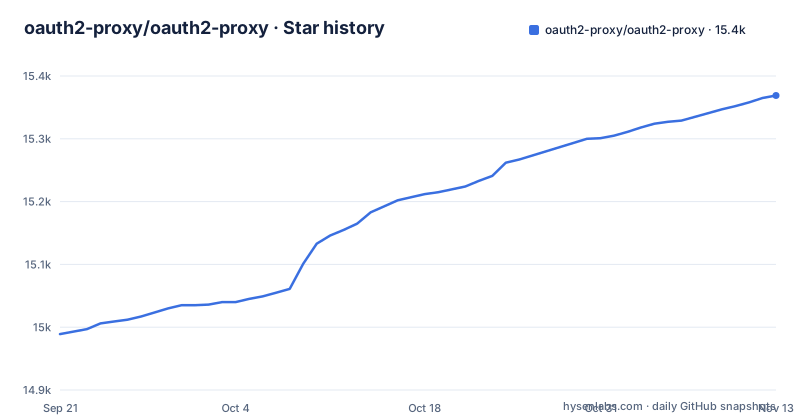
- oauth2-proxy/oauth2-proxy15,369 ★ · +380
| Repository | 2026-09-21 | 2026-11-13 |
|---|---|---|
| oauth2-proxy/oauth2-proxy | 15k | 15.4k |
380 Stars in the last 53 days, measured from the daily GitHub snapshot. Compare with other projects
Editorial analysis
The module requires two major versions of the same JOSE library at once
The dependency manifest has a detail that explains a class of problem for anyone vendoring this or auditing it.
Two entries in the direct requirement block belong to the same JOSE library at different major versions. One is at version 3.0.5, the other at 4.1.5.
That is not a mistake in the file. Go's module system allows two major versions of the same module to coexist in one build when something depends on each, and the usual reason is a transitive dependency that has not yet moved.
The cost is that your build now contains two copies of the cryptographic code that handles JSON web tokens, signing and encryption. Two copies means two sets of types, so a value signed with one is not directly a value the other understands, and it means an audit has to check both.
So when you run a dependency scanner against this project, expect the JOSE library to appear twice, once at each major version, and do not read that as a mistake in your own configuration.
The Go language directive is 1.26.0, which is worth noting separately if you build from source, since that sets the floor for your toolchain.
The Redis client is a direct dependency, so sessions need somewhere to live
Read the direct requirement block and one thing stands out as a deployment dependency rather than a library detail.
Three separate Redis-related entries appear there. One is the Redis client itself at a current major version. One is a distributed locking library on top of Redis. One is a minimal Redis implementation used for tests.
There is also a sentinel-compatible library, which suggests support for Redis in sentinel mode rather than only a single instance.
So Redis support is part of the build: the client is in the direct dependency list.
The base image changed from Alpine to distroless at v7.6.0, and Alpine survives as a suffix
The container story has two eras, and knowing which one you are in saves an afternoon of confusion.
From version 7.6.0 onward the base image is a distroless base rather than Alpine. The stated reason is that it ships with fewer installed dependencies, which should improve the security posture, and that the image is therefore slightly smaller.
Alpine is still available, and the reason given is specific: debugging, and architectures where the distroless image is not practical, with one named example. Those images carry a suffix on the tag.
There is also a nightly image stream, published from the default branch since 2023-11-18 at a separate registry path. The front page is unusually direct about these: they are considered unstable and should not be used for production unless you know what you are doing.
So there are three image variants in play, and the tag tells you which is which.
The consequence is that the default tag and the nightly tag are not interchangeable, and the alpine suffix is a debugging tool rather than an alternative to try in production. If a distroless image is giving you trouble, reach for the alpine variant to diagnose it, then go back.
Provider-specific implementations exist to extract groups and usernames, not to add providers
The provider story is worth reading carefully, because the value beyond generic OIDC is narrower than the count of supported providers suggests.
There is a generic OIDC client, which is the path that works with anything speaking the protocol. Alongside it are specific implementations for Google, Microsoft Entra ID, GitHub and login.gov, with the note that more exist.
The reason the specific implementations exist is stated precisely: they extract more detail about the user, such as preferred usernames and groups. And those details can then be forwarded as HTTP headers to the upstream applications.
That header forwarding is the actual mechanism by which your application learns who the user is. The proxy authenticates, then tells the backend through headers. Which means the security of your whole setup depends on those headers being trustworthy, and depends on nothing upstream being able to set them itself.
So the choice between generic and specific is a choice about what your backend receives. If it needs group membership to make authorisation decisions, the generic client may not give you that, and you need the provider-specific path.
The consequence is to write down what your application actually needs from the identity before you pick a provider configuration.
Security reports go by email to a maintainers file, and there is a standing upgrade notice
The security section is unusually explicit, and both halves of it matter.
The disclosure instruction is stated as a prohibition first. If you believe you have found a vulnerability, in this project or in any of its dependencies, do not open an issue or a pull request on the hosting platform, and do not post any details publicly. Disclosures must be made in private, by email to the people listed in the maintainers file at the top of the repository. A separate security documentation page carries the full process.
Written that way because this software sits in front of other people's applications. A vulnerability report filed publicly on the issue tracker is a disclosure by definition, and the project is asking for the delay that lets a fix ship first.
The second half is a standing notice for old versions. If you are running anything older than 6.0.0, the project strongly recommends moving to a current version, and it links an advisory for an open redirect vulnerability as the reason.
An open redirect in an authentication proxy is worth taking seriously, since the whole job of this component is deciding where a user is allowed to end up.
So if you inherited an old deployment, that notice is the first thing to act on, and if you find something, the email address is the only route.
The project states it is volunteer-driven and that review times vary
The front page makes a claim about itself that is unusual to see stated this plainly, and it changes how you should plan.
It describes the project as community-driven, relying on contributions from users, and as a volunteer-driven project. It says review times can vary and asks for patience and understanding, and states that as a volunteer project it strives to keep things stable and might take longer to merge changes.
Alongside that there is a maintainers file that the security process depends on, a code of conduct, and a Slack channel under the cloud-native organisation with a public invite link for the wider foundation.
The sponsorship section is small. An open source programme from a large enterprise vendor is listed as a sponsor, and a former sponsor's contribution of cloud credits is listed separately.
So the picture is a foundation-hosted sandbox project with a small sponsor base, maintained by volunteers, where the trade for stability is slower merges.
The consequence is for your planning rather than your trust. If you need a fix quickly, this is not a project that promises response times, and the front page says so before you ask. If you need to influence direction, the contribution path is open but slow.
The lineage runs through two renames and a fork, and the current module path is versioned to v7
The repository history explains several naming inconsistencies you will hit while searching for documentation.
The project was forked from a different organisation's repository on 2018-11-27. Versions from 3.0.0 onward are from that fork and have diverged from the original, with the changes listed in the changelog.
Separately, the project was formerly hosted under a different organisation's namespace and was renamed in 2020-03-29. From that point the images moved to a different registry path and the binaries were renamed.
The module path carries its own version suffix, following the convention for a project past its first major version. That suffix appears in the import paths of every file in the module, which is why documentation written for an older major version will not compile against this one without changes.
Now at version 7, with releases 7.15.3 in June 2026, 7.15.4 in August and 7.15.5 on 2026-10-01, and the most recent push on 2026-11-01.
The consequence is that a tutorial you find by searching will often be for the old organisation's project or for a major version behind this one. Check the module path in the first line of any example before you follow it.
Editorial conclusion
This is the right tool when your applications have no authentication of their own and you do not want to build one, and it is a CNCF Sandbox project with a maintainers file, a security disclosure process and a release on 2026-10-01 with pushes as recent as 2026-11-01, which is what you want sitting in front of your applications. Two things to settle first. Where sessions live: the Redis client is a direct dependency, so check the installation docs for whether your setup needs a Redis instance. And how you take updates, because the project states plainly that it is volunteer-driven with review times that vary, and it carries a standing notice recommending anyone below version 6.0.0 move up over an open redirect issue. The middleware mode is the underrated half here if you already run a reverse proxy.
Frequently asked questions
What does an OAuth2 proxy do?
It sits in front of your applications and provides OAuth2 and OIDC authentication for them. As a reverse proxy it intercepts requests and redirects unauthenticated users to an OAuth2 provider. As middleware it integrates into an existing reverse proxy or load balancer setup and handles authentication for multiple applications. Either way the upstream application receives identity details as HTTP headers rather than implementing authentication itself.
Is OAuth2 proxy safe?
It is a CNCF Sandbox project distributed under the MIT licence, and the front page carries a standing notice that anyone running a version older than 6.0.0 should upgrade, citing an open redirect vulnerability advisory. Vulnerabilities should be reported privately by email to the maintainers file rather than on the issue tracker, since this component sits in front of other people's applications.
how to use oauth2 proxy
You choose one of two roles: run it as a standalone reverse proxy, or run it as middleware inside an existing reverse proxy or load balancer. Provider support comes either from a generic OIDC client or from specific implementations for Google, Microsoft Entra ID, GitHub and login.gov, which exist so the proxy can extract preferred usernames and groups and forward them as HTTP headers upstream. The installation documentation and a set of example setup files are linked from the front page.
what is oauth2 proxy
A reverse proxy written in Go that provides authentication with Google, Azure, OpenID Connect and many other identity providers. It began as a fork of another project's repository on 2018-11-27, and versions from 3.0.0 onward come from that fork. Its module path carries a v7 suffix, so import paths differ from documentation written for earlier major versions.
how to install oauth2 proxy
Compiled binaries are published for all major architectures plus less common ones such as ppc64le and s390x. Container images come in three variants: a distroless base used from version 7.6.0 onward, Alpine-based images whose tags carry an alpine suffix and which exist for debugging and for architectures the distroless image does not cover, and nightly images built from the default branch that the front page says should not be used in production.
Official sources
Add this badge to your README
If you maintain this project, the badge below links readers to this analysis and shows its maintenance status from the daily GitHub snapshot. Paste the markdown into your README; add ?metric=license or ?metric=stars to the image URL for a different field.

[](https://hysenlabs.com/projects/oauth2-proxy-oauth2-proxy)Star history chart for your README
[](https://hysenlabs.com/projects/oauth2-proxy-oauth2-proxy)Was this useful?