fluwx ships payment by default and a separate build without it
WeChat SDK for Flutter.
At a glance
- What is it?
- Fluwx is a Flutter plugin that puts WeChat's native SDK behind Dart calls. Its install snippet is a placeholder you must edit, its debug mode fails on Android with errCode -1, and OpenHarmony needs a manual certificate.
- Who is it for?
- Fluwx saves you the platform plumbing for WeChat, and it is honest about the parts it does not do.
- Can I use it commercially?
- Yes. Apache-2.0 is a permissive licence: you can use, modify and sell software built on it, as long as you keep its copyright and licence notices.
- Is it still maintained?
- Yes. The repository last received commits 14 days ago.
- What is it written in?
- Mainly Dart, according to GitHub's language statistics.
Answers come from the project's GitHub data, last synced on November 15, 2026, and from our analysis. They are not legal advice.
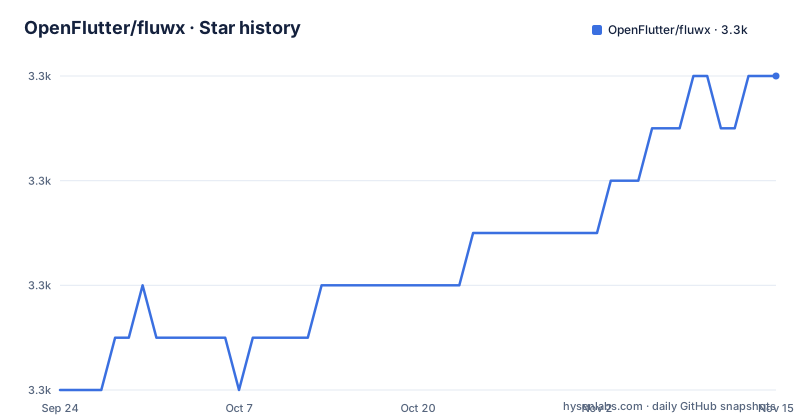
Star history
- OpenFlutter/fluwx3,326 ★ · +6
| Repository | 2026-09-24 | 2026-11-15 |
|---|---|---|
| OpenFlutter/fluwx | 3.3k | 3.3k |
6 Stars in the last 52 days, measured from the daily GitHub snapshot. Compare with other projects
Editorial analysis
Payment rides along unless you move packages
The install section is one line of YAML, and it arrives with two warnings. The snippet is a template rather than something you can paste:
dependencies:
  fluwx: ^${latestVersion}
The first warning says never to forget to replace the version placeholder with a real version, and points at the versions page on the package registry. The second warning is the one that changes your dependency list: the package you are adding includes the payment feature by default, and if you want a version without payment you have to switch to a separate package called fluwx_no_pay. So the decision about payments is made at the dependency line rather than at build time, and a project that later needs payments has to change which package it depends on.
Three pubspec settings, one of them inert on iOS
Since version 4 the plugin reads its configuration from a fluwx section in pubspec.yaml, with a worked example in the repository's example project. Three keys are described. The app identifier is the counter-intuitive one: it is not used to initialise the WeChat SDK, so declaring it does not save you the registration call, which you still have to make by hand. Debug logging is a boolean that turns logs on and, the file admits, does nothing on iOS for now. The launcher activity key is the Android cold boot case, used when WeChat starts your app from a link, and if you leave it out the plugin tries to launch the launcher activity instead.
The sample URL repeats the parameter's typo
Registering the API takes an app identifier and a universal link, and the README's example is short enough to copy:
Fluwx fluwx = Fluwx();
final success = fluwx.registerApi(appId: "wxd930ea5d5a228f5f",universalLink: "https://your.univerallink.com/link/");
print("register API success: $success");
Two things about that snippet are worth knowing before you paste it. The app identifier in the example is not yours, and the universal link in it is spelled with an extra letter compared to the parameter name beside it, so the sample URL carries the same misspelling as the argument it is passed to. And the call returns a boolean rather than throwing, so registration failure is something you have to check for rather than something the framework reports for you. The file recommends registering as early as possible.
Android debug builds come back with errCode -1
The Android section names one failure mode precisely. The MD5 fingerprint of your app's signature has to be registered at WeChat, and you can extract that signature from your keystore with Java's key tool. In debug mode your app is signed with a debug key belonging to the development machine, WeChat does not recognise it, and the call returns errCode = -1. The README's advice at that point is blunt: to test in debug mode you have to modify your debug key. So the error is not a bug in the plugin and not a misconfigured manifest, it is the expected result of shipping an unregistered signature, and the fix sits on your side of the boundary.
iOS needs four things before anything works
The universal link parameter only has an effect on iOS, and the file then condenses WeChat's own iOS guide into four requirements. The app needs a valid universal link. The Associated domains entitlement has to be enabled. The Info.plist needs the queried schemes list modified to include four specific strings: weixin, wechat, weixinULAPI and weixinURLParamsAPI, which the file marks as essential. And the URL types list needs an entry named weixin with the editor role, carrying your app identifier in its URL schemes, followed by a worked XML snippet showing exactly that dictionary. Every one of the four is an Xcode or plist step, and none of them is something the plugin can do for you.
OpenHarmony needs a scheme query and your own certificate
HarmonyOS gets two notes of its own. To check whether WeChat is installed, the project file has to declare a query for the weixin scheme, added as a querySchemes array inside the module object:
{
  "module": {
    "querySchemes": [
      "weixin"
    ],
  }
}
The second note is a debugging warning: do not use the IDE's automatic signing, and apply for a debug certificate manually instead. Between them they say that the newest platform in the list is also the one where the setup is least automated, which is what you would expect from a plugin that started as an Android and iOS integration and grew.
A doc list that mixes two link styles
The capability section points at six documents, five of them written as relative paths and one written as an absolute path from the site root, which does not resolve on a repository page. They cover basic knowledge, sharing, payment, auth, launching an app from a web link and customer service. The QA document is Chinese only, which is the same split as the README itself, since a Chinese version sits beside the English one and the top of the file sends Chinese readers there. Two smaller signals point the same way: the donate line asks for a coffee and ends with a full-width Chinese period in an otherwise English sentence, and the licence block carries a 2023 copyright for the project while the releases under discussion are from 2026.
A .gradle directory is committed at the root
The top level of the repository mixes Dart tooling with Android build output. Alongside the usual suspects, the manifest, the analyser configuration, the documentation directory, the library directory and the tests, there is a .gradle directory, which is the cache Gradle generates locally and normally keeps out of version control, and a .pubignore file, which is the publishing counterpart of the ignore file. There is also a packages directory, consistent with the second package the README tells you to switch to, plus skills, tools and a CI directory. The release history explains the cadence: v6.0.4 was published on 2026-09-23 at the same moment as the last commit, and two earlier releases landed on the same day in July an hour apart, with no 6.0.3 among the three most recent.
Editorial conclusion
Fluwx saves you the platform plumbing for WeChat, and it is honest about the parts it does not do. Before integrating it, check four things: that you have read WeChat's own documentation, which the README insists on twice, since the plugin does not explain how to generate the Android signature or how universal links and URL schemes work, which package you actually want, given that payment ships in the default one and removing it means switching packages, that your debug signing key is registered, because an unregistered debug key returns errCode -1 on Android, and what V6 broke, since the migration note calls the changes substantial on iOS. Budget a day for the four Info.plist entries rather than an hour.
Frequently asked questions
What is the fluwx Flutter plugin?
A Flutter plugin for WeChat's native SDK, letting a Dart application call those native APIs. Its stated capabilities are sharing images, text and music to sessions, favourites and the timeline, WeChat payment, an auth code before login, launching mini programs, subscribe messages, opening WeChat and opening customer service.
Does fluwx include WeChat payment?
By default it does. The install snippet adds the fluwx package with the payment feature included, and the README warns that a version without payment lives in a separate package named fluwx_no_pay, so removing payments means changing packages.
Why does fluwx return errCode -1 on Android in debug mode?
Because a debug build is signed with a development machine key that WeChat does not recognise. The MD5 fingerprint of the app signature has to be registered at WeChat and can be extracted from the keystore with Java's key tool, so testing in debug mode requires modifying the debug key.
What does fluwx require on iOS?
A valid universal link, the Associated domains entitlement enabled, four entries in the queried schemes list including weixinULAPI and weixinURLParamsAPI, and a URL types entry named weixin with the editor role carrying your app ID in its URL schemes.
What are the breaking changes in fluwx V6?
The README warns that V6 brings a lot of them, especially on iOS, naming scene delegate support and Swift Package Manager support among them, and it points at a migration document that it asks you to read carefully before moving.
Official sources
Add this badge to your README
If you maintain this project, the badge below links readers to this analysis and shows its maintenance status from the daily GitHub snapshot. Paste the markdown into your README; add ?metric=license or ?metric=stars to the image URL for a different field.

[](https://hysenlabs.com/projects/openflutter-fluwx)Star history chart for your README
[](https://hysenlabs.com/projects/openflutter-fluwx)Was this useful?