Eleven bundled projects, five licences, and one of them is share-alike
🆔 The easy-to-use OpenStreetMap editor in JavaScript.
At a glance
- What is it?
- iD is the JavaScript editor for OpenStreetMap, shipped as a bundle rather than a single dependency-free application. Its own code is ISC, but it embeds two copyleft-licensed projects, and its design goal is stated as refusing to break other people's data.
- Who is it for?
- iD suits a mapper who wants a forgiving editor that will not corrupt shared data, and a contributor who wants a project where the review burden on a change is legible. Four things to know before you get involved.
- Can I use it commercially?
- Yes. ISC is a permissive licence: you can use, modify and sell software built on it, as long as you keep its copyright and licence notices.
- Is it still maintained?
- Yes. The repository received new commits within the last day.
- What is it written in?
- Mainly JavaScript, according to GitHub's language statistics.
Answers come from the project's GitHub data, last synced on November 15, 2026, and from our analysis. They are not legal advice.
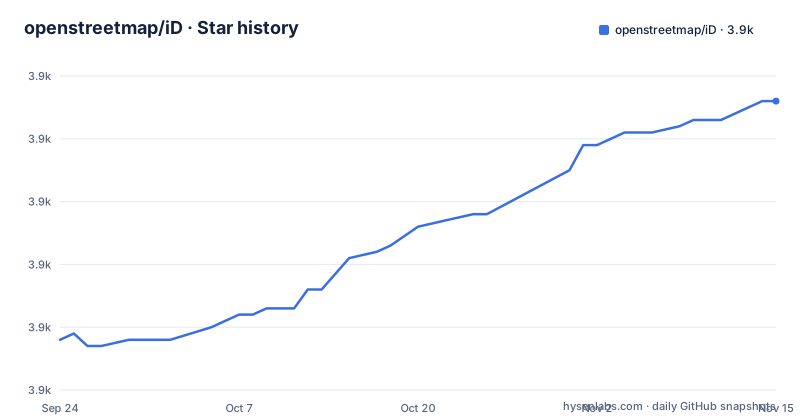
Star history
- openstreetmap/iD3,926 ★ · +38
| Repository | 2026-09-24 | 2026-11-15 |
|---|---|---|
| openstreetmap/iD | 3.9k | 3.9k |
38 Stars in the last 52 days, measured from the daily GitHub snapshot. Compare with other projects
Editorial analysis
The licence section is longer than the feature list, and it is the part to read first
iD's own licence is ISC, which is short and permissive. Then there is a second section headed with a statement that iD also bundles portions of other open source software, and it names eleven projects with eleven different licences. Two of them matter more than the rest. One is the editor layer index, which supplies the imagery and other layers you can turn on, under a share-alike copyleft at version 3.0. The other is the Unicode consortium's common locale data, under the consortium's own terms of use rather than an open source licence at all. The rest are mostly permissive: a BSD-licensed rendering library, an attribution-only icon font, two icon sets released into the public domain, another attribution-only icon set, and three small index projects under ISC or BSD. So a fork of iD is not simply an ISC project. Whether the share-alike terms on the layer index reach your own additions depends on how you use that data rather than on the code, and nobody is going to resolve that for you in a licence file. Read this section before the code, particularly if you plan to redistribute a build.
The design goal is stated as refusing to break other people's data
The Basics section has four bullets and one of them is the whole philosophy. iD is a JavaScript editor for OpenStreetMap. It is, in the README's phrase, intentionally simple, and the reason given is that it lets you do the most basic tasks while not breaking other people's data. That is a constraint on the product rather than a feature, and it explains a great deal about the editor's behaviour. It means the editor favours doing a small set of things correctly over doing a large set of things approximately, because every additional capability is another way to write something a mapper will later have to unpick. It also means the interesting engineering question is validation and constraint, not feature count. The rendering is handled by an external library rather than hand-written, which fits the same instinct: the project spends its effort on the part that touches the shared database and delegates the part that does not. The browser support claim follows the same pattern of underpromising: all popular modern desktop browsers are listed by name, and notably no mobile browser appears in that list.
The manifest version is a development version while the newest release is a month old
Three releases are visible in the recent history and they are tightly spaced: 2.42.0, then 2.42.1 the next day, then 2.42.2 a few days after that, all in the middle of August 2026. The package manifest, however, declares its version as 2.43.0 with a development suffix. That combination is normal and worth naming anyway, because it tells you where the branch actually is. The tagged work is the 2.42 line; the manifest is already on the next minor version, which means development has branched forward and the default branch is ahead of what anyone has downloaded. That fits the stated release cadence, which is a regular update about every month, and it also means the three visible tags are not three months of history but about a week of a single line. The default branch is not the release branch either: it is the development one, which is why the README offers two separate preview deployments, a stable mirror of the release branch and a development mirror of the default branch plus the latest translations. Contributors are pointed at the development branch throughout, including the translation link.
Two preview deployments exist so you can test the unreleased build before it ships
Among the participation notes there is an invitation to test a prerelease version, with two URLs rather than one. One is described as a stable mirror of the release branch, and the other as a development mirror of the default branch plus the latest translations. That is a genuinely useful thing for a project whose users are volunteers who contribute data: it means a mapper can check that a change did not break their workflow, and a translator can confirm new strings render, before either is in a release. The second detail in that bullet is the one that catches people. The development mirror includes the latest translations, so the same URL changes underneath you as strings land. That is the point, and it is also why you should not treat either preview as stable: the release mirror tracks the release branch and so has whatever the release branch has, and the development mirror is by definition ahead of any release. The contributing notes also list two separate chat channels and a community forum as places to ask, which tells you the support surface is the project's own community rather than an issue tracker.
The build is four separate stages and the distribution step copies from node_modules
The package manifest describes a build you can follow without much inference. One script runs clean, build and distribution in sequence. Build itself fans out into three stages: styles, data, and JavaScript. The styles stage runs a script, the data stage creates the output directory and then runs a data build script, and the JavaScript stage runs a bundler configuration. Distribution then runs its sub-tasks in parallel, and this is where the manifest stops being a compiler and starts being an assembler. One distribution task copies the built output of a street-level imagery library out of the installed node modules into the distribution directory. Another does the same for the panoramic imagery library, which is the source of the photospheres you see on some streets. Two more tasks generate SVG sprite sheets from source directories, one from icons in the repository and one from icons inside an installed index package. So the shipped application is not built from this repository alone: it is this repository's code plus several dependencies' built output, copied in at distribution time. That is why the licence section matters, and it is also why a build cannot be reproduced from source without the lock file.
There is a privacy document, a spelling dictionary, and a blame-ignore file for one commit
Three entries in the tree say more about the project's maturity than the code does. There is a privacy document at the root, alongside an API document, an architecture document, an accessibility document, a frequently asked questions file and a releasing guide. Having a privacy document in an editor that talks to third-party tile and imagery services is the right call, and having it visible at the root rather than buried on a wiki is better. Then there is a spell-checking setup with two configuration files, a dictionary at the root and a spell-checker directory, plus a file listing lines to exclude from spell checking, which exists because tagging keys and schema identifiers contain strings that are not misspellings. And there is a blame-ignore file for a single revision range, which is the convention for marking a commit that would otherwise make the history unreadable, usually a whole-tree reformat. A project only needs that file once, and having it means someone cared about the diff being reviewable. Between those three, the impression is of a codebase with deliberate attention to contributor and user friction rather than only to the editor itself.
Bundled icon sets and schema data are what make the editor feel finished
The licence list doubles as a description of what iD actually ships, and the most interesting entries are the ones most users never think about. There are three separate icon projects in the list: a general-purpose font, an attribution-licensed set from a different author, and a public-domain cartography set from a mapping company that has since become infrastructure. Alongside them is a fourth set contributed for iD specifically. Two index projects supply suggestions, which is the autocomplete layer that proposes names for a town or an address as you type, and one of those is maintained by the project itself. Two more are schemas: one is the tagging schema, which is iD's own work and defines which tags are valid for which features, and the other is the community index. Taken together, those five data projects are what separate an editor that draws lines from one that draws valid lines. A mapper picking a preset for a bakery gets the right tags because a schema outside this repository says so. That dependency is also the reason the project has to keep up with its neighbours, and it is why the release cadence is monthly rather than occasional.
Editorial conclusion
iD suits a mapper who wants a forgiving editor that will not corrupt shared data, and a contributor who wants a project where the review burden on a change is legible. Four things to know before you get involved. Read the bundled licence list rather than the ISC grant, because the shipped application includes a share-alike index and a Unicode-terms data set that your redistribution may be affected by. Expect to build from the development branch, since that is where contributions go and where the manifest version already sits ahead of the last tag. Use the development preview deployment to see unreleased changes, but remember it also carries the newest translations and so changes underneath you. And read the wiki's getting-started guide for the actual build steps, since the README deliberately sends you there instead of documenting them.
Frequently asked questions
What is the iD editor for OpenStreetMap?
It is a JavaScript editor for OpenStreetMap, described as intentionally simple so that it lets people do the most basic mapping tasks without breaking other people's data. It runs in all popular modern desktop browsers, renders with an external library, and is the editor behind the main OpenStreetMap site as well as several community instances.
How do I install and run iD locally?
The README does not contain the steps. It points to the project's wiki, which has a how-to-get-started guide covering build and test instructions, and directs you there instead of duplicating them. The repository root also records the Node version the project expects, in a version file, alongside a build script set and a test configuration.
What licence is iD released under?
iD's own code is under the ISC licence. However, the shipped application bundles portions of eleven other open source projects under their own terms, including a share-alike copyleft licence for a layer index and the Unicode consortium's own terms of use for locale data. Anyone redistributing a build needs to read that bundled list rather than relying on the ISC grant.
How often does iD release new versions?
The README states regular update releases about every month. The recent history is consistent with a faster rhythm inside a single line, showing three tagged versions within about a week, while the package manifest already sits on the next minor version with a development suffix. Two preview deployments are offered: a stable mirror of the release branch and a development mirror of the default branch with the latest translations.
Can I contribute a translation to iD?
Translation is one of the named ways to participate, and the contributing document has a dedicated section for it. The development preview deployment is deliberately built with the latest translations so a translator can confirm new strings render before they reach a release. Support and questions go to the project's Slack and Discord channels, both of which have a dedicated channel for the editor.
Official sources
Add this badge to your README
If you maintain this project, the badge below links readers to this analysis and shows its maintenance status from the daily GitHub snapshot. Paste the markdown into your README; add ?metric=license or ?metric=stars to the image URL for a different field.

[](https://hysenlabs.com/projects/openstreetmap-id)Star history chart for your README
[](https://hysenlabs.com/projects/openstreetmap-id)Was this useful?