OuterTune: a Material 3 Android fork whose own project page tells you to leave
A Material 3 Music Player for Android with local file & YouTube Music support. Forked from InnerTune
At a glance
- What is it?
- A GPL-3.0 Kotlin music player forked from InnerTune, distributed outside any app store under the package id com.dd3boh.outertune. It carries real engineering in the audio path and one hard regional gate, and its README says it is no longer in active development; the default branch is lite.
- Who is it for?
- Install OuterTune if you are already on Android and want local files and a streaming catalogue in one Material 3 player, and you are willing to take the update risk that comes with a project whose own page says development has stopped. Read the named successors first, since the author points at InterTune, AsterTune, Metrolist and ArchiveTune for streaming and Gramophone for local playback, and the maintained path is more likely to survive a streaming backend change.
- Can I use it commercially?
- Yes, with conditions. GPL-3.0 is a copyleft licence: if you distribute software that includes it, you must release that software's source code under the same licence. Running it internally without distributing it does not trigger that obligation.
- Is it still maintained?
- Yes. The repository last received commits 34 days ago.
- What is it written in?
- Mainly Kotlin, according to GitHub's language statistics.
Answers come from the project's GitHub data, last synced on November 15, 2026, and from our analysis. They are not legal advice.
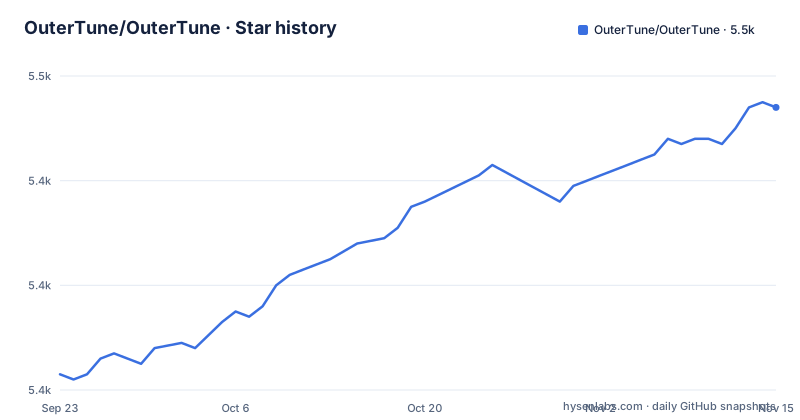
Star history
- OuterTune/OuterTune5,454 ★ · +51
| Repository | 2026-09-23 | 2026-11-15 |
|---|---|---|
| OuterTune/OuterTune | 5.4k | 5.5k |
51 Stars in the last 53 days, measured from the daily GitHub snapshot. Compare with other projects
Editorial analysis
The project page opens by telling you it is over, and names three successors
The first thing the README does is refuse to sell you anything. This app is no longer in active development. Then it routes by what you actually want. For a replacement YouTube Music client it points at InterTune, AsterTune, Metrolist and ArchiveTune. For a local music player, or if you would rather keep with the maintainer's antics, it points at Gramophone.
That routing is more useful than a status line because the project is genuinely two products in one. It is described as a supercharged fork of InnerTune by z-huang, and it is both a local media player and a streaming client. The successors split along exactly that seam, so the recommendation is not a single replacement but a choice between the half you use.
The offer at the end is a maintainer handover: anyone wishing to take on the maintainer role and resurrect the app is invited to make contact, and discussion thread 1116 is linked separately. The repository itself is not archived and the last push is dated 2026-10-12, so the code is reachable and the tree is intact, but the declaration in the README is the honest description of where the project stands.
The release tags stopped being clean version numbers
Three recent releases tell you how versioning works here. v0.11.1 on 2026-09-06 is a plain tag. Then there is pre_rel-0.10.1-b1-glass carrying the release name LIQUID GLASS EDITION from 2026-03-31, and pre_rel-0.10.2-b1 covering v0.10.2-b1 and v0.11.0-a1 from 2026-01-31. The ordering is not monotonic with the version numbers: the 0.10 line shipped after the 0.11 line in tag date.
If you automate updates this matters. The Obtainium configuration the project publishes carries a filterReleaseTitlesByRegEx set to an empty string, which means no title filter, alongside includePrereleases false and fallbackToOlderReleases true, and a verifyLatestTag of false. Those settings together mean the update client is configured to skip prereleases and to accept an older release when the newest cannot be used.
Other flags in that same configuration are worth reading for what they reveal about the device rather than the app: autoApkFilterByArch is true, shizukuPretendToBeGooglePlay is false, allowInsecure is false, and skipUpdateNotifications is false. The default branch is lite rather than master, so anything you build from source is building a line the maintainer chose deliberately.
Three distribution channels, none of them an app store listing
There is no store entry in the project's own links. What is offered is a GitHub releases link, a direct APK path on the IzzyOnDroid F-Droid index at apt.izzysoft.de/fdroid/index/apk/com.dd3boh.outertune, and an Obtainium redirect that builds an install URI from the repository. The application id is com.dd3boh.outertune and it is attributed to DD3Boh, which is what you will see on the device.
The Obtainium link encodes the entire update policy as URL parameters, including exemptFromBackgroundUpdates set to false and the about string describing the app as a Material 3 YouTube Music client and local music player for Android. It is an unwieldy thing to read by eye, but it is also the most complete statement of the update configuration anywhere in the project.
So there is no first-party store channel to lose, and equally no store-mediated update path. Updates are a sideloaded APK you have to replace.
The fork's real additions sit in the audio pipeline, not the streaming client
The feature list does not mark which items are new relative to InnerTune, and much of it is audio rather than networking. Local file playback covers MP3, OGG and FLAC among others, and local and streaming songs can play at the same time. There are multiple queues. Synchronized lyrics are supported in word by word and karaoke formats including LRC and TTML. Audio normalization, tempo and pitch adjustment and other effects are in the list, along with Android Auto support.
The specific complaint worth repeating is about metadata: the project uses a custom tag extractor instead of MediaStore's metadata extractor, with the parenthetical example that tags delimited with a backslash now show up properly. That is a narrow fix, and it is the kind of fix that only gets written by someone who hit it.
The support floor is stated twice, once in the feature list as Android 8 Oreo and higher and once as a note saying Android 7.x Nougat may work but is not officially supported. On the streaming side there is song downloading for offline playback, described as seamless playback with no ads and background playback, and account synchronization, with one exception noted separately.
Playlist sync from the app to the account is marked temporarily unavailable
Account synchronization is listed as a supported capability, and immediately under it the list carries a carve-out: full playlist sync from the app to the remote account is temporally unavailable. The wording is unusual, and it points at the direction that is broken rather than at sync in general.
Read carefully, that means full playlist sync from the app to the remote account is not currently available.
There is a second unavailability elsewhere in the project. The old README is collapsed behind a click to show control, which means the substantive feature documentation on the page is the archived version rather than current. The feature list, including the playlist sync note above, sits inside that collapsed old README.
Region availability is a hard gate, stated as a warning rather than a note
One block on the page is formatted as a warning rather than as a feature or a note, and it is the most consequential line for anyone outside the relevant markets. If you are in a region where the streaming service is not supported, you will not be able to use the app, unless you have a proxy or VPN to connect to a supported region.
That is a hard dependency, not a degradation.
The recommendation to reach for a proxy or VPN is the project's own, and it is worth reading alongside the disclaimer rather than separately. The disclaimer states that the project and its contents are not affiliated with, funded by, authorized by, endorsed by or in any way associated with the streaming platform or its parent company, and that any trademark, service mark, trade name or other intellectual property rights used are owned by the respective owners. The app is distributed under GPL-3.0 and those terms cover the source, not the service.
The tree is a Gradle project with vendored modules and a lite default branch
Building means the Gradle wrapper, and the instructions are not inline. CONTRIBUTING.md is the pointer given for both contributors and anyone who wants to build the app themselves, with the project stating it is looking for contributors, translators and maintainers. The top level shows the usual shape: app/, assets/, build.gradle.kts, settings.gradle.kts, gradle.properties, gradle/, gradlew and gradlew.bat for the Windows wrapper, plus lint.xml.
Two entries are more telling than the rest. There is a .gitmodules file, so parts of the build are git submodules rather than vendored directories, and there are prebuilt/ and material-color-utilities/ directories alongside a Modules.md that presumably accounts for them. fastlane/ is present as well.
Localization runs through Weblate at hosted.weblate.org/projects/outertune/ rather than through pull requests, which is the normal arrangement for an Android app of this size and means translations arrive on their own schedule. Support is split three ways: bug reports and feature requests as GitHub issues, help with the app in the discussion forum, and a protonmail address for everything else, which the page explicitly states is not a support address.
Editorial conclusion
Install OuterTune if you are already on Android and want local files and a streaming catalogue in one Material 3 player, and you are willing to take the update risk that comes with a project whose own page says development has stopped. Read the named successors first, since the author points at InterTune, AsterTune, Metrolist and ArchiveTune for streaming and Gramophone for local playback, and the maintained path is more likely to survive a streaming backend change. Check your region before anything else, because the app is a YouTube Music client and the project states plainly that it does not work where that service is unavailable. And read the disclaimer before drawing your own conclusion about terms of use, since the project states it is not affiliated with or endorsed by the platform holder.
Frequently asked questions
What is OuterTune used for?
It is a Material 3 music player for Android that is both a local media player and a streaming client. Local playback covers formats such as MP3, OGG and FLAC, and local and streaming songs can play at the same time. It also offers multiple queues, synchronized lyrics in word by word karaoke formats including LRC and TTML, audio normalization with tempo and pitch adjustment, and Android Auto support.
Does OuterTune still work?
The project states plainly that the app is no longer in active development, and it invites anyone who wants to resurrect it to take on the maintainer role. The repository is not archived and the last push is dated 2026-10-12, with v0.11.1 released on 2026-09-06, so the code is there and the app is installable, but no fixes are being promised. One feature is already marked unavailable: full playlist sync from the app to the remote account.
What are the key differences between InnerTune and OuterTune?
OuterTune is described as a supercharged fork of InnerTune, with InnerTune credited as the base without which the fork would not exist. The features it lists are multiple queues, synchronized and karaoke lyrics in LRC and TTML, audio normalization with tempo and pitch adjustment and other effects, Android Auto support, and a custom tag extractor used instead of MediaStore's metadata extractor so that tags delimited with a backslash display properly.
is outertune legal
The source is released under the GPL-3.0 License, and the project's disclaimer states that it is not affiliated with, funded by, authorized by, endorsed by or in any way associated with the streaming platform or its parent company, and that trademarks used belong to their respective owners. That disclaimer covers the project's relationship to the service rather than settling questions about individual use, so it is not the same thing as a legal clearance.
how to install outertune on android
There is no app store listing in the project's links. The offered paths are a GitHub release APK, a direct APK on the IzzyOnDroid F-Droid index at apt.izzysoft.de/fdroid/index/apk/com.dd3boh.outertune, and an Obtainium install URI built from the same repository with the application id com.dd3boh.outertune. All three are sideloaded, so there is no store-mediated update path.
Official sources
Add this badge to your README
If you maintain this project, the badge below links readers to this analysis and shows its maintenance status from the daily GitHub snapshot. Paste the markdown into your README; add ?metric=license or ?metric=stars to the image URL for a different field.

[](https://hysenlabs.com/projects/outertune-outertune)Star history chart for your README
[](https://hysenlabs.com/projects/outertune-outertune)Was this useful?