OWASP DevGuide: a Markdown security handbook with a 2002 version 1.0 and four PDF builds
The OWASP Developer Guide
At a glance
- What is it?
- The OWASP Developer Guide repository holds the text of a long-running secure development guide, built with MkDocs and released in PDF in four languages.
- Who is it for?
- Read the guide on devguide.owasp.org if you are a developer who wants OWASP's secure development advice, and clone this repository only to contribute fixes. Teams copying text into their own material must keep attribution and the same license.
- Can I use it commercially?
- Yes, with credit. CC-BY-SA-4.0 allows commercial use as long as you credit the authors and indicate what you changed. It is written for creative content, so check how it applies to any code.
- Is it still maintained?
- Yes. The repository received new commits within the last day.
- What is it written in?
- GitHub does not report a main language for this repository.
Answers come from the project's GitHub data, last synced on November 26, 2026, and from our analysis. They are not legal advice.
Star history
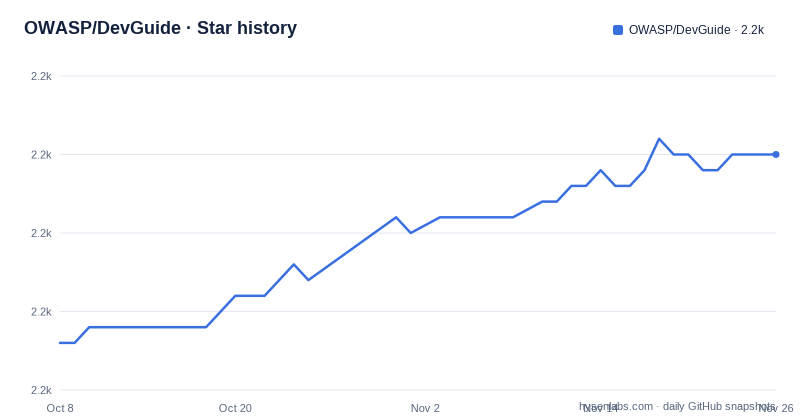
- OWASP/DevGuide2,195 ★ · +12
| Repository | 2026-10-08 | 2026-11-26 |
|---|---|---|
| OWASP/DevGuide | 2.2k | 2.2k |
12 Stars in the last 49 days, measured from the daily GitHub snapshot. Compare with other projects
Editorial analysis
A 2002 PDF called Building Secure Web Applications and Web Services is version 1.0
The Developer Guide is one of the original OWASP documents. The README links its very first release, version 1.0 from 2002, as a PDF named OWASPBuildingSecureWebApplicationsAndWebServices-V1.0.pdf, stored in a DevGuide1.0 folder at a fixed commit of the original repository. The title shows how the guide began: advice on building secure web applications and web services, written before most of today's development stacks existed.
This repository is the current content, and the README says the latest version is available as a web document at devguide.owasp.org. The older versions are kept in the original DevGuide repository, indexed on the Old versions section of its wiki. If you need to cite what the guide said in a given year, that wiki page is the starting point, and this README says nothing more about how the versions differ.
The guide's own tagline, at the foot of the README, is accessible security for developers. The README gives no table of contents, so the chapters themselves have to be read at the website.
The text lives as Markdown under docs/ and is assembled by mkdocs.yaml
The top level of the repository has a docs/ folder, a mkdocs.yaml and a CNAME file. That is the shape of a documentation site generated with MkDocs: the pages are source files in docs/, the site settings are in mkdocs.yaml, and the CNAME file names the custom domain that serves the result. The README links devguide.owasp.org as the latest web document.
There is no application code to install. The README has no install, build or run commands, and no package manifest appears in the top-level listing. A contributor edits text, and the build produces pages.
That shapes who this repository is for. A developer who wants to read the guide goes to the website. A contributor who wants to fix a paragraph reads contributing.md and follows code_of_conduct.md. Nobody needs to clone it just to use the guide, and the README does not suggest they should.
Four mkdocs-pdf files build the guide as a PDF in English, Spanish, Persian and Brazilian Portuguese
Beyond the web version, the root has four PDF configurations: mkdocs-pdf-en.yaml, mkdocs-pdf-es.yaml, mkdocs-pdf-fa.yaml and mkdocs-pdf-pt-br.yaml. The language codes read as English, Spanish, Persian (fa) and Brazilian Portuguese. Each file is a separate build target, so a PDF of the guide in each language comes from its own configuration, not from one shared one.
Quality tooling is uneven across those languages, and the listing shows it. Spellcheck configuration and wordlists exist for three of them: .spellcheck-en.yaml with .wordlist-en.txt, .spellcheck-es.yaml with .wordlist-es.txt, and .spellcheck-pt-br.yaml with .wordlist-pt-br.txt. There is no spellcheck file for fa in the top-level listing.
The practical reading is that the Persian build exists, and no automated spelling check for it is visible at the repository root. The README does not discuss translation status or which language is complete, so a reader who needs a non-English edition should compare the PDF with the English text before relying on it.
A link checker ignore list and a markdown lint config keep the prose buildable
Two small files reveal how the repository guards a book-sized corpus. .lycheeignore is the ignore file for a link checker, listing URLs that should not be tested. .markdownlint.yaml sets the lint rules for the Markdown sources. The README's CI badge points to an actions workflow named ci.yaml in the www-project-developer-guide repository, and a .github/ folder holds this repository's own workflows.
For a contributor the consequence is concrete. A pull request that adds a new term to the English text may trip the English spellcheck unless the word is added to .wordlist-en.txt. A pull request that adds a broken external link may fail the link check unless the URL is added to the ignore list. The README does not describe either rule, so you learn about them from a failing check.
The README also carries an OpenSSF Best Practices badge, linked to project 9373. It says nothing about what the badge level is.
Guide content and project pages live in two repositories, and mixing them up wastes a pull request
The README says the content for the OWASP Developer Guide project pages is in its own repo, www-project-developer-guide, and the project pages themselves are on owasp.org/projects/developer-guide. This repository is the document. The other is the project's presence on the OWASP site, including the CI workflow that the README's build badge reports on.
So a typo in a chapter goes here, while a fix to the project page, its leaders list or its description goes to the other repository. The README states this split once and does not repeat it in the contributing section, which only says to read contributing.md, follow the code of conduct, create an issue or open a pull request.
For conversation instead of edits, the README names the OWASP Slack channel #project-developer-guide, with a note that you may need to subscribe to the workspace first, a Bluesky account for following the guide, and a project wiki with background and purpose. If you forked the repository earlier, the default branch was renamed to main, and a FAQ page in the wiki explains the change.
Version 4.2.0 shipped on 16 March 2026, and the last push came on 21 October 2026
The repository is not archived. The newest release is v4.2.0, dated 16 March 2026. Before it came v4.1.9 on 18 July 2025 and v4.1.8 on 26 April 2025. Releases are therefore a few months apart, and the gap between 4.1.9 and 4.2.0 was about eight months. The last push to main was on 21 October 2026, after the last release, which means edits have landed that are not in v4.2.0.
A release-process.md file at the root documents how releases are cut, though its contents are not shown here. A security.md file covers reporting. The README names five project leaders: Andra Lezza, Shruti Kulkarni, Vandana Verma Sehgal, Harold Blankenship and Jon Gadsden.
If you cite the guide, cite the version. The website shows the latest text, and the text can change after any push, so a reference that matters should name v4.2.0 or the date you read it.
CC-BY-SA-4.0 lets you reuse the text, with attribution and under the same license
The repository metadata gives the license as CC-BY-SA-4.0, and the README badge points to license.txt. The name encodes the terms: attribution is required, and anything derived from the text must be shared under the same license. A company that wants to copy chapters into an internal training manual should keep the credit and apply the same terms to the manual, which is the part that surprises teams who assume a free document can go into a proprietary handbook.
The license covers the guide's text. It does not turn the guide into a standard or a certification, and the README makes no such claim. It also does not list what the chapters recommend, so a reader cannot judge coverage from the README alone.
Editorial conclusion
Read the guide on devguide.owasp.org if you are a developer who wants OWASP's secure development advice, and clone this repository only to contribute fixes. Teams copying text into their own material must keep attribution and the same license. Before citing it, note the release version, because pushes after v4.2.0 are not in that tag.
Frequently asked questions
What is the OWASP Developer Guide?
It is one of the original OWASP documents, with a first version 1.0 released in 2002. This repository holds its current content, and the latest version is available as a web document at devguide.owasp.org.
Which languages does the OWASP DevGuide cover?
The repository has PDF build configurations for English, Spanish, Persian and Brazilian Portuguese: mkdocs-pdf-en.yaml, mkdocs-pdf-es.yaml, mkdocs-pdf-fa.yaml and mkdocs-pdf-pt-br.yaml.
What license is the OWASP DevGuide under?
CC-BY-SA-4.0, with the terms in license.txt in the repository root.
How do I contribute to the OWASP DevGuide?
Read contributing.md and follow the code of conduct. You can also create an issue, open a pull request or join the #project-developer-guide channel on OWASP Slack.
Official sources
Add this badge to your README
If you maintain this project, the badge below links readers to this analysis and shows its maintenance status from the daily GitHub snapshot. Paste the markdown into your README; add ?metric=license or ?metric=stars to the image URL for a different field.

[](https://hysenlabs.com/projects/owasp-devguide)Star history chart for your README
[](https://hysenlabs.com/projects/owasp-devguide)Was this useful?