reth says cargo test is untested, and its two build paths disagree on the profile name
Modular, contributor-friendly and blazing-fast implementation of the Ethereum protocol, in Rust
At a glance
- What is it?
- A Rust Ethereum execution layer client: Storage V2 is the default with V1 support scheduled for removal, the documented test command is nextest with cargo test called out as unsupported, full coverage needs the competing client installed, and the container build defaults to a maxperf profile while the Makefile defaults to release.
- Who is it for?
- reth is a serious choice for anyone running an execution node or building on the execution layer, and the README is unusually candid about the parts that will cost you time. Three things to settle first.
- Can I use it commercially?
- Yes. Apache-2.0 is a permissive licence: you can use, modify and sell software built on it, as long as you keep its copyright and licence notices.
- Is it still maintained?
- Yes. The repository last received commits 1 day ago.
- What is it written in?
- Mainly Rust, according to GitHub's language statistics.
Answers come from the project's GitHub data, last synced on November 22, 2026, and from our analysis. They are not legal advice.
Star history
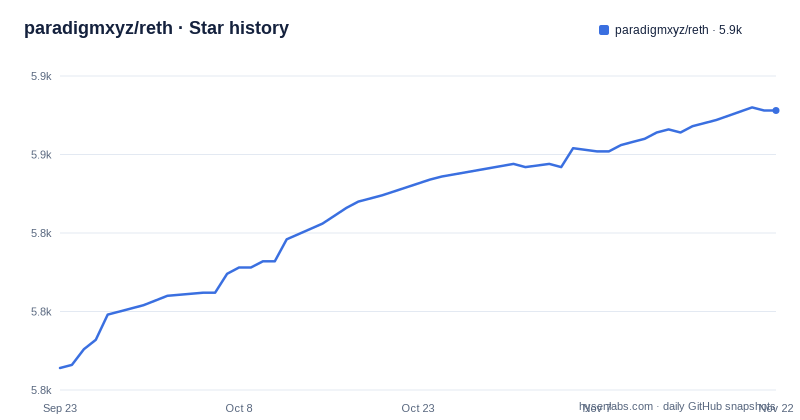
- paradigmxyz/reth5,864 ★ · +82
| Repository | 2026-09-23 | 2026-11-22 |
|---|---|---|
| paradigmxyz/reth | 5.8k | 5.9k |
82 Stars in the last 60 days, measured from the daily GitHub snapshot. Compare with other projects
Editorial analysis
Storage V2 is the default, and V1 is on its way out
The storage section is three sentences. Storage V2 is the default for new nodes as of Reth 2.0. Existing V1 nodes continue to work, V1 support will be removed in a future release, and all users are encouraged to migrate. Prebuilt V2 snapshots are published at a separate address, `snapshots.reth.rs`.
So a node operator has three states to be in. New nodes land on V2 without choosing. Existing V1 nodes still run, so nothing breaks on upgrade day, but they are running a format with a stated end. And anyone who wants to skip the migration has a snapshot service to pull from instead of resyncing.
The version history records an earlier format change too. The first beta, on 2024-03-04, is described as the project's first breaking change to the database model, and the three benefits claimed for it are faster query speed, a smaller database footprint, and the ability to mount history on separate drives. Reth 2.0 shipped in April 2026, and Storage V2 is the default for new nodes in that release.
One related file sits at the root: `HARDFORK-CHECKLIST.md`, a checklist for shipping a hardfork.
The documented test command is nextest, and cargo test is called out as untested
The build and test section is the most specific part of the README. The clone is two lines, then the tests are two more:
git clone https://github.com/paradigmxyz/reth
cd rethcargo nextest run --workspace
# Run the Ethereum Foundation tests
make ef-testsNextest is recommended rather than merely offered. The text says it is highly recommended to speed up testing, and then says that using `cargo test` may work fine but is not tested and does not support more advanced features such as retries for spurious failures. That is a precise admission: the fallback path that most contributors would reach for is the one the project does not exercise.
The retry point matters for an execution client, where a failing test can be a race rather than a defect, and nextest's retry is what turns a flake into a log line instead of a red build.
One more testing fact sits in a note box. Some tests use random number generators to produce their data, and a deterministic run is available by setting the `SEED` environment variable. So a failure is reproducible for a colleague only if they know the seed.
Full coverage needs Geth installed, and two external suites are pinned by tag
Running the whole test suite requires an external program: to fully test reth you need Geth installed, though a subset of tests can run without it. Geth is a competing Ethereum client, so the test suite of this client reaches outside itself for reference behaviour.
The two external suites are pinned to specific release tags in the Makefile, and they come from two different repositories into one directory. The Ethereum Foundation tests are fetched from the `ethereum/tests` archive at tag `v17.0`, and the execution spec tests come from `ethereum/execution-spec-tests` at tag `v4.5.0`, as a file named `fixtures_stable.tar.gz`. Both land under `./testing/ef-tests/`, one in `ethereum-tests` and one in `execution-spec-tests`. The `make ef-tests` target named in the README is what drives them.
Pinning by tag is the right call for reproducibility and it also dates the suite: the Foundation tests are at a version from before the current releases, and the spec tests at v4.5.0.
The Makefile also carries the paths for two things that are not in the repository root listing. `MDBX_PATH` points at `crates/storage/libmdbx-rs/mdbx-sys/libmdbx`, and `DB_TOOLS_DIR` is set to `db-tools`, a directory name that does not appear among the top-level entries.
The minimum Rust version is 1.95, and a comment tells you to update it in four places
The README states the minimum supported Rust version in prose, and the same section carries a comment block that exists only to keep that number in step:
When updating this, also update:
- Cargo.toml
- .github/workflows/lint.yml
The number then appears in at least three committed places. The workspace manifest carries `rust-version = "1.96"` alongside `edition = "2024"`, an edition that is itself a recent choice. The container base image is `lukemathwalker/cargo-chef:latest-rust-1.96-trixie`, so the Rust version is baked into the image tag next to a Debian codename. And the workflow named in the comment is where the lint job runs.
The README comment asks a human to remember. A build image that silently trails the manifest would still compile, just against a different compiler than the project claims to support.
The `Cross.toml` file at the root is the cross-compilation configuration, and `flake.nix` with its lock file is a second, independent way to pin a toolchain. So the Rust version is pinned in at least three mechanisms, only some of which are connected to the one number in the README.
The container builds maxperf by default while the Makefile builds release
Two entry points build the same binary and they disagree about its profile name.
The container defines `ARG BUILD_PROFILE=maxperf` with the comment that maxperf is the default, and passes it to `cargo chef cook --profile $BUILD_PROFILE` and then to `cargo build --profile $BUILD_PROFILE --features "$FEATURES" --locked --bin reth`. The Makefile sets `PROFILE ?= release`, with a comment saying the default is for local builds and CI uses an override. So a binary from the container and a binary from the Makefile are compiled under differently named profiles, and comparing their numbers compares two builds.
The rest of the container is careful in ways worth naming. Platform-specific compiler flags are set only for `linux/amd64`, where the Dockerfile applies `-C target-cpu=x86-64-v3` together with `+pclmulqdq`, with a comment attributing the CPU level to Haswell and later and the carry-less multiply to rocksdb. Any RUSTFLAGS passed in from outside take precedence over that branch. The build needs system packages installed in a layer that copies a script out of `.github/scripts/` and then deletes it.
There is also a hack the file admits to. Because ARG is not resolved inside COPY, the built binary is moved to `/app/reth` by a separate layer after the build, and the comment says so. The build orchestration around it is `docker-bake.hcl`, and two sibling Dockerfiles exist for a depot-based build and for a reproducible one.
A bare make prints a colourised target list borrowed from Lighthouse
The Makefile opens with `.DEFAULT_GOAL := help`, so running make with no target prints usage rather than building anything, and its first line credits the design to the Lighthouse consensus client with a full permalink to that project's Makefile.
The help recipe is a single awk program rather than a script. It sets the field separator to a colon followed by anything and a double hash, prints a usage line wrapped in colour escape codes, then matches target definitions carrying a `##` comment and prints them padded to fifteen columns, also in colour. Section headers come from lines beginning `##@`, which is why the file is organised into labelled groups, Help and Build being the first two.
Variables are declared in a block at the top, each with a comment explaining what it is for. `GIT_SHA` and `GIT_TAG` are read from git directly, `BIN_DIR` holds the output path, `CARGO_TARGET_DIR` is overridable, `FEATURES` is empty by default with a note that it can be set from the environment, `EXTRA_RUSTFLAGS` carries its own example of a CPU target flag, and `CARGO_INSTALL_EXTRA_FLAGS` is left empty for callers who need it.
The install target builds and installs the binary under the Cargo home bin directory, passing `--force` and `--locked`, the features variable, and the profile variable.
The performance goal introduces a mainnet comparison and then nothing follows
The goals section lists six numbered items. The second one is performance, and it credits Rust, Alloy, evm2 and Foundry as the stack, then points at a third-party dashboard for a comparison against other Ethereum clients. After that comes a sentence: here's what that looks like in practice on Ethereum Mainnet.
What follows the sentence is the third numbered goal. No table, no figures and no timing appear between them, so the one place the README promises measured mainnet evidence is the one place it points elsewhere.
The other goals are claims of a different kind. Modularity is the first, and it is the one with the most support behind it: every component is built to be used as a library, and the examples directory holds twenty-four separate programs that plug into different layers, including custom EVM, custom hardforks, a custom inspector, a custom payload builder, custom RPC and authentication middleware, node builder API, database access, manual and BSC peer-to-peer, network proxy and transaction pool, beacon API sidecar and SSE clients, and two examples built around the exex surface. The last goal, configurability, is backed by profiles described as ranging from high-performance RPC operators to hobbyists on consumer hardware.
One closing detail: Reth completed an audit with Sigma Prime, whose report sits in the repository as a PDF whose filename carries a v2 marker.
Editorial conclusion
reth is a serious choice for anyone running an execution node or building on the execution layer, and the README is unusually candid about the parts that will cost you time. Three things to settle first. Storage V2 is already the default for new nodes and V1 support is stated to be removed in a future release, so a node on V1 is on a clock and the snapshots service is the migration path. Your test command is `cargo nextest`, because the project states that `cargo test` is not tested and lacks retries for spurious failures, and a full run additionally needs Geth installed even though this is a competing client. And the two build entry points disagree: the container defaults to a maxperf Cargo profile while the Makefile defaults to release, so a binary built one way is not comparable to one built the other. Whatever you build, pin to a released tag rather than the branch.
Frequently asked questions
What is reth used for?
It is a production-ready Ethereum execution layer client written in Rust, built and driven forward by Paradigm. It is compatible with all consensus layer implementations that support the Engine API, and the README recommends it for RPC, MEV, indexing, simulations and peer-to-peer workloads.
What is Reth and under what licence is it released?
Reth, short for Rust Ethereum, is a modular and production-ready execution layer client focused on performance and configurability. It is licensed under both Apache and MIT, with no business licence restrictions, and the workspace manifest records the pair as MIT OR Apache-2.0.
How do you build and test reth from source?
Clone the repository and run cargo nextest run --workspace, with make ef-tests for the Ethereum Foundation tests. The minimum supported Rust version is 1.96, a full test run needs Geth installed, and the SEED environment variable makes randomised test data deterministic.
Does reth keep its database compatible across major versions?
For now, yes. Storage V1 nodes continue to work, but Storage V2 became the default for new nodes in Reth 2.0 and V1 support is stated to be removed in a future release, with users encouraged to migrate. V2 snapshots are published at snapshots.reth.rs.
Can the reth crates be used as libraries?
That is the first stated goal: every component is built to be used as a library, well tested, documented and benchmarked, and the crates are meant to be imported and mixed. Crate documentation is published at reth.rs/docs and the repository's examples directory holds twenty-four programs that extend different layers of the client.
Official sources
Add this badge to your README
If you maintain this project, the badge below links readers to this analysis and shows its maintenance status from the daily GitHub snapshot. Paste the markdown into your README; add ?metric=license or ?metric=stars to the image URL for a different field.

[](https://hysenlabs.com/projects/paradigmxyz-reth)Star history chart for your README
[](https://hysenlabs.com/projects/paradigmxyz-reth)Was this useful?