Phusion Passenger: the submodule step, three install binaries, and a package.json that says 0.0.0
A fast and robust web server and application server for Ruby, Python and Node.js
At a glance
- What is it?
- Phusion Passenger is an MIT licensed web and application server for Ruby, Python and Node.js built around a C++ core. The repository documents almost none of its own setup: one submodule command, three separate install binaries with no recommendation between them, and an Installation heading that hands the rest to the vendor website.
- Who is it for?
- Passenger is a serious app server with a real C++ core, but this repository is not where you learn to run it: the install steps live on a vendor page, the three binaries are offered without criteria, and the packaged version numbers do not match the release tags.
- Can I use it commercially?
- Yes. MIT is a permissive licence: you can use, modify and sell software built on it, as long as you keep its copyright and licence notices.
- Is it still maintained?
- Yes. The repository last received commits 5 days ago.
- What is it written in?
- Mainly C++, according to GitHub's language statistics.
Answers come from the project's GitHub data, last synced on November 15, 2026, and from our analysis. They are not legal advice.
Star history
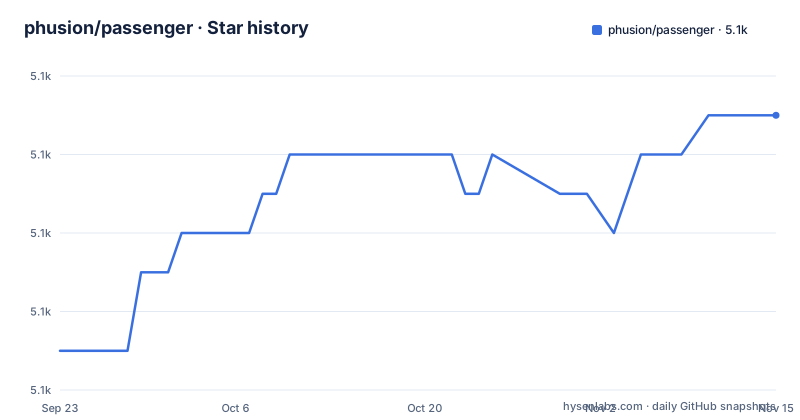
- phusion/passenger5,093 ★ · +6
| Repository | 2026-09-23 | 2026-11-15 |
|---|---|---|
| phusion/passenger | 5.1k | 5.1k |
6 Stars in the last 53 days, measured from the daily GitHub snapshot. Compare with other projects
Editorial analysis
The install section is one link, and INSTALL.md is never named
The Installation heading holds a single instruction: follow the installation instructions on the website, which points at phusionpassenger.com/docs/tutorials/what_is_passenger/. The URL is a tutorial about what Passenger is, not a sequence of steps. The repository root, meanwhile, carries INSTALL.md, a doc/ directory and a man/ directory, and the install path never points at any of them. A reader who wants to know what happens to their system during setup has to leave the checkout to find out. No Ruby, Python or Node.js version requirement appears in that README either, and it does not document an upgrade path or a rollback. Every version-related decision is delegated to the site, which means the repository alone cannot tell you what a given release expects of your runtime.
A git checkout is the tarball plus one submodule command
Installing from this repository is described as the same thing as the tarball method with exactly one difference: the git submodules have to be cloned first. A .gitmodules file sits at the root, so the extra step is real rather than a convenience.
git submodule update --init --recursiveAfter that, three mutually exclusive commands are offered and none of them is chosen over the others. The first two build an integration module for a web server you already run:
./bin/passenger-install-apache2-module./bin/passenger-install-nginx-moduleThe third starts the standalone server from your application directory instead:
# From your application directory
~/path-to-passenger/bin/passenger start
Which one applies depends on whether a front-end server already owns the socket. The README gives no criteria, no comparison, and no account of what each binary writes into your Apache or Nginx configuration.
The gem command ends in a literal x.x.x
Ruby users get a second route that never leaves the checkout. Two commands build and install the gem, and the second carries a placeholder exactly where the version belongs:
gem build passenger.gemspecgem install passenger-x.x.x.gemThe README leaves the version for the reader to fill in from the gem file that `gem build` writes before the install command resolves to a real file. The root already carries a Gemfile, a Gemfile.lock and a .rubocop.yml, so Ruby packaging and Ruby lint rules are checked in, and the gem path is the one install route you can complete without leaving the repository. The same section then sends you back to the manual on the website for configuration and troubleshooting, which is the same round trip the Installation heading asks for.
package.json reports version 0.0.0 and an entry point that is not in the root
The only package manifest at the root describes Node.js support in a way that does not line up with the releases. It is named passenger, its version field is 0.0.0 while the latest tag is release-6.2.1 and the default branch is stable-6.2, and its description field repeats the repository description word for word. Every dependency is a devDependency: webpack 5 with terser, babel with the env and react presets, four CSS build packages, express, body-parser, multer, mocha, sinon and should, plus jquery and preact declared side by side. There is exactly one script, and it hands the work to Ruby: `test` runs `rake test:node`. The main field points at index.js, and no index.js appears among the top-level entries. Read this file as build tooling for the test bundle rather than as a published runtime package, and treat 0.0.0 as a placeholder instead of a version to pin.
Zero-copy, watchdog, hybrid: three claims with no measurement
One short paragraph carries the whole performance story: a C++ core, a zero-copy architecture, a watchdog system, and a hybrid design that is evented, multi-threaded and multi-process at once. No benchmark, request rate, memory figure or startup time appears anywhere in that text, and the tree has no benchmark directory either. The only quantity anywhere is a claim of over 650.000 websites, written with a European thousands separator and linked to a third-party technology survey rather than to a measurement of this project. A named user list follows: Apple, Pixar, New York Times, AirBnB and Juniper. Watch the language drift as well. The page heading and the description name Ruby, Node.js and Python, while the body adds Meteor as a fourth supported runtime, so the two lists of supported languages in the same file are not the same list.
MIT for the code, Asynchronous B.V. for the name
Three different names have to be kept apart before you build anything on this project. The repository metadata reports MIT, package.json repeats MIT, and a LICENSE file is checked in. The README closes with a Legal section stating that Passenger and Phusion Passenger are registered trademarks of Asynchronous B.V. Meanwhile the manifest names Phusion as the author, the links point at phusion.nl and phusionpassenger.com, and the code sits under the phusion organization. The MIT grant covers the code in the tree; the trademark line covers the two strings most people use to refer to the product. Forking settles neither question, and the README offers no guidance on renaming or on how the mark should be used in derived work.
Release notes live on a blog tag while CHANGELOG sits in the root
The version story is split across three places. The default branch is stable-6.2 rather than main. The most recent releases are release-6.2.1 dated 2026-10-19, release-6.2.0 dated 2026-08-18 and release-6.1.8 dated 2026-07-20, and the last push to the repository is dated 2026-10-19. The Further reading list sends readers to blog.phusion.nl/tag/passenger-releases/ for release notes, while a CHANGELOG file is checked into the root, and neither file says which one is authoritative or whether they match. The doc/ directory is offered as further reading and man/ is not mentioned at all, even though both are in the tree. For a component that sits in front of production traffic, that ambiguity is worth closing before you deploy.
Four editors' metadata and two agent files sit in a C++ tree
The root is where this project keeps its tooling preferences, and there are more of them than the source layout suggests. Eclipse contributes .project, .cproject, .settings/ and .externalToolBuilders/. The .vscode/ directory and Passenger.sublime-project add two more editors, while .clangd and .editorconfig cover the C++ side and formatting. Two files named AGENTS.md and CLAUDE.md, plus an .agents/ directory, sit next to .rubocop.yml for Ruby and a .github/ directory. The build entries live alongside all of it: configure, build/, src/, bin/, packaging/, resources/, dev/ and test/. Nothing explains why the editor files are committed or who is expected to read AGENTS.md, so anyone planning a fork inherits a contributor setup assembled for a different set of tools than the C++ core requires.
Editorial conclusion
Passenger is a serious app server with a real C++ core, but this repository is not where you learn to run it: the install steps live on a vendor page, the three binaries are offered without criteria, and the packaged version numbers do not match the release tags. Read the website tutorial for the actual setup, pin a release tag instead of the 0.0.0 in package.json, and rename before you publish anything under the Passenger name, since the code is MIT but the mark belongs to Asynchronous B.V.
Frequently asked questions
What is Phusion Passenger and which languages does it serve?
It is a web server and application server whose primary language is C++, released under the MIT license. The README names Ruby, Python, Node.js and Meteor as supported runtimes, while the repository description names only Ruby, Python and Node.js. The project homepage is phusionpassenger.com.
How do I install Phusion Passenger from the git repository?
Run `git submodule update --init --recursive` first, because installing from git is otherwise the same as the tarball method. After that, run one of `./bin/passenger-install-apache2-module`, `./bin/passenger-install-nginx-module`, or `~/path-to-passenger/bin/passenger start` from your application directory.
Which Phusion Passenger release should I pin, and is the project still moving?
The default branch is stable-6.2, the newest release is release-6.2.1 dated 2026-10-19, and the last push to the repository is dated 2026-10-19. Earlier tags are release-6.2.0 dated 2026-08-18 and release-6.1.8 dated 2026-07-20. The repository is not archived.
What license is Phusion Passenger under, and what about the name itself?
The repository metadata and package.json both report MIT, and a LICENSE file sits in the root. The Legal section of the README says Passenger and Phusion Passenger are registered trademarks of Asynchronous B.V., so the code grant and the product name are separate questions.
Can I install Phusion Passenger from npm?
No such route is documented. The root package.json reports version 0.0.0, keeps every dependency in devDependencies, exposes one script that runs `rake test:node`, and names index.js as its main entry even though no index.js appears among the top-level entries. The README points Ruby users at `gem build passenger.gemspec` and everyone else at the website tutorial.
Official sources
Add this badge to your README
If you maintain this project, the badge below links readers to this analysis and shows its maintenance status from the daily GitHub snapshot. Paste the markdown into your README; add ?metric=license or ?metric=stars to the image URL for a different field.

[](https://hysenlabs.com/projects/phusion-passenger)Star history chart for your README
[](https://hysenlabs.com/projects/phusion-passenger)Was this useful?