piston: a Rust game engine core made of traits and three path dependencies
A modular game engine written in Rust
At a glance
- What is it?
- piston is the core library of a modular Rust game engine, and it is deliberately thin: the manifest depends on three crates that live inside the same repository, one feature flag turns on async event handling, and the architectural rule is that backends are plugged in at the application level rather than compiled into the library. Its newest tag is from 2017 while the manifest says 1.0.0.
- Who is it for?
- piston fits a Rust developer who wants windowing, input and an event loop as swappable pieces and is willing to pick the backends in their own application, since that separation is the entire design.
- Can I use it commercially?
- Yes. MIT is a permissive licence: you can use, modify and sell software built on it, as long as you keep its copyright and licence notices.
- Is it still maintained?
- Yes. The repository last received commits 88 days ago.
- What is it written in?
- Mainly Rust, according to GitHub's language statistics.
Answers come from the project's GitHub data, last synced on November 22, 2026, and from our analysis. They are not legal advice.
Star history
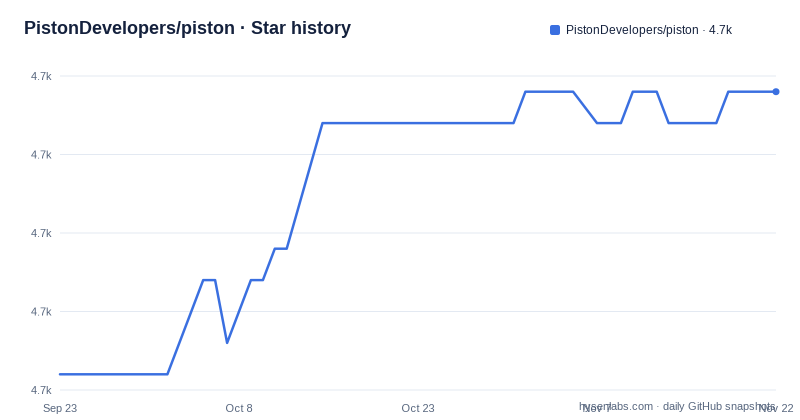
- PistonDevelopers/piston4,712 ★ · +9
| Repository | 2026-09-23 | 2026-11-22 |
|---|---|---|
| PistonDevelopers/piston | 4.7k | 4.7k |
9 Stars in the last 60 days, measured from the daily GitHub snapshot. Compare with other projects
Editorial analysis
Backends are plugged in by the application, not by the library
One rule explains the whole design. Piston's architecture decouples backend-specific code from abstraction: when you write a library for the Piston ecosystem you write code using generics and traits without depending on any backend, and backends implement those traits and are plugged in at the application level of coding. Nothing in the core knows whether your window comes from X11, Wayland or a test harness, and nothing in it knows where keyboard events originate. The file connects this to Rust's type system and calls the result an improvement in ecosystem stability, which is the honest framing: a core that names no backend cannot break when a backend changes. The cost is equally clear. Choosing what actually draws to the screen is your problem, and a project using piston is a project assembling a stack rather than adopting one.
The whole manifest is three path dependencies and one flag
The build file is short enough to read in full, and it explains how thin the core is:
[features]
async = ["pistoncore-event_loop/async"]

[dependencies.pistoncore-input]
path = "src/input"
version = "1.0.1"
The dependencies are three crates that live inside the same repository, pistoncore-input at version 1.0.1 from src/input, pistoncore-window at 1.0.0 from src/window, and pistoncore-event_loop at 1.0.0 from src/event_loop, and the workspace members list names those same three directories. Nothing is fetched from crates.io for the core itself. The single feature flag, async, forwards to the event loop crate rather than implementing anything locally, which is the decoupling rule applied to a feature. The package excludes the images directory and builds a library target from src/lib.rs, and the language edition is 2018.
Model-View-Controller is a convention here, not an interface
The file names Model-View-Controller as the default programming pattern and then immediately removes the obligation. There are no traits needed to use this pattern, and the three roles are described in the loosest possible terms. A model is simply some data structure, database or similar. A view is how something is rendered. A controller stores the state, transforms input events into other events or actions, or deals with application logic in general. That last phrasing is the useful one, because it describes a controller as a translator between events, which is what makes the pattern fit an event-loop engine without needing a base class or a lifecycle hook. Nothing enforces the arrangement, so a project can use the same crates with a different shape, and the only cost of ignoring the convention is losing the vocabulary the documentation uses when it explains an example.
The boundary between Piston and plain Rust is blurred on purpose
The stated philosophy is less is more, and it is followed by an admission that is unusual in a project readme. As much as possible of the ecosystem is decoupled from the core and shared with the broader Rust ecosystem, which blurs the boundary between what is Piston and what is just Rust. The file treats that blur as the feature rather than the problem, because it lets a developer write the code a specific application needs without inventing an entire new framework to solve it. Read practically, it means a piston project is a normal Rust project that happens to use a few traits from these crates. Nothing here requires you to adopt a house style, a directory layout or a naming convention, and if you later decide the ecosystem no longer fits, the parts you wrote are ordinary Rust that still compiles.
The readme argues about maintenance cost more than features
Most of the prose here is about the economics of keeping code alive. Developers who use Piston typically maintain their code bases for long periods of time, where the main problem is reducing the cost of maintenance, and those code bases often use several programming languages rather than only Rust. From that follows the argument about patterns: a pattern that solves a small technical problem can reduce cognitive load, but if it does not work well with the rest of the ecosystem, it increases maintenance costs. The tone is deliberately dry about it, and the file even says you might find the architecture boring, which it calls a good thing and describes as a design optimized for overall quality of life. There is also an unconnected line telling you to take regular breaks, ideally with some physical exercise.
Tutorials, examples and forums are all other repositories
The introduction is a list of links, and almost none of them point into this repository. Tutorials live in a piston-tutorials repository and runnable examples in a piston-examples one, while the overview, the feature list, a list of games made with Piston and the frequently asked questions are wiki pages. API documentation is on docs.rs, contribution guidance is a CONTRIBUTING.md in this repository, and two forum entry points are linked issues in this one: a general discussion issue and a separate issue for maintainers of the core libraries. What is left here is small, a Travis configuration file, a ci directory, a rustfmt.toml, an images directory and the src tree holding the three sub-crates. That is the shape of a core repository rather than an engine repository, and it is worth knowing before you clone expecting a project template.
The newest tag is from 2017, the manifest says 1.0.0
The version history and the build file disagree in a way that affects anyone pinning a dependency. The most recent releases visible are V0.33.0 from 2017-08-28, whose description mentions a better lazy event loop, button events, refactoring and serde integration, V0.23.0 from 2016-06-02 about handling multiple windows in one application, and V0.5.0 from 2015-07-22. The manifest in the repository declares version 1.0.0 on edition 2018. So the tags stopped a decade ago while the branch kept moving, with a last push on 2026-08-26 and no archival. The repository is not frozen, but nothing in it tells you what version a consumer would actually resolve from crates.io, which is a question for the published documentation page rather than for the source tree.
Editorial conclusion
piston fits a Rust developer who wants windowing, input and an event loop as swappable pieces and is willing to pick the backends in their own application, since that separation is the entire design. It does not fit someone looking for a batteries-included engine with an asset pipeline and a renderer, because none of that is in this repository, and it does not fit a team that reads release tags to decide what to pin, because the newest tag predates the manifest version by years. Before you adopt it, check four things: whether the crate you actually need is piston or one of the pistoncore crates it depends on, what the current published version on docs.rs is rather than what the manifest says, which backend implementations you will plug in at the application level, and whether your code base can live with an architecture the file itself calls boring.
Frequently asked questions
What is the Piston game engine core?
piston is the MIT licensed core library of a modular game engine written in Rust. Its architectural rule is that backend-specific code is decoupled from abstraction: libraries are written with generics and traits without depending on a backend, and backends implement those traits and are plugged in at the application level.
What does the piston crate depend on?
Three crates inside the same repository, declared as path dependencies: pistoncore-input at version 1.0.1 from src/input, pistoncore-window at 1.0.0 from src/window, and pistoncore-event_loop at 1.0.0 from src/event_loop. The workspace members are those same three directories, and the single feature flag named async forwards to the event loop crate.
Do I have to use Model-View-Controller with Piston?
No. Model-View-Controller is described as the default programming pattern, and the file says no traits are needed to use it. A model is any data structure or database, a view is how something is rendered, and a controller holds state and turns input events into other events or actions.
How do I write a backend for the Piston ecosystem?
A backend implements the core traits and is plugged in at the application level of your own code; libraries, by contrast, are written against the traits without depending on any backend. That is the mechanism the file describes: the core never names an implementation, so choosing and wiring the windowing, input or event loop implementation happens in the program that uses it.
Is the Piston engine still being worked on?
The repository is not archived and the last push to master was on 2026-08-26, but the newest visible tag is V0.33.0 from 2017-08-28 while the manifest declares version 1.0.0. The repository also still carries a Travis configuration file from that earlier era, so treat the published documentation rather than the tags as the source for current versions.
Where are Piston tutorials and examples?
In separate repositories: piston-tutorials for the tutorials and piston-examples for runnable projects. The wiki holds an overview, a features page, a list of games made with Piston and a frequently asked questions page, API documentation is on docs.rs, and the forum entry points are linked issues in this repository.
Official sources
Add this badge to your README
If you maintain this project, the badge below links readers to this analysis and shows its maintenance status from the daily GitHub snapshot. Paste the markdown into your README; add ?metric=license or ?metric=stars to the image URL for a different field.

[](https://hysenlabs.com/projects/pistondevelopers-piston)Star history chart for your README
[](https://hysenlabs.com/projects/pistondevelopers-piston)Was this useful?