Cubyz is a Zig voxel sandbox whose two run paths differ in who downloads the compiler
Voxel sandbox game with a large render distance, procedurally generated content and some cool graphical effects.
At a glance
- What is it?
- Cubyz is a Minecraft inspired voxel sandbox written in Zig, with level of detail rendering, 3D chunks that have no height or depth limit and procedural crafting. Windows and Linux are supported and macOS is not, because of OpenGL 4.3, and the Java version the project replaced is still linked from the README.
- Who is it for?
- Cubyz suits a player who wants a voxel sandbox with long view distances and does not mind compiling it, since both documented paths build the game from source. It does not suit anyone on macOS, which the project excludes outright on OpenGL grounds.
- Can I use it commercially?
- Yes, with conditions. GPL-3.0 is a copyleft licence: if you distribute software that includes it, you must release that software's source code under the same licence. Running it internally without distributing it does not trigger that obligation.
- Is it still maintained?
- Yes. The repository received new commits within the last day.
- What is it written in?
- Mainly Zig, according to GitHub's language statistics.
Answers come from the project's GitHub data, last synced on November 15, 2026, and from our analysis. They are not legal advice.
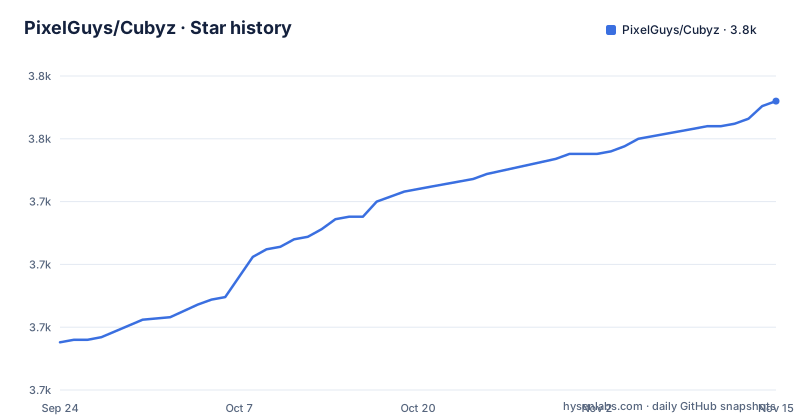
Star history
- PixelGuys/Cubyz3,765 ★ · +96
| Repository | 2026-09-24 | 2026-11-15 |
|---|---|---|
| PixelGuys/Cubyz | 3.7k | 3.8k |
96 Stars in the last 52 days, measured from the daily GitHub snapshot. Compare with other projects
Editorial analysis
Level of Detail is what buys the long view distance
Three features are named, and each one is stated with the consequence it produces. Level of Detail is what enables far view distances. 3D Chunks is what removes the height or depth limit, so the world is not bounded by a vertical cap in the way many voxel games are. Procedural Crafting is described as leaving infinite possibilities for tool crafting. The project description adds the same idea from a different angle, calling Cubyz a voxel sandbox game with a large render distance, procedurally generated content and some cool graphical effects, and the README opens by placing it in the Minecraft lineage. What the three features share is that none of them is a content pack or a mode. They are rendering and world structure decisions, which is why the render distance is the thing the README leads with.
macOS is excluded for one stated reason, OpenGL 4.3
Platform support is not a matter of testing effort here, it is a hardware requirement, and the README states it in one line. Windows and Linux are supported. Mac is not supported, as it does not have OpenGL 4.3. That phrasing puts the blame on the graphics API rather than on the porting work, and it has a practical effect: there is no macOS build to wait for, and no macOS entry in the run scripts either. The two launch scripts at the root are run_linux.sh and run_windows.bat, with matching debug_linux.sh and debug_windows.bat for the debug path, so the supported pair is visible in the file names before you read anything else.
Two ways to run it, and one of them fetches a compiler for you
Both documented paths compile the game, and the difference is where the compiler comes from. The easy way needs no tools: download the latest source code as a zip from the master branch, extract it, go into the extracted folder and double click run_linux.sh or run_windows.bat depending on the system. The script then fetches what it needs, which is why the README can end that section with a first program compiled. The better way installs Git, clones the repository with git clone https://github.com/pixelguys/Cubyz, and then either runs the same script or, if Zig is already installed in a compatible version, uses the build command directly:
git clone https://github.com/pixelguys/Cubyz
zig build run
git pull
The update step matters more than it looks. git pull keeps everything in one place and avoids repeatedly downloading the compiler on every update, which is the cost the zip path pays each time.
A build that runs for ten minutes without output is a known failure
The troubleshooting notes describe an unresolved problem, and the wording is candid about it. If the process keeps running for more than ten minutes without doing anything, the advice is to kill it and restart, since a few people seem to experience this and the cause has not been found. Deleting the zig-cache folder may also help, which matters because the cache is what the build reuses between attempts. Two routes out of the failure are offered. An error message in the terminal should be reported in the issues tab or on the Discord server, and if the game cannot be compiled on a machine at all, the Discord server is where that is asked, with the offer that a maintainer may compile a release for the person asking.
The Java version is still linked, with a TODO attached to it
The history section explains the current state of the codebase and points back at the old one. The Zig rewrite started in August 2022, and until recently the game was written in Java. That Java code is still visible in a separate repository, Cubyz-Java, and the old version can be played through the Java Launcher releases. A literal comment in that paragraph reads `// TODO: Move this over to a separate repository`, so the migration is acknowledged as unfinished housekeeping rather than a clean cut. The origins go back further: Cubyz was created on August 22, 2018 by zenith391 and ZaUserA, and it was called Cubz back then. Both left the project at some point, and it is now maintained by IntegratedQuantum.
A pinned Zig version and a zon manifest sit at the root
The build definition is plain Zig project layout, and the root entries describe it. There is build.zig for the build script and build.zig.zon for the package manifest, plus a .zigversion file that pins which Zig the project expects, which is what makes the phrase compatible version in the run instructions checkable. The four shell entry points are the two run scripts for players and the two debug scripts for development. Source lives under src, with assets, mods and scripts as siblings, and docs holds the three contribution documents described below. The licence at the root is GPL-3.0, and the recent releases carry version numbers without a v prefix, the newest being Cubyz 0.4.1.
Code, gameplay and content each have their own document
The contributing section splits into three, and the split is the useful part. Code changes go through the contributing guidelines at docs/CONTRIBUTING.md. Gameplay additions go through the game design principles at docs/GAME_DESIGN_PRINCIPLES.md, which is a different kind of document and implies that a new mechanic is judged on design grounds before it is judged on implementation. Content additions go through the content guidelines at docs/CONTENT_SUGGESTIONS.md, so a new block, model or texture is judged against a different set of rules than a patch. There is also a mods directory at the root for that kind of work. Community conversation happens on the Discord server, and the devlogs are published as a YouTube playlist.
0.4.0 and 0.4.1 were published an hour apart
The release history shows a fast patch sequence. Cubyz 0.4.0 was published on 2026-09-26 at 09:23 UTC and Cubyz 0.4.1 the same day at 10:34 UTC, so the two landed roughly an hour apart, which reads as a fix for something found immediately after the first release rather than a planned double release. Before that, Cubyz 0.3.0 came on 2026-07-04, so the gap between the 0.3 line and the 0.4 line was close to three months. The last push to the default branch master is dated 2026-10-04, a few days after the 0.4.1 tag, and the repository is not archived. Nothing in the repository is labelled prerelease, so whether 0.4.1 is the version to install is a question the releases page has to answer rather than the tag names.
Editorial conclusion
Cubyz suits a player who wants a voxel sandbox with long view distances and does not mind compiling it, since both documented paths build the game from source. It does not suit anyone on macOS, which the project excludes outright on OpenGL grounds. Before building, install a Zig version compatible with the pinned .zigversion, keep the zig-cache folder in mind if a build appears to hang, and pick the right contribution document: code, gameplay and content each have a separate set of rules.
Frequently asked questions
What is Cubyz and what makes it different from other voxel games?
Cubyz is a 3D voxel sandbox game inspired by Minecraft, written in Zig. Its three named features are Level of Detail for far view distances, 3D Chunks with no height or depth limit, and procedural crafting with infinite possibilities for tool crafting.
Can I play Cubyz on a Mac?
No. Windows and Linux are supported, and Mac is not supported as it does not have OpenGL 4.3. The repository ships run_linux.sh and run_windows.bat plus their debug counterparts, so there is no macOS path to wait for.
How do I run Cubyz from source?
Either download the master branch as a zip, extract it and double click run_linux.sh or run_windows.bat, which needs no tools, or install Git, run git clone https://github.com/pixelguys/Cubyz and use zig build run if a compatible Zig is already installed. Updating a clone with git pull avoids downloading the compiler again.
What should I do if the Cubyz build seems to hang?
If it keeps running for more than ten minutes without doing anything, kill the process and restart it, since the cause is not known, and deleting the zig-cache folder may also help. Error messages belong in the issues tab or on the Discord server, where a maintainer may also compile a release for you.
What happened to the Java version of Cubyz?
The game was written in Java until the Zig rewrite began in August 2022. That code is still visible in the Cubyz-Java repository and can be played with the Java Launcher releases, and the README carries a TODO comment about moving it to its own repository. The game was created on August 22, 2018 by zenith391 and ZaUserA, was called Cubz, and is now maintained by IntegratedQuantum.
Official sources
Add this badge to your README
If you maintain this project, the badge below links readers to this analysis and shows its maintenance status from the daily GitHub snapshot. Paste the markdown into your README; add ?metric=license or ?metric=stars to the image URL for a different field.

[](https://hysenlabs.com/projects/pixelguys-cubyz)Star history chart for your README
[](https://hysenlabs.com/projects/pixelguys-cubyz)Was this useful?