Poem keeps its web layers in one Cargo workspace, and the version numbers disagree
A full-featured and easy-to-use web framework with the Rust programming language.
At a glance
- What is it?
- poem-web/poem is a Rust web framework repository that ships the core server alongside OpenAPI, gRPC, Lambda and MCP crates, all pinned from a single Cargo.toml. The layout makes protocol upgrades one workspace edit, but one workspace member is missing from the README table and the numbers do not line up.
- Who is it for?
- Poem offers a Rust web framework and related OpenAPI, gRPC and MCP crates in one workspace. Choose the published crate versions and features your application needs, check their Rust toolchain requirements, and review the migration notes before upgrading.
- Can I use it commercially?
- Yes. Apache-2.0 is a permissive licence: you can use, modify and sell software built on it, as long as you keep its copyright and licence notices.
- Is it still maintained?
- Yes. The repository last received commits 2 days ago.
- What is it written in?
- Mainly Rust, according to GitHub's language statistics.
Answers come from the project's GitHub data, last synced on November 21, 2026, and from our analysis. They are not legal advice.
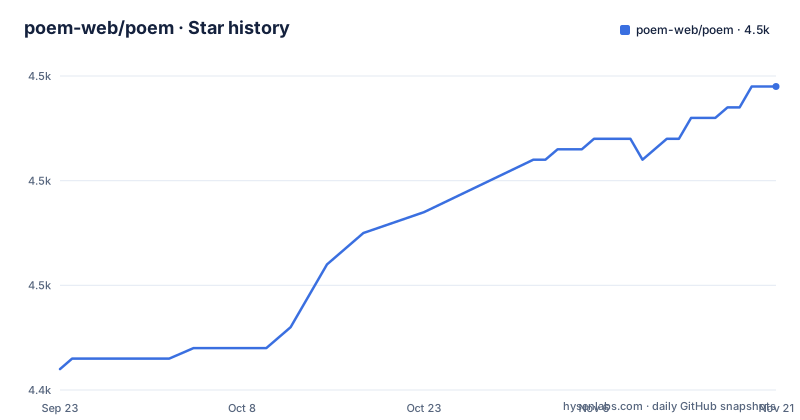
Star history
- poem-web/poem4,469 ★ · +27
| Repository | 2026-09-23 | 2026-11-21 |
|---|---|---|
| poem-web/poem | 4.4k | 4.5k |
27 Stars in the last 59 days, measured from the daily GitHub snapshot. Compare with other projects
Editorial analysis
One workspace member, poem-worker, is not in the README table
The fastest way to misjudge this repository is to read the README table and stop. It lists five components: poem, poem-lambda, poem-openapi, poem-grpc and poem-mcpserver, each with a crates.io link, a README and a changelog. The workspace Cargo.toml in the repository root tells a longer story. Its members array carries ten entries, adding poem-derive, poem-openapi-derive, poem-grpc-build, poem-mcpserver-macros and poem-worker.
Five of those are plumbing: derive macros, a gRPC build helper and an MCP macro crate. Their version numbers are what a careful reader should note. poem and poem-derive are both at 4.0.0, but poem-openapi-derive sits at 6.0.0, poem-grpc-build at 0.6.0 and poem-mcpserver-macros at 0.4.0. So the pieces that make up one integrated framework do not share a version line. The OpenAPI derive crate sits two major versions ahead of the core, and the gRPC build helper is still pre-1.0.
poem-worker is the entry with no matching README row and no crates.io link in the table. It is a workspace member and therefore compiles as part of the same build, but the README gives no description of it.
Shared workspace dependency requirements
Poem concentrates its third-party choices in a single block:
# rustls, update together
rustls = "0.23.45"
tokio-rustls = "0.26.6"
That comment above the pair is the mechanism, and it is worth reading literally. rustls 0.23.45 and tokio-rustls 0.26.6 are meant to move as a pair, and the workspace declares one version for each. Workspace members that inherit these entries share the declared version requirements; features and dependency graphs still differ by crate.
The wider dependency list is similarly centralized. tokio is held at 1.53.1, serde at 1.0.229, http at 1.5.0, and the proc-macro stack is frozen together: proc-macro-crate 3.5.0, proc-macro2 1.0.107, quote 1.0.47 and syn 3.0.6. Regex is 1.13.1, bytes is 1.12.1, thiserror is 2.0.21.
A plain Cargo requirement such as `1.53.1` allows compatible versions; it is not an exact pin. The lockfile records a particular resolution for the workspace, while downstream applications resolve their own dependency graphs.
Two serialization stacks coexist as well, serde_json 1.0.151 and sonic-rs 0.5.10. The root file does not say how each is used.
The toolchain floor, edition 2024 with rust-version 1.94, is the first upgrade gate
The shared package metadata states the requirement before any code:
rust-version = "1.94"
edition = "2024"
These two lines are a migration cost, not a formality. Edition 2024 changes language semantics, so every macro in this repository, all of which live in the derive and macros crates listed as workspace members, has to parse edition 2024 source correctly. The floor of Rust 1.94 rules out the large installed base still on older stable channels.
The README points at two documents for exactly this transition, and both live in the repository rather than on a docs site: docs/migration-4.0.md for the 4.0 transition and docs/dependency-upgrades.md for version choices, public API changes, behavior changes and reviewed upstream notes. A skim of the README will send you to crates.io instead, which is the wrong destination for someone upgrading.
Note what that pair of documents is not. Neither is linked from the component table, and no per-crate summary repeats the breaking changes. Anyone running more than one Poem crate has to reconcile five separate changelogs and the two root documents against each other.
Five example directories, one named disabled, describe the covered surface
The examples directory is a table of contents with a gap in it. It holds a Cargo.toml, a .gitignore and five subdirectories: poem, openapi, grpc, mcpserver and disabled. Four of them map one to one onto the crates you would actually reach for. The fifth is literally named disabled, which means the set of examples the maintainers consider worth shipping is smaller than the set that exists in the tree.
The mapping is the useful part. poem is the base server, openapi covers the OpenAPI layer, grpc the gRPC layer and mcpserver the Model Context Protocol server implementation. The README does not explain what the disabled directory holds.
The examples directory has its own Cargo.toml and is not among the root workspace members.
The dependency lines say 4.0.0 while the newest tag on the repo says 2.0.0
Here is the contradiction worth catching. The workspace dependency lines declare poem at version 4.0.0 and poem-derive at 4.0.0, and the README announces an upcoming Poem 4 with a migration guide, yet the newest tag attached to this repository is v2.0.0 for poem-openapi dated 2022-05-31.
For adoption this matters in a concrete way. The source tree and the tag history are describing different generations of the same project. The last commit to the default branch was pushed on 30 October 2026, so the tree itself is current.
Poem against Axum comes down to how many protocol layers travel in one repo
People comparing Rust web frameworks ask about this directly. A narrow answer is defensible here, and it is not a benchmark claim: the difference of approach is packaging, not runtime.
Axum is built on the tower ecosystem, and layers arrive as separately versioned crates chosen by the application. Poem instead keeps its protocol layers in the same repository and the same workspace: OpenAPI, gRPC, Lambda and MCP each live in a subdirectory beside the core, each has its own crates.io entry, and each is pinned from the root manifest. The trade is explicit. Published Poem crates are versioned separately, subject to their declared compatibility requirements; the shared workspace centralizes development dependencies, and you get protocol layers that are documented alongside the core instead of assembled from separate trees.
There is also a mismatch worth naming: both projects reach for Rust's async runtime through tokio, so adopting either does not let you avoid tokio in your graph. And Poem's Lambda crate is shaped for AWS Lambda, while a plain library-first framework gives you nothing to configure there.
The community list in the README leans toward infrastructure and data systems rather than small services, with entries such as databend, warpgate, lust, delicate and aptos listed as cases of community use. That is a sample, not a benchmark, but it does say where the maintainers think the framework has been exercised.
Version-specific behavior notes sit with each crate, not at the root
Each component in the README table links to its own change log under the crate directory, and each crate directory also carries its own README. That is the archive a version-sensitive reader should work from rather than the root page, because the root page describes the layout and the per-crate notes describe behavior.
The repository also ships a SECURITY.md at the root. Its presence is the whole of what the root file discloses, since the README does not summarize it, so anyone with a vulnerability to report should read that file rather than assume a security contact from the badge block or the Discord link.
For the surrounding ecosystem, the README points at two third-party extensions built for this framework: poem-casbin, an access control middleware, and poem-grants, an authorization extension for protecting endpoints. Both are outside the workspace, so both resolve independently and both can pin the framework version they need. That is the practical test of the packaging claim above. If your authorization needs are met by one of them, adopting Poem buys you a middleware that already assumes it. If it is not, you are back to assembling extensions yourself, which is the same shape of work Axum asks for.
Editorial conclusion
Poem offers a Rust web framework and related OpenAPI, gRPC and MCP crates in one workspace. Choose the published crate versions and features your application needs, check their Rust toolchain requirements, and review the migration notes before upgrading. Workspace dependency declarations coordinate repository development but do not force downstream users to consume every crate.
Frequently asked questions
Which crates does the poem-web/poem workspace publish?
Five are published and documented in the README table: poem, poem-lambda, poem-openapi, poem-grpc and poem-mcpserver. The workspace also contains poem-derive, poem-openapi-derive, poem-grpc-build, poem-mcpserver-macros and poem-worker as internal or unlisted members.
What Rust version does poem-web/poem require?
The workspace metadata sets rust-version to 1.94 and edition to 2024. Both are declared in the shared workspace package section of the repository root Cargo.toml.
Where do I find the poem-web/poem 4 upgrade notes?
They are stored in the repository rather than on the docs site, as docs/migration-4.0.md and docs/dependency-upgrades.md. The README links both from its opening note about the Poem 4 family.
How are third-party dependencies shared across the poem-web/poem crates?
A single [workspace.dependencies] block in the root Cargo.toml holds every shared pin, so tokio 1.53.1, syn 3.0.6 and the rustls 0.23.45 pair apply to all members at once.
Does poem-web/poem include authorization or access control middleware?
Not in the workspace. The README points to two external projects built for it, poem-casbin for access control middleware and poem-grants for endpoint authorization, and both resolve outside the repository's own crates.
Official sources
Add this badge to your README
If you maintain this project, the badge below links readers to this analysis and shows its maintenance status from the daily GitHub snapshot. Paste the markdown into your README; add ?metric=license or ?metric=stars to the image URL for a different field.

[](https://hysenlabs.com/projects/poem-web-poem)Star history chart for your README
[](https://hysenlabs.com/projects/poem-web-poem)Was this useful?