YTPro, a YouTube client that is one WebView and a layer of injected JavaScript
Youtube client with older Android version support, background player, Google Gemini ✨ and many more features.
At a glance
- What is it?
- YTPro puts a JavaScript layer over YouTube's own web player inside an Android WebView. Its downloaders, ad blocker and Gemini summaries all depend on that page staying unchanged, and the release history shows the project patching for it.
- Who is it for?
- Treat YTPro as a WebView experiment, not as a phone's daily YouTube. The parts worth knowing are the mechanism (one page, injected scripts, no official API), the fragility (a CSP fix in v3.95, a downloader fixed again in v3.98), and the gaps (no Gemini key setup, no Android version floor, an unexplained signer/ directory).
- Can I use it commercially?
- Yes. MIT is a permissive licence: you can use, modify and sell software built on it, as long as you keep its copyright and licence notices.
- Is it still maintained?
- Yes. The repository last received commits 39 days ago.
- What is it written in?
- Mainly JavaScript, according to GitHub's language statistics.
Answers come from the project's GitHub data, last synced on November 25, 2026, and from our analysis. They are not legal advice.
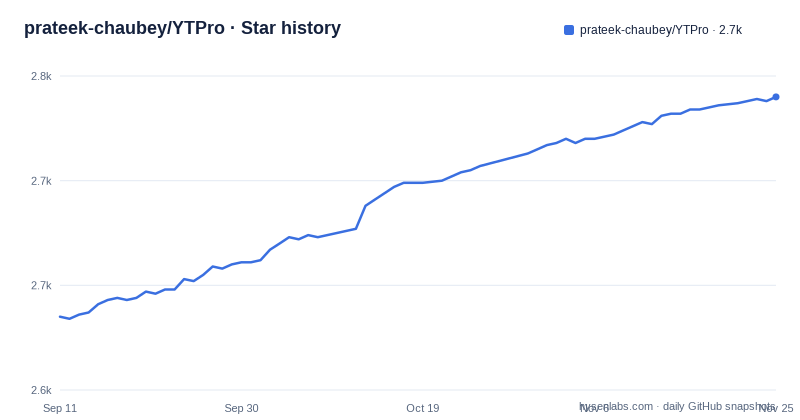
Star history
- prateek-chaubey/YTPro2,740 ★ · +105
| Repository | 2026-09-11 | 2026-11-25 |
|---|---|---|
| prateek-chaubey/YTPro | 2.6k | 2.7k |
105 Stars in the last 75 days, measured from the daily GitHub snapshot. Compare with other projects
Editorial analysis
YouTube's own terms cover every bullet in the list
YTPro is distributed under the MIT license and asks for no account of its own, but every feature on its list runs against YouTube: an ad blocker, four downloaders, sponsor skipping, background audio and a Gemini summary of a video. None of that is YTPro's service to license. The project's disclaimer calls it an educational project aimed at showcasing javascript injection into a webview to enhance productivity, which is an accurate description of the mechanism and an unhelpful one for anyone deciding whether it is safe to sign in with. The terms question therefore comes first. The client reads and rewrites a session that belongs to YouTube, and whatever follows falls on the account, not on the app.
Every feature bullet is a script inside one WebView
The repository is a Gradle Android project (app/, build.gradle, settings.gradle, gradlew, gradlew.bat) yet its primary language is JavaScript, which says where the work happens. Picture in Picture, minimise video, background audio, gesture control for volume and brightness, force zoom, hide Shorts, speed up to 10x, enable or disable media codecs: each of these is a change to a running web player, not a native feature. None of them is reachable through an official client interface, and none needs one, because a WebView renders the same page a browser would. That is also the ceiling. Anything the page stops exposing is a feature that stops existing, and no compatibility note accompanies any of the 24 bullets.
The CSP fix in v3.95 is the architecture in one release note
Release v3.95, dated 2025-11-14, is titled Fixed CSP issue and other minor bugs. A Content Security Policy is the header a page uses to declare which script sources it will accept, so a client that injects its own script runs straight into it, and that fix is the project acknowledging the collision. Two later releases keep the same thread: v3.98 on 2026-05-01 is Fixed Downloader and other minor bugs, and v4.0 shipped on 2026-09-27 as a pre-Diwali update. The version numbers also skip values on the way, 3.95 to 3.98 to 4.0, with nothing in the repository explaining what happened between them. The last push to the default branch main is dated 2026-09-28.
The Gemini prompt takes three variables and shows no key setup
Google Gemini is the feature with the most room for disappointment, because the only thing specified is the prompt template. Three variables are available:
{url}
{title}
{videoId}
Customisable prompts and models is the whole of the model story. No model name, no key setup step and no request limit appear anywhere, and Summarise Vidoes, typo included, is how the summary feature is written. Read Gemini here as a prompt box wired to three placeholders, not as a documented integration, and expect the channel name and the transcript to be missing because neither is passed in.
Downloading and saving without an account happen off Google's servers
Four downloader entries cover video, Shorts, thumbnails and captions, joined by an in-built video and audio muxer, so the client pulls media files itself and joins them locally. That is where YouTube's terms stop being background noise: it is the distance between watching and extracting. Next to it sits the Custom Heart feature to save videos without logging into your account, and no sentence says where that list lives. A local file, the WebView's own storage or something on a remote server decides whether your saved videos can be found again after a reinstall, and that answer is not written down.
Sponsor skipping and dislike counts are somebody else's code
The Credits list names SponsorBlock, return-youtube-dislike and YouTube.js. Two feature bullets map straight onto the first two: Skip Sponsers draws on SponsorBlock's segment database, and Shows Number of Dislikes draws on return-youtube-dislike. YouTube.js sits under both, since it speaks YouTube's internal player interface, which is what a WebView client has to use because the public Data API hands out no player controls. Two bullets further down claim Minimal APK size and Almost 0 Internal Dependencies, while three upstream projects are credited one line apart. Whether those three are bundled, fetched at build time or loaded at run time is not stated, and that difference decides how much of your traffic reaches somebody else's server.
The feature list has dangling bullets and an empty screenshot table
Some entries under Features stop mid-thought. Minimal sits as its own line right after Adaptive UI icons, with no noun attached to it. Minimal APK size is a claim with no number behind it in any file. The Screenshots heading is followed by a three column table whose cells are all empty, so the visual evidence promised near the top of the page is not there. Two items are parked in a ToDo list instead of shipped: Enhance Audio and Skip Silence. Two bullets carry typos, Vidoes and Sponsers. None of this makes the project unusable, but it does make the feature list a wishlist with a download button rather than a specification.
Older Android support is promised with no version floor named
The repository description leads with older Android version support, and it is the one promise no page in the repository backs up. No minimum Android version, no API level and no device matrix appear next to the feature list, the Gemini variables or the credits, and the 2026-09-28 push carries no changelog. The tree does hold the files that would carry the answer: gradle.properties, gradle/ and app/, plus a signer/ directory that nothing explains, scripts/, and _config.yml for the GitHub Pages site at prateek.is-a.dev. Read those files before trusting the compatibility claim, and find out what signer/ holds before trusting any build you did not produce yourself.
Editorial conclusion
Treat YTPro as a WebView experiment, not as a phone's daily YouTube. The parts worth knowing are the mechanism (one page, injected scripts, no official API), the fragility (a CSP fix in v3.95, a downloader fixed again in v3.98), and the gaps (no Gemini key setup, no Android version floor, an unexplained signer/ directory). Nothing here belongs on the device you sign in with daily, and before any build goes onto a real phone, read the Gradle files and find out what signer/ holds.
Frequently asked questions
What exactly is YTPro built on?
An Android Gradle project (app/, build.gradle, gradlew) whose primary language is JavaScript. Its disclaimer states the goal is showcasing javascript injection into a webview, and the feature list is built on that one mechanism.
Which YTPro features come from other people's projects?
Sponsor skipping maps to SponsorBlock and the dislike count maps to return-youtube-dislike. Both are named in the credits alongside YouTube.js, which handles YouTube's internal player interface.
What minimum Android version does YTPro support?
Unstated. The repository description promises older Android version support, but no minimum version or API level appears in the feature list, the prompt variables or the credits, and the repo is not archived.
How are YTPro releases numbered and dated?
v3.95 on 2025-11-14 fixed a CSP issue, v3.98 on 2026-05-01 fixed the downloader, and v4.0 arrived on 2026-09-27. The default branch main was last pushed on 2026-09-28.
Official sources
Add this badge to your README
If you maintain this project, the badge below links readers to this analysis and shows its maintenance status from the daily GitHub snapshot. Paste the markdown into your README; add ?metric=license or ?metric=stars to the image URL for a different field.

[](https://hysenlabs.com/projects/prateek-chaubey-ytpro)Star history chart for your README
[](https://hysenlabs.com/projects/prateek-chaubey-ytpro)Was this useful?