The Ultimate AI Engineer Roadmap counts 18 phases and says 17
Ultimate AI Engineer Roadmap 2026 - built specifically for your context as an AI Architect building PrinceSinghAI, PrinceSinghDev, Multi-LLM orchestration, RoadmapAI, CodeLLM, and AskAI, Global AI Search
At a glance
- What is it?
- A learning roadmap stored entirely in one Markdown file, covering Python, math, machine learning, transformers, LLM engineering, orchestration, retrieval, agents, fine-tuning, MLOps, system design, quantization, reinforcement learning and ethics. It is written around its author's own products, its own numbering lists 18 phases under a heading that says 17, and the repository holds two files.
- Who is it for?
- Use this roadmap as a checklist rather than as a curriculum. The phase list is a good map of what an AI engineer is expected to have touched, and the three entry points are the most reusable part, since a mid-level reader can start at Phase 3 and an expert at Phase 5.
- Can I use it commercially?
- Yes. MIT is a permissive licence: you can use, modify and sell software built on it, as long as you keep its copyright and licence notices.
- Is it still maintained?
- Yes. The repository last received commits 106 days ago.
- What is it written in?
- GitHub does not report a main language for this repository.
Answers come from the project's GitHub data, last synced on November 14, 2026, and from our analysis. They are not legal advice.
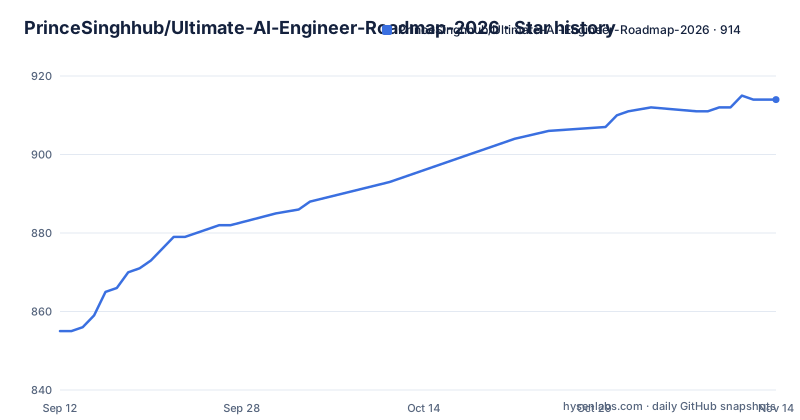
Star history
- PrinceSinghhub/Ultimate-AI-Engineer-Roadmap-2026914 ★ · +59
| Repository | 2026-09-12 | 2026-11-14 |
|---|---|---|
| PrinceSinghhub/Ultimate-AI-Engineer-Roadmap-2026 | 855 | 914 |
59 Stars in the last 63 days, measured from the daily GitHub snapshot. Compare with other projects
Editorial analysis
Eighteen numbered phases under a heading that says seventeen
The page is headed as containing 17 phases plus a capstone, and the list underneath runs from Phase 0 to Phase 17. That is eighteen numbered entries, and Phase 0 is a real phase with its own section rather than a preface, so it is not the explanation for the discrepancy.
The project arithmetic points the same way. Every phase is said to carry three projects at easy, medium and hard difficulty, and the stated total is 51. Three times seventeen is 51, so the total was computed from 17 phases while the list contains 18. A reader counting the phases will be one ahead of the reader counting the projects.
The capstone line has the same sloppiness in a smaller way. It reads as a sentence broken across a blank line, with the phrase about a full multi-LLM platform architecture separated from the sentence introducing it, so the two halves are not adjacent in the rendered page.
The repository is a licence file and a readme
The top level of the repository contains two entries: `LICENSE` and `README.md`. That is the entire deliverable.
Everything the roadmap describes therefore lives in one Markdown document. The 51 projects are announced as three per phase, but the page shows only the three difficulty labels, with one line of intent for each: easy builds confidence and reinforces fundamentals, medium is described as real-world patterns and production thinking, hard as production-grade, multi-system and scalable. No project brief, no repository, no starter code and no evaluation criteria appear anywhere in the tree.
The same applies to the videos and the external links. There is a link to a complete video on YouTube, a home page hosted off GitHub, and a self-referencing line that repeats the full title together with that home page address. The roadmap as a document is the whole project, and the surrounding links are the only other material on offer.
The description addresses you and names the author's products
The one-line repository summary reads as a prompt rather than a description. It says the roadmap is built specifically for your context, as an AI architect building named projects, and the list of names is the author's own: PrinceSinghAI, PrinceSinghDev, multi-LLM orchestration, RoadmapAI, CodeLLM, AskAI, and Global AI Search.
That framing runs through the document. Phase 7, multi-LLM orchestration, is labelled as the reader's specialty, and Phase 9 on agents and agentic systems names one of those products as the framework. Phase 0 decides what the reader is by drawing a table between an AI engineer and an ML engineer, and the AI engineer column ends with the words you are this in bold, with the ML engineer column labelled as the data science role.
So the document is partly a syllabus and partly an argument for a particular career shape. That is a legitimate choice, and it is also the reason the market section is phrased as a list of what companies are actively hiring for, nine items running from multi-LLM orchestration and RAG architecture through to cost optimisation and inference efficiency.
Phase 1 advertises async and its own sections do not list it
The phase summary for the programming foundation calls out async and await for AI APIs, and adds a parenthetical claim that most roadmaps miss this. The goal line for the phase is stated as writing clean production-quality Python, described as non-negotiable.
The sections that follow run from 1.1 to 1.8. They cover data types and conversion, strings, collections, control flow, functions with an item on `*args` and `**kwargs` said to be used constantly in AI SDKs, object-oriented programming with an item on abstract classes and `ABC` said to be used heavily in LangChain and LlamaIndex, Pythonic idioms, file I/O with the standard library modules, error handling with logging and pdb, performance and memory with generators and `yield` described as critical for streaming AI responses, and NumPy.
No section in that list mentions async, await, coroutines, event loops or an async client. The last visible entry sits inside the NumPy section and stops partway through a line about matrix operations. So the one thing the phase advertises as its differentiator is the one thing its own section headings leave out.
None of the three entry paths includes Phase 0
The page offers a short block of routing advice, and it is the most directly usable thing in the document:
FRESHER  → Follow Phase 1 → 2 → 3 → 4 (foundation-first approach)
MID-LEVEL → Start Phase 3, revisit Phase 1-2 gaps
EXPERT   → Phase 5 → 6 → 7 → 8 (advanced systems & architecture)
The three paths cover a beginner, someone part way through and someone advanced, which is a sensible split. The gap is that all three start after Phase 0. The freshest path begins at Phase 1, the mid-level path at Phase 3, and the expert path at Phase 5.
Phase 0 is where the document defines what an AI engineer is, contrasts that role with an ML engineer, and lists what companies are hiring for. A reader who skips it gets the foundation phases without the definition those phases are meant to serve, and the phase that does the orienting is the only one with no path leading to it.
Phase 10 and Phase 16 both carry RLHF and DPO
The phase list names specific technologies, and reading it as a whole shows where the overlap sits. Phase 6 covers LLM engineering with the major APIs named as OpenAI, Claude, Gemini, Mistral, Groq and NVIDIA. Phase 7 covers multi-LLM orchestration with routing and fallbacks, and names MCP alongside LangGraph, LangChain, CrewAI and AutoGen. Phase 8 covers retrieval and vector databases with HyDE, reranking and hybrid search as the advanced techniques.
Phase 10 is fine-tuning, with LoRA, QLoRA, DPO and RLHF listed. Phase 16 is reinforcement learning, with RLHF, DPO and PPO. Two of the three items in Phase 16 already appear in Phase 10, so the two phases overlap by DPO and RLHF and differ mainly by PPO, six phases apart.
The rest of the list is uncontested: Phase 11 for generative AI across diffusion, multimodal, voice and video, Phase 12 for MLOps and LLMOps including Kubernetes and CI/CD, Phase 13 for system design, Phase 14 for SQL with pgvector, Phase 15 for quantization and optimization with vLLM, GGUF and small language models, and Phase 17 for ethics, safety and governance.
A 2026 roadmap whose last commit is dated 2026-08-01
The document is titled for a year and makes a claim about the market in that year, and the repository has no GitHub releases at all. There is no tag to install, no version to pin and no changelog. The tree is a licence and a readme, so the only maintenance signal available is the date of the last commit on the default branch, which is 2026-08-01.
The subtitle promises a route from zero to production-grade AI systems, and the phase list does run the whole distance, from a mindset phase through Python, mathematics, machine learning, deep learning, transformers, LLM engineering, orchestration, retrieval, agents, fine-tuning, generative AI, MLOps, system design, SQL with pgvector, quantization and reinforcement learning, ending with ethics, safety and governance.
The document also links outward three times in its opening section: to a complete video, to a home page hosted on a personal domain with a path segment, and to that same home page repeated inline with the project title. There is no contributing guide, no issue template and no tests, which for a learning roadmap is defensible and for anything else would not be.
Editorial conclusion
Use this roadmap as a checklist rather than as a curriculum. The phase list is a good map of what an AI engineer is expected to have touched, and the three entry points are the most reusable part, since a mid-level reader can start at Phase 3 and an expert at Phase 5. Two things to weigh first. The repository is one Markdown file and a licence, so the 51 projects and the capstone exist as a count rather than as specifications you can pick up, and there is nothing to grade yourself against. And the sequencing has gaps you can see: the numbering says 17 where the list shows 18, the freshest path never visits Phase 0 where the role is defined, and Phase 1 advertises async support that its own sections do not list.
Frequently asked questions
How many phases are in the Ultimate AI Engineer Roadmap 2026?
The page is headed as 17 phases plus a capstone, and the list runs from Phase 0 through Phase 17, which is 18 numbered entries. The stated total of 51 projects equals 17 phases at three projects each, so the numbering and the project count disagree by one phase.
Does the Ultimate AI Engineer Roadmap include code or project specs?
It announces 51 projects at three difficulty levels per phase and a capstone described as a full multi-LLM platform architecture, giving each difficulty a one-line description. The repository itself contains only a licence file and the README, so no project brief or starter code is in the tree.
Which model providers and frameworks does the roadmap cover?
The LLM engineering phase names OpenAI, Claude, Gemini, Mistral, Groq and NVIDIA APIs, and the orchestration phase covers routing and fallbacks while naming MCP, LangGraph, LangChain, CrewAI and AutoGen. Later phases add vLLM, GGUF, LoRA, QLoRA, DPO, RLHF, PPO and pgvector.
Where should I start on the roadmap if I already know Python?
The page gives three entry points: a fresher follows Phase 1 through 4, a mid-level reader starts at Phase 3 and revisits the Phase 1 and 2 gaps, and an expert runs from Phase 5 to 8. None of the three routes includes Phase 0, which is where the AI engineer role is defined.
Official sources
Add this badge to your README
If you maintain this project, the badge below links readers to this analysis and shows its maintenance status from the daily GitHub snapshot. Paste the markdown into your README; add ?metric=license or ?metric=stars to the image URL for a different field.

[](https://hysenlabs.com/projects/princesinghhub-ultimate-ai-engineer-roadmap-2026)Star history chart for your README
[](https://hysenlabs.com/projects/princesinghhub-ultimate-ai-engineer-roadmap-2026)Was this useful?