prism-php/prism: a Laravel LLM package whose newest release is also its newest commit
A unified interface for working with LLMs in Laravel
At a glance
- What is it?
- Prism gives Laravel applications one interface for text generation, multi-step conversations and tool use across providers. The repository is careful about tooling and thin on instructions, and nothing has been published since 2026-03-20.
- Who is it for?
- Prism is a package to evaluate against the documentation site rather than the repository, because the repository tells you what the tool does and nothing about how to install or configure it. Three things are worth checking before you build on it.
- Can I use it commercially?
- Yes. MIT is a permissive licence: you can use, modify and sell software built on it, as long as you keep its copyright and licence notices.
- Is it still maintained?
- Yes. The repository last received commits 8 days ago.
- What is it written in?
- Mainly PHP, according to GitHub's language statistics.
Answers come from the project's GitHub data, last synced on November 15, 2026, and from our analysis. They are not legal advice.
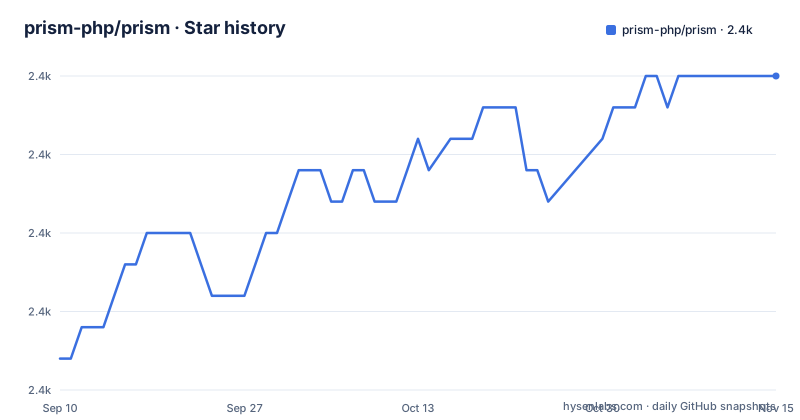
Star history
- prism-php/prism2,430 ★ · +9
| Repository | 2026-09-10 | 2026-11-15 |
|---|---|---|
| prism-php/prism | 2.4k | 2.4k |
9 Stars in the last 66 days, measured from the daily GitHub snapshot. Compare with other projects
Editorial analysis
The newest release and the newest commit carry the same timestamp
Two dates decide how this repository should be read, and they are the same date. The last recorded push to the default branch main is 2026-03-20T20:37:40Z. The newest release, v0.100.1, was published at 2026-03-20T20:37:40Z as well, down to the second. That means the tag was cut from the tip of the branch, which is what a release script does, and it also means the two most recent events in this repository are one event. Before that, v0.100.0 appeared five hours earlier the same day at 15:36:43Z, and v0.99.22 came eight days before that on 2026-03-12. A pair of releases on one afternoon followed by a patch is a normal release day, and a repository with nothing published in the six months since is a different kind of record. Anyone deciding whether to depend on this package is deciding about a snapshot from the spring of 2026, and the README offers no hint that a gap exists.
The version line reaches 0.99.22 before it becomes 0.100.0
The three most recent tags tell you how this project counts. v0.99.22 is the older of the pair before the jump, with a patch number in the twenties, and the next release is v0.100.0 rather than v0.99.23. So the minor segment moved from 99 to 100 while the patch counter reset, which means the project treats the third digit as a running counter rather than as a conventional patch level. That has a practical consequence for anyone pinning: there is no such thing as a quiet patch release here, because the number you would pin moves constantly within a minor series. It also means the version you write into a composer constraint is not a statement about compatibility in the usual semantic versioning sense. The project has not left the 0.x range, so every consumer is on a pre-1.0 package, and the two releases published on 2026-03-20 differ only in the last digit of the patch segment.
config/ ships with the package and not one key is named in the README
The top level listing carries a config/ directory, which in a Laravel package is where the publishable configuration file lives. The README names no configuration key, no environment variable, no default provider and no API key variable. What it does instead is describe the interface in one paragraph: text generation, multi-step conversations, and tool use across various AI providers, followed by an Official Documentation section that points at prismphp.com and nothing else. That gap is the practical shape of this repository. The three capabilities are named, so you can tell from the README whether the package is in the right category, and every detail that decides whether you can actually run it lives off the repository. It also means the provider question has no answer here, since the README says various AI providers without naming a single one, and a Laravel package that reads credentials from configuration cannot be evaluated without knowing which variables it expects.
bin/ is in the listing and the README documents no command
There is a bin/ directory at the root of a package whose README runs to 138 words, and the file names no command of any kind. No artisan command, no CLI invocation, no composer require line, no publish step. For a Laravel package that is an unusual amount of silence, because bin/ is where a package's console entry point would live and a README that documents nothing executable leaves a reader with no first action. The install path is not merely undocumented here, it is delegated: the Official Documentation section exists to carry it. The rest of the README is devoted to things that do not help you run the code, namely a Code of Conduct section that points at the Laravel one, an Authors section crediting a single creator with contributions from the open source community, and a License section naming MIT with a link to the LICENSE file at the root. The tree is much better documented than the file: src/, tests/, resources/, assets/ and docs/ are all visible at the top level, and none of them appear in the README.
Four tool configurations at the root, none of them described
The listing carries phpstan.neon.dist for static analysis, pint.json for code style, rector.php for automated refactoring, and a Taskfile.yml for running tasks, plus a phpunit.xml.dist for tests and a testbench.yaml with a workbench/ directory for exercising the package outside a full application. Six files, six conventions, and not one line of prose about any of them. That is normal for a PHP package and worth noting anyway, because it tells you the project expects contributors to arrive with their own tooling rather than to be walked through it. The Taskfile.yml is the one worth a second look: a task runner config means there are commands for building, testing and checking the package that a contributor is expected to know or discover, and the README does not point at it. whisky.json sits in the same group with no explanation anywhere in the repository's visible files. For an outside contributor the practical effect is that the on-ramp is the docs site, not the repository, even for people who only want to run the tests.
The header is three empty badge blocks pointing at the same package page
The README opens before its title with three centered blocks, and each one holds a link to the same Packagist package page. The three are identical, they all resolve to prism-php/prism on Packagist, and the space where a badge would render is empty in the file as it stands. So the visual identity of the project at the top of its own README is three copies of one pointer to a package registry, with nothing distinguishing install counts, versions or licence. Underneath, the description paragraph is the only substantive prose in the file, and it is one sentence about a fluent interface for large language models followed by a sentence about not getting lost in technical intricacies. Everything a reader needs to decide anything is delegated to prismphp.com. The LICENSE file at the root and the MIT line in the README agree with each other, and that is the only claim in the file that two sources confirm.
docs/ is in the repository while the documentation link points away from it
Two documentation locations exist and the README chooses the external one. A docs/ directory sits at the top level of the repository, and the README's Official Documentation section links to prismphp.com instead. Nothing in the visible files says whether the site is generated from that directory, maintained separately, or whether one is stale relative to the other, and the Taskfile.yml that would answer the first question is not described. The same split shows up in the project's self-description. The repository says it is not affiliated with Laravel, and then adopts the Laravel Code of Conduct, which is a reasonable way to signal courtesy without claiming a relationship. The Authors section names one creator and credits the wider community for contributions, and the License section names MIT. So the identity claims in this repository are consistent and modest. What is missing is the operational half: which providers, which keys, which command, and which version to pin.
Editorial conclusion
Prism is a package to evaluate against the documentation site rather than the repository, because the repository tells you what the tool does and nothing about how to install or configure it. Three things are worth checking before you build on it. Name the providers you need against the provider list on prismphp.com, since the README says only various AI providers. Expect a config file to publish and keys to supply, since config/ ships with the package while no key is named anywhere in the README. And weigh the release record against your own timeline: the last push and the newest tag, v0.100.1, share the timestamp 2026-03-20, with nothing published in the six months since, so plan for a package whose version line you may have to hold rather than track.
Frequently asked questions
What does prism-php/prism do for a Laravel application?
It provides one interface for working with large language models inside Laravel, covering text generation, multi-step conversations and tool use across several providers. The repository description calls it a unified interface for LLMs in Laravel.
How do I install prism-php/prism?
The README contains no install command, no composer require line and no publish step. It points to the official documentation at prismphp.com instead. The repository itself carries composer.json at the root, alongside src/, config/ and tests/.
Which AI providers does prism-php/prism support?
The README says the package works with various AI providers and does not name any of them. No provider list appears in the repository's visible files; the official documentation site is where the README sends that question.
When was prism-php/prism last updated?
The last recorded push to the default branch main is 2026-03-20, and the newest release, v0.100.1, was published the same day at the same time. The releases before it were v0.100.0 on 2026-03-20 and v0.99.22 on 2026-03-12.
Who writes prism-php/prism and under what license?
The README credits TJ Miller as the creator with contributions from the open source community, and states the project is not affiliated with Laravel while following the Laravel Code of Conduct. The license is MIT, and a LICENSE file is present at the repository root.
Official sources
Add this badge to your README
If you maintain this project, the badge below links readers to this analysis and shows its maintenance status from the daily GitHub snapshot. Paste the markdown into your README; add ?metric=license or ?metric=stars to the image URL for a different field.

[](https://hysenlabs.com/projects/prism-php-prism)Star history chart for your README
[](https://hysenlabs.com/projects/prism-php-prism)Was this useful?