netdisk-fast-download's open drive list, its published auth key, and a Dockerfile that never exposes the API port
An aggregated direct-link parsing and download service for mainstream Chinese cloud drives, with one-click resolve-and-download; supports Quark Drive, UC Drive, Lanzou Cloud, Lanzou Youxiang, Xiaofeiji Drive, 123 Cloud Drive and more, including shared-folder parsing.
At a glance
- What is it?
- netdisk-fast-download is a Java service that converts cloud drive share links into direct download links, and its documentation is written in Chinese. The open source list covers the long tail of drives while Baidu, Xunlei, Quark, UC and the three carrier drives sit behind a hosted pro version, the auth parameter is encrypted with a key printed in the documentation, and the container image publishes only the web tool's port.
- Who is it for?
- This service fits the case where you hold a share link and want the bytes, not the case where you hold an account and want someone else's files, and the distinction matters because the open repository already refuses the biggest names: Baidu, Xunlei, Quark, UC, China Mobile, China Unicom and China Telecom are all in the hosted tier, and the two drives that still parse open links are flagged in the documentation as banning accounts and blocking mainland traffic.
- Can I use it commercially?
- Yes. MIT is a permissive licence: you can use, modify and sell software built on it, as long as you keep its copyright and licence notices.
- Is it still maintained?
- Yes. The repository last received commits 11 days ago.
- What is it written in?
- Mainly Java, according to GitHub's language statistics.
Answers come from the project's GitHub data, last synced on November 15, 2026, and from our analysis. They are not legal advice.
Star history
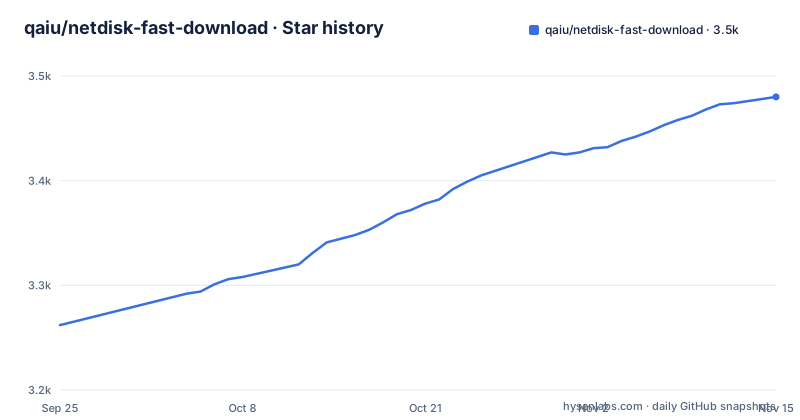
- qaiu/netdisk-fast-download3,480 ★ · +218
| Repository | 2026-09-25 | 2026-11-15 |
|---|---|---|
| qaiu/netdisk-fast-download | 3.3k | 3.5k |
218 Stars in the last 51 days, measured from the daily GitHub snapshot. Compare with other projects
Editorial analysis
The open drive list is the long tail, and the mainstream drives are in the hosted tier
The documentation, which is written in Chinese, splits the supported drives into two groups and the split is where the project's actual reach becomes clear. The open group is a long tail with a short identifier for each entry: lz and iz for the two Lanzou services, ec for China Mobile's cloud space, fj for Feiji, fc for Fangcloud, ye for 123 Pan, ws, le, qqw, qqsc, ct, ys, ce for self hosted Cloudreve, pcx, fs, pwps, and pgd, pod, pdp, pic for Google Drive, OneDrive, Dropbox and iCloud. The second group is headed as provided by the pro version and holds the names most readers would look for first: Baidu, Xunlei, Guangyu, Quark, UC, China Mobile, China Unicom and China Telecom. The banner at the top of the file says the same thing, telling readers who need complete Baidu, Xunlei, UC and Quark support to use the pro site.
The auth parameter is AES encrypted with a key printed in the documentation
Some drives cannot be parsed anonymously, so the service accepts credentials as a query parameter, and the file then documents exactly how that parameter is protected. The value is a JSON object holding an authType of cookie, accesstoken, authorization, password or custom, plus token, username, password and two extension fields. The encryption is AES in ECB mode with PKCS5 padding under the 16 byte key nfd_auth_key2026, and the pipeline is JSON, then AES, then Base64, then URL encoding. The file also names the configuration keys: server.authEncryptKey for this parameter, required to be 16 characters for AES-128, and server.donatedAccountFailureTokenSignKey for HMAC signing failure counts, which the file says should be a strong random string and should not equal the auth key. Since the default key is published in the documentation, an auth value seen in a log or on the wire is not protected by it, so treat that parameter as transport encoding and set your own key.
Two authentication mechanisms with different scopes, and a precedence rule
There are two ways to supply credentials and the file is careful to keep them apart. The auth query parameter applies to that one request and takes precedence over anything in app-dev.yml, which suits a caller who hands you a different account per user. The auths node in app-dev.yml applies server side and permanently, and every request that arrives without an auth parameter reuses it, which suits an operator who keeps one account for the whole deployment. Both support several spellings for the same thing: username and password together, or token, or authorization, which the file notes is equivalent to token and that you pick one. It also warns that leaving a key with no value counts as not configured at all. The requirement table says Quark and UC must have a cookie before they will parse, Feiji, Lanzou Youxiang and 123 Pan only need one for large files or for shares that require login, and 123 Pan additionally accepts an account and password.
The image publishes 6401 and never mentions 6400
The two services the file describes sit on different ports: 6400 for the API, which the documentation says should sit behind Nginx, and 6401 for the built in web parsing tool, which it says can be opened directly for personal use. The Dockerfile does not mention the first one. It starts from eclipse-temurin:17-jre, installs unzip, copies the built archive at web-service/target/netdisk-fast-download-bin.zip, unpacks it into the working directory, makes run.sh executable and creates db and logs directories, then copies in docker-entrypoint.sh. The only port instruction in the file is EXPOSE 6401. The image also ends by adding a system group appgroup and a system user appuser, so the entrypoint runs as an unprivileged account. Anyone publishing this image should assume they have to add 6400 themselves.
A Node manifest in a Maven project whose one dependency is Maven
The root carries package.json, and its entire dependency list is mvn at ^3.5.0, sitting next to mvnw, mvnw.cmd and a .mvn directory that already provide the wrapper locally. The reason the JavaScript side exists at all is the parser extension path: parser/README.md documents the parser modules, and parser/doc holds a JavaScript parser guide, a custom parser guide and a quick start for writing one, alongside a document about password protecting the playground where they can be tried. The rest of the tree is similarly mixed, with core/, core-database/, parser/, web-service/, web-front/, webroot/ and bin/ next to a Dockerfile, a .devcontainer, a .run directory, a note.txt and verify_fangcloud_share.py. One small inconsistency: the license badge resolves to the master branch while the default branch is main.
Tombstones in the support list, and failure notes dated 2023
The drive list keeps its dead entries in place instead of removing them. Two entries are struck through and labelled as failed: 115 Pan with the identifier p115, and Weiyun cloud storage with pvvy. Under the list sit two dated notes that were never cleaned up: 20230824 for 123 Pan failing on files over 100MB without a login, and 20230722 for UC Pan needing a login. The rest of the list is annotated where the behaviour is unusual. Chaoxing needs a referer pointing at its own pan-yz host. Yongshuo E Pan is a space share where the password is the space access password and multiple files need the file list interface instead. Feiji carries two warnings of its own, one that parsing has IP restrictions and that most mainland addresses get blocked, and one that accounts there are being banned frequently enough that the file recommends choosing a different drive.
Music identifiers are still listed after the music tooling moved out
The banner at the top of the file announces that the music parsing tools are no longer maintained and points readers to a separate player project on a different site. Six music identifiers are still in the supported list below it: NetEase Cloud Music as mnes, Kugou as mkgs, Kuwo as mkws, QQ Music as mqqs, Qishui Music as qishui_music and Migu as migu. So the parsers for those platforms remain addressable by identifier while the tool built around them has been declared finished elsewhere. The same pattern shows up in the folder endpoint, which is labelled as fixed from v0.1.8fixed3 onward, a tag scheme that does not match the plain v0.4.x releases the project now publishes.
Short links exist because the share link contains a hash and an ampersand
The quick start takes a share link that already contains # and &, which is why the documentation insists on URL encoding it before it goes in as the url parameter, and why a second form exists. The key is the data parameter taken out of the share link, and the extraction code is appended with an @ sign:
# curl
curl -LOJ "https://lz.qaiu.top/parser?url=https%3A%2F%2Fwww.ecpan.cn%2Fweb%2F%23%2FyunpanProxy%3Fpath%3D%252F%2523%252Fdrive%252Foutside%26data%3D70017ece572737b12b30709b7f029308eJD0%26isShare%3D1&pwd=1234"

# wget
wget -O v01 "https://lz.qaiu.top/parser?url=https%3A%2F%2Fwww.ecpan.cn%2Fweb%2F%23%2FyunpanProxy%3Fpath%3D%252F%2523%252Fdrive%252Foutside%26data%3D70017ece572737b12b30709b7f029308eJD0%26isShare%3D1&pwd=1234"
With no extraction code you drop the pwd parameter or the @ suffix. The short form is also what the preview page wants, because its src parameter needs the @ encoded as %40 and the short form avoids that second round of encoding. Behind those two calls sit three endpoints: a 302 redirect form at /parser, a JSON form at /json/parser, and a folder listing at /json/getFileList, each with a short variant shaped like /d/{identifier}/{key}@{password}.
Editorial conclusion
This service fits the case where you hold a share link and want the bytes, not the case where you hold an account and want someone else's files, and the distinction matters because the open repository already refuses the biggest names: Baidu, Xunlei, Quark, UC, China Mobile, China Unicom and China Telecom are all in the hosted tier, and the two drives that still parse open links are flagged in the documentation as banning accounts and blocking mainland traffic. Three things to settle before you run it. First, change server.authEncryptKey, because the value in the documentation is public and the parameter it protects carries cookies. Second, decide whether you are comfortable with the drive vendors' reaction to request volume, since the docs themselves say a busy server gets limited and advise self hosting rather than leaning on the public site. Third, know which port you are exposing, since the API listens on 6400 and the built in web tool on 6401, and the image only publishes the second one.
Frequently asked questions
What is netdisk-fast-download?
A Java service that turns cloud drive share links into direct download links. It handles file shares, folder shares and encrypted shares, exposes a redirect endpoint, a JSON endpoint and a file list endpoint, and is MIT licensed with the last push dated 2026-09-29.
Which cloud drives does netdisk-fast-download parse?
The open build lists identifiers including lz, iz, ec, fj, fc, ye, ws, le, qqw, qqsc, ct, ys, ce, pcx, fs, pwps, plus pgd, pod, pdp and pic, with p115 and pvvy struck through as failed. Baidu, Xunlei, Guangyu, Quark, UC, China Mobile, China Unicom and China Telecom are listed as provided by the pro version instead.
Does netdisk-fast-download need my account cookie?
For some drives, yes. The requirements table marks Quark and UC as requiring a cookie before parsing, and lists Feiji, Lanzou Youxiang and 123 Pan as optional, needed for large files or for shares that require login. Credentials travel in the auth query parameter or in the auths node of app-dev.yml.
How do I run netdisk-fast-download myself?
The image builds from eclipse-temurin:17-jre, copies web-service/target/netdisk-fast-download-bin.zip, unpacks it, makes run.sh executable and exposes 6401. The API service is documented as listening on 6400 with Nginx recommended in front of it, a port the Dockerfile never publishes.
Official sources
Add this badge to your README
If you maintain this project, the badge below links readers to this analysis and shows its maintenance status from the daily GitHub snapshot. Paste the markdown into your README; add ?metric=license or ?metric=stars to the image URL for a different field.

[](https://hysenlabs.com/projects/qaiu-netdisk-fast-download)Star history chart for your README
[](https://hysenlabs.com/projects/qaiu-netdisk-fast-download)Was this useful?