Read You's feature list is a checklist with two boxes still open
An Android RSS reader presented in Material You style.
At a glance
- What is it?
- A GPL licensed Android feed reader built with Jetpack Compose, where the readme uses tick boxes as a roadmap, ships every package flavour from continuous integration on each commit, and warns that the nightly channel comes out of a workflow run and expects you to back up first. Two translations are marked outdated in the text; five exist in the repository.
- Who is it for?
- Read You fits an Android user who wants a native feed reader with real article extraction rather than a web view, and who keeps subscriptions in a service it can sync with. It does not fit someone who needs a home server install or a stable nightly channel.
- Can I use it commercially?
- Yes, with conditions. GPL-3.0 is a copyleft licence: if you distribute software that includes it, you must release that software's source code under the same licence. Running it internally without distributing it does not trigger that obligation.
- Is it still maintained?
- Yes. The repository last received commits 95 days ago.
- What is it written in?
- Mainly Kotlin, according to GitHub's language statistics.
Answers come from the project's GitHub data, last synced on November 14, 2026, and from our analysis. They are not legal advice.
Star history
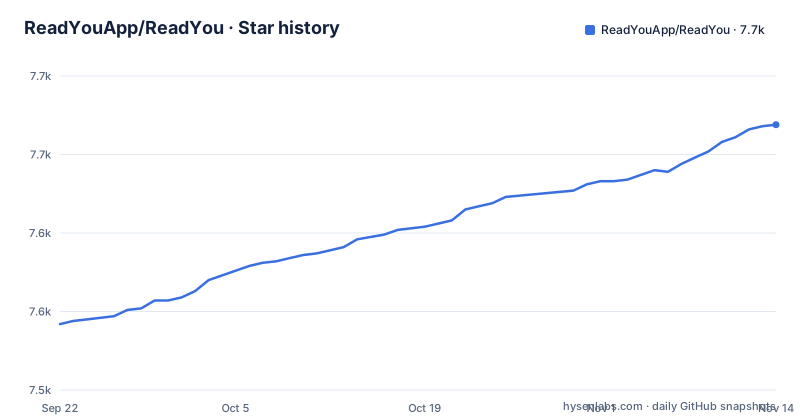
- ReadYouApp/ReadYou7,669 ★ · +127
| Repository | 2026-09-22 | 2026-11-14 |
|---|---|---|
| ReadYouApp/ReadYou | 7.5k | 7.7k |
127 Stars in the last 53 days, measured from the daily GitHub snapshot. Compare with other projects
Editorial analysis
The feature list is a roadmap in tick boxes
The features section is a markdown task list rather than prose, and it is split into done and not done.
Marked complete: subscribing to feed links, importing and exporting files in a standard subscription format, notification of new articles, article readability optimisation, full content parsing of original articles, multiple accounts, and reading aloud.
Marked incomplete: an Android widget, and then an ellipsis.
That last tick box is the honest part. A roadmap that ends in an ellipsis is a project stating that the list is open rather than pretending the two remaining items are the whole future.
So the reader gets the feature set and the author gets a to-do list in the same section, which is unusual and more useful than a marketing paragraph.
Three sync services work and four are wanted
The integration section is a second tick box list, and it is about using existing cloud accounts as data sources rather than about exporting anything.
Three are marked complete, and they are telling choices: a minimal self-hosted service, a discontinued reader whose API is still widely deployed, and another self-hosted service. In other words, the finished integrations are the ones people who already have data tend to have.
Five are marked incomplete: Miniflux, Tiny Tiny RSS, Inoreader, Feedly and Feedbin, plus an ellipsis.
Read as a set, the completed integrations are self-hosted or legacy APIs, while the incomplete ones mix self-hosted services and commercial readers.
F-Droid builds cannot upgrade to other builds
There are three download sources, and one of them comes with a restriction stated in the same paragraph.
Project releases, a chat channel, and a package repository are the three routes. Next to the package repository the readme says that builds from it cannot upgrade to other releases, and that they are compiled, signed and distributed uniformly by that project.
That is a packaging property rather than a defect, but it has a real consequence for users. If you install from there, you stay there: a later version from the project's own releases will have a different signature, and the updater will not cross that boundary.
So the choice of channel at install time is a choice about how you will be updated for the life of the installation. The readme tells you this once, in a sentence, and it is the sentence to read before tapping install.
Nightly comes out of a workflow run, with a backup warning
There is a separate section for testing builds, and it is more careful than most.
The builds include the latest features and improvements but may not be as stable as the regular releases, and they are explicitly not recommended for everyday use. They may have bugs.
The delivery mechanism is unusual and worth noting: there is no download page. You go to a continuous integration workflow, choose the latest run, and download the artefacts from that run's summary page, which may require signing in to the forge.
And then the reminder to back up your data before trying one.
That combination is coherent. If the artefact is the output of a commit rather than of a release, it is unreviewed by definition, and the readme is telling you that the cost of testing it is your subscription database.
Every package flavour is built on every commit
The build section is four sentences long, and the second one is the important one.
Continuous integration automatically packages all flavours of the package files for each commit. That is a stronger guarantee than most small projects make, and it means the build matrix is part of the repository's normal operation rather than something that happens at release time.
The rest is the ordinary contributor path: get the source with one command, open it in a recent version of the integrated development environment, and press run.
git clone https://github.com/ReadYouApp/ReadYou.gitThe repository also carries a Gradle wrapper, a build script written with the Kotlin DSL, a settings script, a properties file, a release automation directory and a signing directory, which is what the automated packaging runs against. The project is based on a declarative UI toolkit for Android, so there is no native build to configure by hand.
There is one odd instruction at the end: in case of lag, select the release build variant. That is a debugging-oriented note for developers rather than for users, and it tells you the debug variant is meaningfully slower.
Six translations exist and two are labelled outdated
The header of the readme is a language selector, and it carries status information that translation files rarely do.
Five languages are listed: English, German, Simplified Chinese, and two that are explicitly marked as outdated, Traditional Chinese and Persian.
The repository contains five translated readme files, which means there is one more than the selector links: a Japanese translation exists in the tree and is not linked from the language line.
So there are three states here rather than two. Current, outdated, and present but unlisted. That is useful information for a translator looking for work, and it is unusual to see a project volunteer the staleness of its own translations in the header.
Jetpack Compose, and a design lineage named in the credits
The technology choice is stated once: the project is based on the declarative UI toolkit for Android's native interfaces, and the readme links the design language specification it follows.
The credits section is longer than the technology section, and it is the more informative of the two. Around a dozen open source projects are credited, and they map onto the features.
The readability work is a stack of three: a parser, an article extraction library, and a component that renders extracted HTML in a declarative tree. There is also a subscription format parser, and the syndication library that project is probably best known for.
Then the acknowledgements. A named individual is thanked for the design inspiration and for the Monet engine implementation, which explains where the visual identity came from. Two more are thanked for infrastructure: free development-environment licences, and free hosting for the translation platform that the localisation section points at.
Editorial conclusion
Read You fits an Android user who wants a native feed reader with real article extraction rather than a web view, and who keeps subscriptions in a service it can sync with. It does not fit someone who needs a home server install or a stable nightly channel. Before adopting, note that F-Droid builds cannot upgrade to builds from elsewhere, so pick one distribution channel and stay on it, and back up before trying a nightly build.
Frequently asked questions
What is Read You?
Read You is a free, open source Android RSS reader released under the GPL version 3 and presented in a particular design language. It is written in Kotlin with Jetpack Compose, and its feature list covers subscribing, subscription file import and export, notifications, readability optimisation, full content parsing, multiple accounts and reading aloud.
How do I install Read You?
There are three routes: the project's own releases, a chat channel linked from the readme, and an independent Android package repository. Builds from the package repository cannot upgrade to releases from elsewhere, because they are compiled, signed and distributed uniformly, so install from one channel and stay on it.
Which sync services does Read You support?
Three are marked complete: Fever, Google Reader and FreshRSS. Five more are listed as not yet done, among them Miniflux, Tiny Tiny RSS, Inoreader, Feedly and Feedbin. The app uses these services as data sources so you can keep using an existing cloud account rather than importing and exporting files.
How do I build Read You from source?
Clone the repository, open it in a recent version of Android Studio, and press run. Continuous integration packages all flavours of the package files on every commit, so a build matrix already exists. If the debug variant feels slow while you are developing, the readme suggests switching to the release variant.
Official sources
Add this badge to your README
If you maintain this project, the badge below links readers to this analysis and shows its maintenance status from the daily GitHub snapshot. Paste the markdown into your README; add ?metric=license or ?metric=stars to the image URL for a different field.

[](https://hysenlabs.com/projects/readyouapp-readyou)Star history chart for your README
[](https://hysenlabs.com/projects/readyouapp-readyou)Was this useful?