Remeda: data-first and data-last calls, lazy pipes and a monorepo that ships three releases in four days
A utility library for JavaScript and TypeScript.
At a glance
- What is it?
- Remeda is an MIT-licensed TypeScript utility library that accepts both filter(array, fn) and filter(fn)(array) call styles and evaluates pipe chains lazily. This piece covers the call styles, the lazy pipe trace, the package layout and what the library does not promise.
- Who is it for?
- Pick Remeda for a TypeScript codebase that wants Lodash-style helpers with types as specific as the library can make them, and that already likes pipe chains. Skip it if you rely on a Lodash function the documentation does not list, or if you cannot absorb frequent minor releases.
- Can I use it commercially?
- Yes. MIT is a permissive licence: you can use, modify and sell software built on it, as long as you keep its copyright and licence notices.
- Is it still maintained?
- Yes. The repository received new commits within the last day.
- What is it written in?
- Mainly TypeScript, according to GitHub's language statistics.
Answers come from the project's GitHub data, last synced on November 26, 2026, and from our analysis. They are not legal advice.
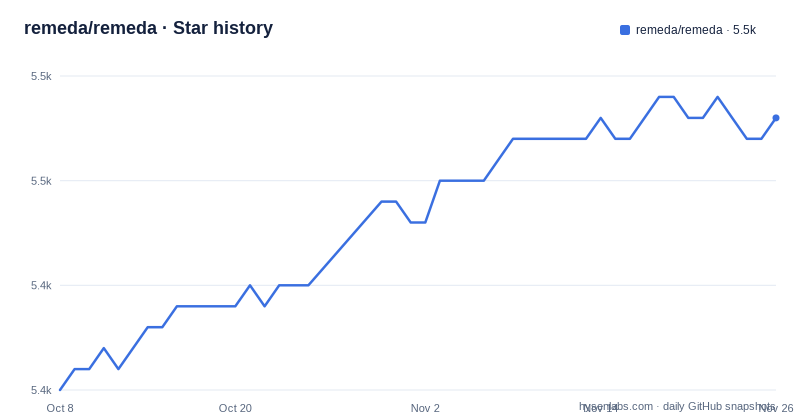
Star history
- remeda/remeda5,453 ★ · +13
| Repository | 2026-10-08 | 2026-11-26 |
|---|---|---|
| remeda/remeda | 5.4k | 5.5k |
13 Stars in the last 49 days, measured from the daily GitHub snapshot. Compare with other projects
Editorial analysis
One function, two call shapes: filter(array, fn) and filter(fn)(array)
Remeda describes itself as the first data-first and data-last utility library designed especially for TypeScript. The distinction is concrete. Data-first is the shape most people know from Lodash, where the array comes first: filter(array, fn). Data-last returns a function that waits for the array: filter(fn)(array).
Both styles work for the same function, so a codebase does not have to pick a side project-wide. Direct calls on a value you already hold read naturally in the first form. The second form exists for composition, because a function with the data argument missing can be handed to pipe as a step.
The practical gain is that a helper written for one context does not have to be re-wrapped for the other. The cost is that the same name has two signatures to type, which is presumably why the library advertises types that are as specific as possible. Whether a given inference is as sharp as you need is something to confirm in your own editor, since the README makes the claim without examples of the inferred types.
The pipe example prints four lines for an eight-element array
Lazy evaluation is the second headline feature, supported through pipe and piped. The README example makes it visible. It imports pipe, forEach, unique and take, then runs them over [1, 2, 2, 3, 3, 4, 5, 6]:
import { pipe, forEach, unique, take } from "remeda";

pipe(
  [1, 2, 2, 3, 3, 4, 5, 6],
  forEach((value) => console.log(`Got ${value}`)),
  unique(),
  take(3),
); // => [1, 2, 3]
The expected console output is Got 1, Got 2, Got 2 and Got 3, then nothing. Eight elements went in, yet only four were logged. Each element flows through the whole chain one at a time, and once take(3) has three unique values it stops asking for more. An eager chain would have logged all eight lines before unique ran.
The consequence for side effects is real. A forEach placed before a take, as here, sees only the elements consumed upstream of the cutoff. If you expect the callback to run for every item, put it after the step that shrinks the list, or do not use it inside a lazy chain.
Installation is one line per package manager, including Deno through JSR
The README lists five installs, one per tool:
npm install remeda
pnpm add remeda
yarn add remeda
bun install remeda
deno add jsr:@remeda/remeda
Four of them pull the package from npm. Deno uses the JSR registry under the scope @remeda, so the Deno package name differs from the others by that prefix. The library supports both CJS and ESM and is tree-shakable, which means a bundler can drop the functions you never import.
The repository does not ask you to pick a build. There is no separate lite package in the README, and the import in the usage example is a plain named import from remeda.
The tree-shaking claim is only as good as your bundler configuration. Importing many helpers from the package root is the style shown in the example, so check your production bundle once if size is a constraint.
Migration guides exist for Lodash and Ramda, and nothing else
The README links two migration guides at remedajs.com: one for Lodash and one for Ramda. These are the two libraries the project names as sources people move from. The full docs and API reference are at remedajs.com/docs.
The guides matter because the three libraries do not agree on argument order. Lodash is data-first. Ramda is data-last. Remeda supports both, which makes the move from either one mechanical in principle, but a function present in the old library is not guaranteed to have a counterpart under the same name. The README does not list function counts or coverage, so the migration guide is where you find out what is missing.
Other comparison questions have no answer in the repository. The README does not compare Remeda with es-toolkit or ts-belt. If you are choosing between utility libraries, compare on the features you will use, because the project makes no benchmark claims.
The root package.json is a private workspace at version 2.0.0, not the published package
Anyone who opens the repository root and sees version 2.0.0 might think the library is far behind its releases. The root package.json is marked private and declares four workspaces: packages/remeda, packages/docs, packages/stackblitz-template and packages/brand. Its only script of note is docs:build, which runs the build across all workspaces, plus prepare for husky.
The library itself lives under packages/remeda, and the documentation site, a StackBlitz template and the brand assets sit beside it. The root devDependencies cover coverage, formatting and linting tools, and the overrides section pins vite versions for vitest and related plugins.
Top-level files such as AGENTS.md, CLAUDE.md and skills-lock.json also appear in the entry list, which points to AI-assistant configuration for contributors. The README does not discuss them. For a consumer, none of this changes the install command, but it explains why the release tags (v2.58.0) and the root file (2.0.0) disagree.
Releases arrive as minor versions, three in two days
The release list shows v2.57.0 on 29 October 2026, v2.57.1 on 1 November 2026, and v2.58.0 later the same day. The last push was on 2 November 2026 and the repository is not archived. That is a fast cadence: two minor bumps and one patch release.
For an app that pins exact versions, that means regular lockfile churn. For one that uses a caret range, it means new functions arrive without changing the major version. The README does not describe a deprecation policy, a changelog location or how breaking changes are announced, so the GitHub releases page is the place to read what each version changed.
The repository also shows signals of process: the README links badges for code coverage, the CI workflow, OpenSSF Scorecard and best-practices listings, but the badge images are not part of the text. Read them on the live page if supply-chain posture matters to you.
Tests cover both the runtime and the types, and the docs live in JSDoc
The feature list says runtime and types are both extensively tested, with full code coverage. Type-level testing matters for a library whose selling point is specific types: a regression in an inferred type would break user code without failing any runtime assertion. The root devDependencies include @vitest/coverage-v8, so coverage is measured with Vitest.
The functions are fully documented with JSDoc, so documentation appears in the editor when you hover or autocomplete. That is the quickest way to see the two signatures of each function without leaving the file.
Support goes through GitHub issues: questions, bug reports and feature requests are all tracked there, and there is a contributing guide and a code of conduct in the repository. No chat server or forum is named in the README, so expect answers on the issue tracker, not in real time.
Editorial conclusion
Pick Remeda for a TypeScript codebase that wants Lodash-style helpers with types as specific as the library can make them, and that already likes pipe chains. Skip it if you rely on a Lodash function the documentation does not list, or if you cannot absorb frequent minor releases. Check the Lodash or Ramda migration guide for every function you use before you swap an import.
Frequently asked questions
What is Remeda and what is it for?
Remeda is a utility library for JavaScript and TypeScript, described as the first data-first and data-last utility library designed especially for TypeScript. It is MIT licensed and supports both CJS and ESM.
Can Remeda be used as a Lodash alternative?
The project publishes migration guides for Lodash and Ramda at remedajs.com. Remeda supports both data-first and data-last calls, so either argument order is available.
How do you install Remeda?
Run npm install remeda, pnpm add remeda, yarn add remeda or bun install remeda. On Deno, use deno add jsr:@remeda/remeda.
Official sources
Add this badge to your README
If you maintain this project, the badge below links readers to this analysis and shows its maintenance status from the daily GitHub snapshot. Paste the markdown into your README; add ?metric=license or ?metric=stars to the image URL for a different field.

[](https://hysenlabs.com/projects/remeda-remeda)Star history chart for your README
[](https://hysenlabs.com/projects/remeda-remeda)Was this useful?