Sedgewick and Wayne exercise solutions in Java, tied to the September 2015 printing
Solutions to all the exercises of the Algorithms book by Robert Sedgewick and Kevin Wayne
At a glance
- What is it?
- A single-author Java repository that answers every exercise in the fourth edition of Algorithms, with a clear warning about printing differences and about copying homework.
- Who is it for?
- Use this repository if you are working through the fourth edition of Algorithms and want a second opinion on your own answer after you have attempted the exercise. Skip it if you own a printing other than the seventh, or if you need written explanations rather than code.
- Can I use it commercially?
- Yes. MIT is a permissive licence: you can use, modify and sell software built on it, as long as you keep its copyright and licence notices.
- Is it still maintained?
- Yes. The repository last received commits 26 days ago.
- What is it written in?
- Mainly Java, according to GitHub's language statistics.
Answers come from the project's GitHub data, last synced on November 7, 2026, and from our analysis. They are not legal advice.
Star history
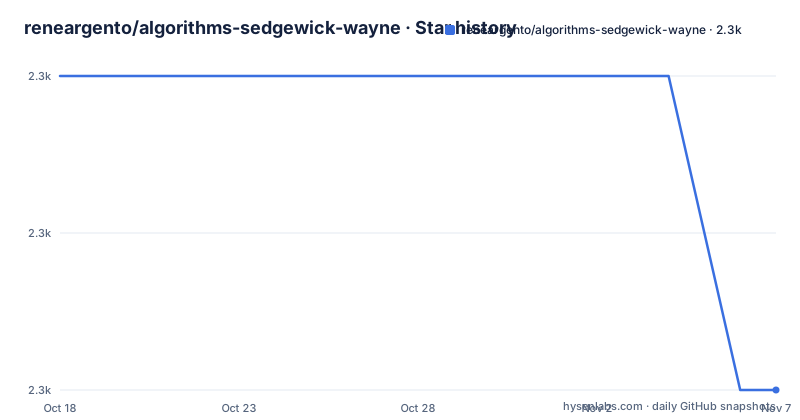
- reneargento/algorithms-sedgewick-wayne2,317 ★ · -2
| Repository | 2026-10-18 | 2026-11-07 |
|---|---|---|
| reneargento/algorithms-sedgewick-wayne | 2.3k | 2.3k |
-2 Stars in the last 20 days, measured from the daily GitHub snapshot. Compare with other projects
Editorial analysis
Every exercise in the fourth edition has an answer here
The repository is a collection of solutions to the exercises in Algorithms by Robert Sedgewick and Kevin Wayne, fourth edition. The author posted an update dated November 26 2018 stating that the work took two and a half years and that the repository is complete. In that update he says the solutions now cover all the exercises in the book, not a selection of the easy ones.
That completeness is the main reason to look at it. The author's own motivation, as he writes it, is that there were almost no solutions to these exercises on the Internet, and the few that existed were incomplete. A reader who gets stuck on a late exercise in a chapter can expect to find an answer rather than a gap.
Why Java and why the src and lib folders
GitHub lists Java as the primary language, and the top-level entries of the repository are .github/, .gitignore, LICENSE, README.ch.md, README.md, lib/, resources/ and src/. The solutions live under src/. The lib/ folder sits next to it, and resources/ is there for supporting files.
The book itself is written around Java, so solutions in Java line up with the code a reader meets in the text. Anyone who plans to compile and run an answer will want a Java toolchain. The README gives no build command, no list of Java versions, and no instructions for setting up an IDE, so those decisions are left to the reader.
The September 2015 seventh printing sets the numbering
Exercise numbers in this repository follow the seventh printing of the book, dated September 2015. The README warns that other printings, and older ones in particular, may order the exercises slightly differently.
The consequence is practical. If your copy is an earlier printing, exercise 1.3.17 in your book may not be the exercise 1.3.17 that the solution addresses. Before reading a solution, compare the problem statement in your edition with what the code is solving. The README offers no mapping table between printings, so the matching is manual work.
Correctness rests on the author's word and on pull requests
The README states the correctness claim modestly: to the best of the author's knowledge, the solutions are correct. There is no statement of a test suite or of any review by the book's authors. Corrections arrive through the channel the README names, which is to create an issue or open a pull request.
For a reader this means a solution is a strong hint and not a guarantee. If your answer differs from the repository's, treat the disagreement as a prompt to re-derive the result by hand. Either side can be wrong. The README does not claim that every output has been verified against the book's published results.
Homework use is discouraged in the README itself
The author notes that many of these exercises are assigned as homework in universities. His request is specific: if the exercise is yours to hand in, make sure you understand the problem and solution instead of simply copying it. He argues that understanding the algorithms and data structures will be valuable in a career.
That shapes how the repository is best used. It is meant for validation, which the README frames as helping students and professionals check their own solutions and learn more about the book's content. Reading the answer before attempting the problem defeats that purpose, and instructors who set these exercises may well recognise public solutions.
An English README and a Simplified Chinese README
Two documentation files sit at the top level: README.md in English and README.ch.md in Simplified Chinese. The English file links to the Chinese one at its head. The Chinese file is the only translation mentioned.
The repository carries an MIT license, so the code can be reused under that license's terms, though the homework warning above still applies as a matter of academic honesty. The exercise text itself belongs to the book, which is why you need your own copy to read the problems. The repository contains solutions, and the README does not say that it reproduces the exercise statements.
No releases, no packaging, and a last push on 13 October 2026
The repository has no GitHub releases, and the README gives no install command, no package coordinates, and no instructions for using it as a dependency. It is a source tree to browse and clone, not a library to import. The only getting-started step the README implies is reading the files on GitHub or cloning the repository.
The most recent push was on 13 October 2026, and the repository is not archived. Given that the author declared the work complete in November 2018, later activity is presumably small corrections and housekeeping, though the README does not say what the recent commits contain. If you need a specific fix, the issue tracker is the route the README points to.
Editorial conclusion
Use this repository if you are working through the fourth edition of Algorithms and want a second opinion on your own answer after you have attempted the exercise. Skip it if you own a printing other than the seventh, or if you need written explanations rather than code. Before relying on any single solution, open the exercise in your own copy and confirm that the numbering and wording match the September 2015 printing the author used.
Frequently asked questions
Does algorithms-sedgewick-wayne cover every exercise in the book?
The author's update of November 26 2018 says the repository is complete and contains the solutions to all the exercises in the book. The book in question is the fourth edition of Algorithms.
Which printing of Algorithms does the repository follow?
The exercises are based on the seventh printing, dated September 2015. The README warns that other printings, especially older ones, may order the exercises slightly differently.
How do I report a wrong solution in algorithms-sedgewick-wayne?
The README asks readers who find anything incorrect to create an issue or to open a pull request. The author states that the solutions are correct to the best of his knowledge.
What language and license does algorithms-sedgewick-wayne use?
The primary language is Java and the license is MIT. The README is available in English and in Simplified Chinese.
Official sources
Add this badge to your README
If you maintain this project, the badge below links readers to this analysis and shows its maintenance status from the daily GitHub snapshot. Paste the markdown into your README; add ?metric=license or ?metric=stars to the image URL for a different field.

[](https://hysenlabs.com/projects/reneargento-algorithms-sedgewick-wayne)Star history chart for your README
[](https://hysenlabs.com/projects/reneargento-algorithms-sedgewick-wayne)Was this useful?