Scriberr: a struck-through status update above the current one, eight compose files, and an offline claim the chat feature complicates
Self-hosted AI audio transcription
At a glance
- What is it?
- The self-hosted transcription tool whose readme carries a retracted personal status note above the current one, whose repository root holds a committed log file and eight deployment variants the readme never mentions, whose module has no domain in its path, and whose absolute offline claim sits next to a feature that can call a hosted model.
- Who is it for?
- Scriberr suits a self-hoster who wants speaker-labelled transcripts with word-level timing produced on their own hardware, because the model choices are named and the interface does more than transcription. Verify five things first.
- Can I use it commercially?
- Yes. MIT is a permissive licence: you can use, modify and sell software built on it, as long as you keep its copyright and licence notices.
- Is it still maintained?
- Yes. The repository last received commits 56 days ago.
- What is it written in?
- Mainly Go, according to GitHub's language statistics.
Answers come from the project's GitHub data, last synced on November 15, 2026, and from our analysis. They are not legal advice.
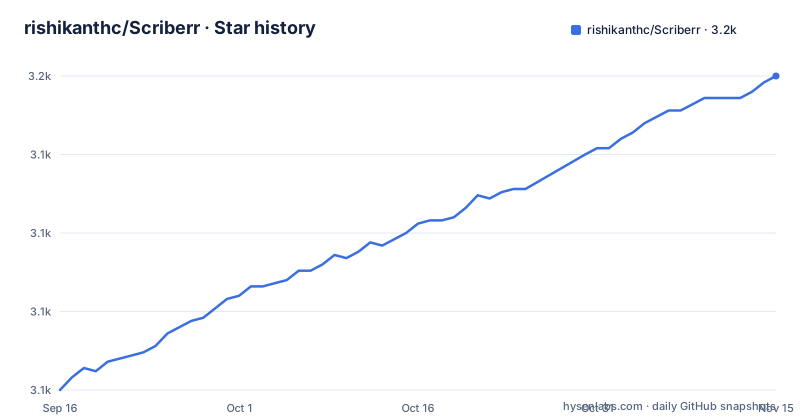
Star history
- rishikanthc/Scriberr3,150 ★ · +100
| Repository | 2026-09-16 | 2026-11-15 |
|---|---|---|
| rishikanthc/Scriberr | 3.1k | 3.2k |
100 Stars in the last 60 days, measured from the daily GitHub snapshot. Compare with other projects
Editorial analysis
Two status notes sit at the top of the readme and the older one is struck through
The first substantive section of the readme is about the project's status, and it contains two notes. The current one is ordinary: the maintainer took a break after a job move, is getting back into personal projects, and plans to start development again. It also mentions, in passing, that he still has not set up the self-hosting server he has been putting off, and asks the community for input on a decision through a link to a discussion thread.
Then the older note follows, and every line of it is struck through. That version describes a redundancy affecting a large number of roles, says development is paused but not abandoned, invites contributors to step in, and asks for referrals. Someone went back and retracted all of it, line by line, and left it in place rather than deleting it.
That is a defensible thing to do, and it is also the first thing every visitor reads, which is an unusual place to keep a retraction of a personal note. The current note's substance is a question about direction, not a plan, which means the roadmap is being decided in a discussion thread rather than in the repository.
The offline promise is absolute and the chat feature is not
The introduction says audio and video are transcribed on your machine and that no data is ever sent to a third-party cloud provider. Two features sit next to that sentence. One connects to a local model runner or to any provider that speaks the same API shape as a hosted one, to summarise, ask questions, or hold a conversation with a transcript. The other is a folder watcher that processes new files automatically.
no data is ever sent to a third-party cloud providerThe audio path and the chat path are different, and only one of them can honour that sentence unconditionally. If you configure the chat to use a hosted provider, transcript text leaves the machine, and the readme does not separate the two claims or say which is which. The feature list also names a meeting transcription service as a sponsor, under a heading that reads as a recommendation rather than as an advertisement, and that service's whole pitch is that it pulls speaker data from the meeting platforms itself, which is the opposite approach to running the model locally.
The compose file sets three variables, publishes one port and contains no credential
The deployment story is a single service pulling the project's own published image.
services:
  scriberr:
    image: ghcr.io/rishikanthc/scriberr:latest
    ports:
      - "8080:8080"
The image is on a latest tag, so a compose up does not pin anything. The environment block sets a user id and group id with a fallback of the usual non-root value, sets the application to production mode, and includes an origin allow-list that is present but commented out. There is no credential anywhere in the file, no database password, because the storage is a file, and no initial account. The application does have a token library among its dependencies, so authentication exists in the code, but nothing in the compose file or the readme's quick path sets it up. Two named volumes persist the data directory and a second directory for a Python environment, which is the mechanism behind the separate runtime described below.
A separate Python environment is mounted on its own volume
The container's build comment says the runtime stage ships Python, a package installer, and a media downloader for the transcription and download tooling. The compose file then mounts a named volume at a path whose name is the transcription library's environment, and the runtime variables confirm it. So the image does not carry a prepared Python environment; it creates one at some point after start, on a volume that survives restarts, which is how an application written in Go ends up managing a Python environment at runtime.
That has a consequence for the offline claim that the readme does not address. A prepared environment would be offline by construction. One created after start generally involves a package download on first run, and the variable name for the directory plus the presence of the installer in the build comment together suggest exactly that. If you are deploying this without egress, that is the step to test first, and nothing in the visible text tells you it happens at all.
Eight deployment variants and the readme names none of them
The repository root contains a compose file and seven more that qualify it by accelerator and by purpose: variants for a CUDA build, a build-oriented compose file for each, and two more qualified by a newer accelerator generation. There are correspondingly several Dockerfiles, including one qualified by accelerator and one by an exact version of that accelerator's runtime. So the deployment matrix is a cross product of which accelerator you have and whether you are building or pulling, and it is discoverable only by listing the root.
The readme does not mention any of them. It links a website, a documentation site, and an API reference, and describes the project as cross-platform in the sense that it runs on your desktop or phone as an installable web app. So a self-hoster with a graphics card has eight plausible ways to deploy and no guidance on which one is correct, and the naming convention alone requires guessing whether the qualified files supersede the base one or sit beside it.
The Go module has no domain, which means it is an application and not a library
The module declaration is a single word with no host in front of it. That is unusual for a Go project and it has a direct consequence: the module cannot be resolved by the usual remote-fetch mechanism, so nothing in this codebase can be imported as a dependency by name. It is consistent with everything else in the tree, where the binary is built from a path inside the repository rather than from the module path, and where there are two command directories, one for the server and one for a command line tool.
The same build file cross-compiles that command line tool for four platform and architecture combinations in one stage, which means the runtime image carries binaries for platforms other than the one it is running on. For a self-hoster who pulls one image on one machine, three of those four are dead weight, and the reason for building them inside the runtime image rather than a separate artefact per platform is not explained.
The frontend is embedded in the binary and development needs a placeholder file
The container build compiles the web frontend in one stage, deletes the directory the Go binary expects to embed, recreates it, and copies the built assets into it before compiling the server. So the shipped binary contains the interface and the server is a single file to run.
The development target in the build file solves the consequence of that arrangement. Before starting the server it checks whether the embed directory is empty and, if it is, writes two placeholder files into it, with a comment saying it is doing so for the embed to work at all. That is the real cost of embedding: a developer who has not run a frontend build cannot start the backend, and the build file papers over it by creating dummy assets. The same target also installs a live-reload tool from the network on first use, mutating the shell's path variable in the process to find it, and falling back to a plain run if that fails.
The repository root holds a log file and two extensionless directories
Most roots are tidy. This one has a committed text file whose name says it is a startup log, sitting between the license and the readme, and two entries named with no extension that look like directories or binaries and have no counterpart in the source layout. There is also an editor configuration directory for one commercial IDE, a separate tool's configuration directory, an air configuration for live reloading, a Node package manager configuration, and a file naming a version of Python. Two logo files at the root are named as though they were variants of one image rather than as two files, alongside four more logo and icon assets in several formats.
None of that is a problem, and all of it is evidence that the root is being used as a workspace rather than curated as a package manifest. The build file's help target discovers its own commands by grepping the file for targets carrying a comment, so the documented surface of the build is generated from the file itself, which is the one piece of this root that is deliberately self-describing.
Editorial conclusion
Scriberr suits a self-hoster who wants speaker-labelled transcripts with word-level timing produced on their own hardware, because the model choices are named and the interface does more than transcription. Verify five things first. The readme's newest release is from December 2025 while the branch is still being pushed, so there is no release covering recent work. The privacy claim is absolute and applies to transcription, while the chat feature can call a hosted model, so the two paths are not the same promise. The compose file sets no credential, so a default deployment has whatever the application does on first start. The deployment matrix is eight files and none is described in the readme. And the roadmap is currently a question put to the community rather than a plan, so a feature you need may simply never arrive.
Frequently asked questions
What is Scriberr?
A self-hosted audio and video transcription application that runs models on your own machine and produces word-level timing. It adds automatic speaker detection and labelling, chat over your transcripts using a local model or any provider with a compatible API, a folder watcher that processes new files automatically, a built-in recorder with inline note taking, and installation as a progressive web app.
Does Scriberr send my recordings to a cloud service?
The introduction says no data is ever sent to a third-party cloud provider. That claim describes transcription. The chat feature can be pointed at any provider with a compatible API, in which case transcript text leaves the machine, and the readme does not separate the two cases.
Which transcription models does Scriberr use?
Two are named as current, one from a hardware vendor and a multilingual one, along with the older and more popular Whisper family. The container also ships Python, a package installer and a media downloader, and the compose file mounts a second named volume for a Python environment, so that environment appears to be created after start rather than baked into the image.
How do I deploy Scriberr?
With the compose file, which runs one service from the project's published image on a latest tag, publishes one port, sets a user and group id with a non-root fallback, sets the application to production mode, and includes an origin allow-list that is present but commented out. There is no credential anywhere in the file.
Is Scriberr still being developed?
The current status note in the readme says development is restarting after a pause and that the maintainer is asking the community for input on a direction through a discussion thread, rather than publishing a roadmap. The newest release is from December 2025 while the default branch is still receiving commits, so recent work is not in a tagged build.
Does Scriberr label speakers in a transcript?
Yes, by running diarization locally: it detects different speakers and labels who said what. The readme's sponsor section describes a different approach, where a paid meeting transcription service pulls speaker data and separate audio streams from the meeting platforms themselves, which is worth knowing about because it is the one part of the feature set with a hosted alternative being promoted.
Official sources
Add this badge to your README
If you maintain this project, the badge below links readers to this analysis and shows its maintenance status from the daily GitHub snapshot. Paste the markdown into your README; add ?metric=license or ?metric=stars to the image URL for a different field.

[](https://hysenlabs.com/projects/rishikanthc-scriberr)Star history chart for your README
[](https://hysenlabs.com/projects/rishikanthc-scriberr)Was this useful?